Get Full Government Meeting Transcripts, Videos, & Alerts Forever!
Get email alerts on the Legislative Agenda topic
No spam. Unsubscribe anytime.
University Place council reviews 2026 legislative agenda, lists seven projects and policy priorities for Olympia
Summary
Council held a study session to finalize project requests and policy positions for the 2026 state legislative session, listing seven capital projects and several policy asks (police funding clarification, mandate costs, local design-control authority, SHAPE housing collaboration, emergency planning funding).
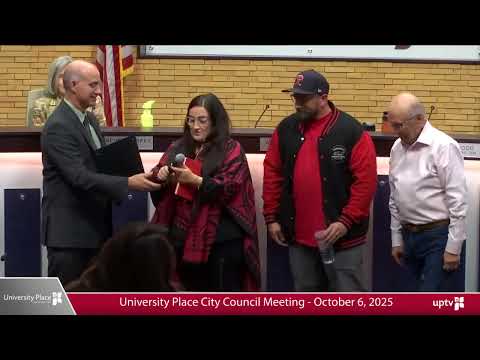
City staff and council on Oct. 6, 2025 reviewed a proposed legislative agenda for the 2026 session in Olympia, including a project list of seven capital needs and a set of policy requests the city may ask its state delegation to support.
City Manager Steve Sugg and Public Works Director Jack Eklund framed the discussion by noting the 2026 session is a short session (60 days) and that state funding is expected to be limited. “Just keep that in mind in terms of the ability for legislators to pass legislation and get their business done,” Sugg said during the study session. Eklund summarized the project list that staff proposes to forward to legislators: completing design for the Day Island (Bridal) Bridge; a traffic-signal upgrade project (expanded to include video-detection replacement and battery backups); Alameda Drive street-lighting and sidewalk improvements; Dale and Spit Road seawall and roadway elevation improvements; Serp (site) park spray pad and restroom; Serp park multiuse sports courts; and a city-hall battery backup system for emergency power.
Staff said the projects are priorities but cautioned that available state funds appear limited. “I don’t have a lot of hope that we would get a lot of these projects on the list,” Jack Eklund said, adding that the city still benefits from presenting priorities to legislators so they can look for fit with any state funding that does become available.
Council members discussed whether to pare or prioritize the list. Several members favoured keeping a broader list so the city has options if modest amounts of funding arise for different categories (roads, parks, public safety). Mayor Javier Figueroa and multiple council members encouraged council presence during legislative advocacy to increase the city’s visibility if opportunities appear.
Staff also presented policy items for council consideration. Those included asking the legislature for clarification and possible statutory changes related to House Bill 2015 (a local funding option and grant program for public safety) to ensure cities that contract for police services can qualify; support for funding indigent defense (a state-level court administration and funding issue); support for SHAPE (South Sound Housing Affordability Project) and other housing-supply efforts; and a city-request to allow more local control over design standards and tools so cities can better influence building design and street-facing development. Council members expressed particular support for the design-control item, saying it affects the long-term look and walkability of development in University Place.
No final resolution or ordinance was adopted at the study session; staff said the council’s feedback would be incorporated and a more concise set of priorities would be returned for formal adoption. Council members and staff noted that in a short session the likelihood of major new funding is low but advocacy remains valuable for small or targeted grants that can be matched to ready projects.