Get Full Government Meeting Transcripts, Videos, & Alerts Forever!
Get email alerts on the Commerce Budget topic
No spam. Unsubscribe anytime.
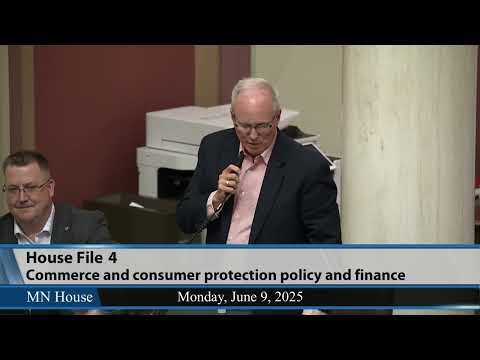
Minnesota House passes commerce budget (House File 4) after debate over Medigap changes
Summary
The Minnesota House passed House File 4, the commerce budget bill, by a 112-19 vote after debate over Medigap changes, exemptions for certain product prohibitions and several consumer protections were added; sponsors said the Medigap changes are a compromise and will be revisited annually though no reporting requirement was included in the bill.
The Minnesota House passed House File 4, a commerce budget bill that funds the Department of Commerce and the Office of Cannabis Management, by a 112-19 roll-call vote after members debated provisions affecting Medigap, consumer protections for electric vehicle charging and temporary exemptions to product prohibitions.
Supporters said the bill combines policy and finance work from the House and Senate and includes multiple new provisions. "This is the commerce bill. ... it was posted on the May 29, and, this is, part of the work that we need to take up and and and pass," Representative Herr said as he introduced the measure. Representative O'Driscoll, a member from Stearns, described the bill as "a solid bill" and credited conference committee work for improving language on telecom and insurance issues.
The bill includes a temporary three-year exemption for keys from Minnesota's lead prohibition, exemptions for some paints from the state's cadmium prohibition, a consumer-protection provision for retail EV charging, transition plans for analog phones for voice-over-IP services and a requirement that Minnesotans have access to water at entertainment venues. Sponsors also extended the reinsurance program for the individual insurance market for two years, the bill's proponents said.
A central point of floor debate concerned changes to Medigap enrollment and penalties. Representative Melissa Liebling raised concerns that the bill's Medigap provision treats beneficiaries aged 65–70 differently from those 71 and older, imposes guaranteed-issue windows with escalating penalties and, she said, "I didn't see anything in the bill that requires any sort of reporting on it so that it can be revisited in the future." Liebling pressed whether the Department of Commerce or the bill itself would require data collection and reporting to monitor the impact on premiums and consumer access.
Representative O'Driscoll said actuarial information provided by insurers indicated premium increases "upwards of 90 percent to a 100%" under a full open-enrollment approach and that the bill's graduated penalties were a compromise between zero penalties and much larger industry-proposed penalties. He said the chairs and conferees planned to "get a chance to look at what's happening to premiums and make some decisions about how to move forward," but he did not point to a statutory reporting requirement in the bill.
Representative Herr, the bill author, said the change represents a compromise between a full repeal and insurers' proposals and that stakeholders — including insurers and the Department of Commerce — had agreed to review the provisions. "We as a group and the insurance industry and the department of commerce have all committed that this would be reviewed and it would be looked at," Herr said, while acknowledging that no formal reporting mandate was included in the bill text.
After debate, the House voted to suspend the rules under Article IV, Section 19 of the Minnesota Constitution so House File 4 could receive its readings and be placed on final passage. The roll call concluded with 112 ayes and 19 nays; Representative Olsen was recorded voting yes by the clerk.
The bill's supporters described the vehicle as a compromise intended to stabilize the individual insurance market and to preserve guaranteed renewability over a limited period while monitoring market effects. Critics on the floor said consumer groups and some senior advocates had not been at the table during negotiations and urged stronger, codified requirements for tracking outcomes.
Votes at a glance House File 4 (commerce budget) — Passed, 112 ayes, 19 nays.
What happens next The bill passed the House and its title was agreed to; further steps (including enrollment in law and any required implementation actions by the Department of Commerce) were not specified in the House floor transcript.