Get Full Government Meeting Transcripts, Videos, & Alerts Forever!
Get email alerts on the Cannabis Ordinance topic
No spam. Unsubscribe anytime.
Lake County planning commission reviews cannabis-policy summary; votes to add homeschools to protected setbacks
Summary
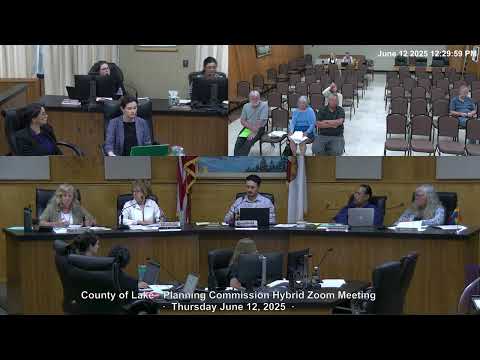
The Lake County Planning Commission on June 12 reviewed staff and task-force recommendations for an updated cannabis ordinance and sent multiple requests to the Board of Supervisors, including asking staff to examine higher site reclamation bonds and additional odor controls; the commission also voted 3-2 to recommend that certified homeschools be treated like K-12 schools for setback/exclusion purposes.
The Lake County Planning Commission on June 12 reviewed a staff summary of recommendations from the county's cannabis ordinance task force and sent multiple recommendations to the Board of Supervisors, including asking staff to examine raising the site reclamation bond and to seek more options to mitigate odor impacts. The commission also voted 3-2 to recommend that the county treat certified homeschools the same as public and private K'12 schools for setback/exclusion purposes.
The summary was presented by Mireya Turner, Community Development Director, who told commissioners: "What you have before you today is a summary of the recommendations made by the cannabis ordinance task force as well as some additional recommendations that . . . were not put before the task force for their consideration." Turner said staff will forward the planning commission's recommendations to the Board of Supervisors before drafting a formal ordinance.
Why it matters: Lake County is updating local rules that affect where cultivation, processing and delivery businesses can operate, what foundations and structures are allowed on prime agricultural soils, how the county enforces nuisance and odor complaints, and how water use and site reclamation are handled. Those rules affect property owners, existing permittees and nearby residents and will shape future permitting and enforcement.
Key staff recommendations and task force items - Synchronize canopy measurement with the state: Staff told the commission the county plans to adopt the state's method of measuring canopy to avoid duplicate or inconsistent enforcement during site visits.
- Farm Land Protection Zone boundaries: The Board of Supervisors and staff said they are not seeking changes to the farm land protection zone map or its regulations; the map is attached to the board's existing resolution and the planning commission may request a copy.
- Greenhouses vs. hoop houses and foundations: Senior planner Mary Clavaughn explained technical distinctions: "Hoop houses . . . are temporary in nature and can only be applied for and utilized for up to 180 days." She added that mixed'light greenhouse structures are generally permanent engineered structures and may include electrical and filtration systems; staff and some commissioners said they prefer anchor-point foundations over concrete slabs to reduce permanent impacts on prime agricultural soils but acknowledged slabs would not be strictly prohibited in every case.
- Site reclamation bond: The task force recommended mirroring the state and requiring a $5,000 surety bond for site reclamation; several commissioners and public commenters said $5,000 is likely too low. One commissioner recommended staff research actual restoration costs and consider a higher bond; at the meeting some commissioners suggested asking staff to study raising the bond (an informal suggestion included a $50,000 example), and staff agreed to research options.
- Background checks and warrants: The board had suggested adding a property-owner background-check step and flagging active warrants during application completeness review. Several public commenters and a civil-rights advocate warned against using warrants as an automatic basis to pause or deny permits without due process and urged legal review of any policy that would suspend applications on the existence of active warrants.
- Odor mitigation, setbacks and enforcement: Staff summarized task-force discussion on seeking "additional options to mitigate odor impacts to residential uses," including aligning delivery and operations hours with other agricultural operations and setting scheduled delivery hours (task force recommended 7 a.m. to 7 p.m.). Commissioners and multiple public speakers pressed staff for clearer enforcement, more regular annual reviews of permits, and standardized complaint response procedures. Staff said annual monitoring visits are required, that mixed'light and indoor operations require on'site inspections (pre'scheduled) and that annual inspections generally happen during the growing season; staff also said they respond to complaints but noted resource constraints.
- Voluntary termination of a use permit and site remediation: Task'force materials and staff proposed a voluntary termination process for permittees who no longer wish to operate. Staff said fees must be paid and the site must be remediated, but that the details of what constitutes adequate remediation remain to be defined. Public commenters urged clear rules so property owners, lessees and the water board can close out responsibilities cleanly.
- Opt'out / reduced canopy process: Staff recommended formalizing a June 1 deadline for permittees to declare an opt'out (reduce or waive cultivation for a year), and limiting the number of opt'uts allowed during the 10'year permit term. Staff and county inspectors said mixed'light and indoor operations that opt out still require an annual site visit because structures can conceal cultivation.
- Hemp vs. cannabis setbacks: Staff said there is no current formal setback between hemp and cannabis on adjacent premises and proposed that the board consider a setback to help field staff distinguish permitted hemp from cannabis and to prevent circumvention of permit limits.
- Water and NOA issues: Several speakers — including Janae Fried of the Central Valley Regional Water Quality Control Board — urged the commission and board to consider the state's notice of applicability (NOA) deadline (discharge permits with NOAs dated 10/31/2020 or earlier) and the practical effects of that cutoff, which limits which properties can readily seek new local permits. Staff said the county requires hydrology reports for discretionary projects proposing well or surface water use and that staff is developing standardized hydrology-report criteria; multiple public commenters urged independent or county-managed hydrogeologic review to avoid perceived conflicts of interest.
- Generators and power: The planning staff noted generator usage and power source should be examined during environmental review; speakers urged consideration of photovoltaic-plus-battery solutions and stronger limitations on fossil-fuel generators because of fire risk and air-quality impacts.
Enforcement, appeals and process changes - Revocation appeals: Staff proposed sending revocation appeals directly to the Board of Supervisors (instead of having the planning commission hear them first) to save staff and applicant time; staff said the planning commission's recommendation would still be provided to the board.
- Compliance monitoring and annual reviews: Task'force materials discussed whether inspections should remain annual or move to every other year for operations with strong compliance records. Staff suggested a streamlined reporting approach: batch staff reviews and targeted follow'up for projects with issues rather than presenting hundreds of single annual reviews to the planning commission.
Public comment and concerns Public commenters included growers, neighbors and representatives of the regulated industry. Recurrent themes were enforcement capacity, odors and setbacks, water availability and cumulative groundwater impacts, the state NOA moratorium effect on parcel eligibility, the adequacy of reclamation bonds, and civil'rights concerns about using warrants as a screening tool. Commenters urged staff and the board to include community-submitted materials in the formal record and to provide clear procedures for terminating permits and closing out state water board enrollments.
Exact quotes (selected) - Mireya Turner, Community Development Director: "What you have before you today is a summary of the recommendations made by the cannabis ordinance task force . . . and some additional recommendations that are from staff." (6/12/2025) - Mary Clavaughn, Senior Planner: "Hoop houses . . . are temporary in nature and can only be applied for and utilized for up to 180 days." (6/12/2025) - Janae Fried, Central Valley Regional Water Quality Control Board: "there's that moratorium on new applications . . . that don't have a notice applicability from the water board dated 10/31/2020 or prior." (6/12/2025)
Decisions and next steps - The commission passed a formal recommendation, 3-2, asking the Board of Supervisors to include homeschools in the same exclusion/setback category as public and private K'12 schools (motion recorded; mover not specified in the transcript). Staff said it will compile the commission's recommendations and forward them to the Board of Supervisors; staff expects the board to consider direction in early July before staff begins drafting an ordinance for the usual review, agency/stakeholder review and environmental analysis.
What the commission asked staff to provide to the board (summary of consensus items and requests) - Research raising the site reclamation bond (task force suggested $5,000; commissioners asked staff to research larger amounts and present cost data). - Seek additional odor mitigation options (setbacks, filtration standards, operational/delivery-hour limits) and present enforcement options and a complaint-response protocol. - Synchronize local canopy measurement and ownership-declaration requirements with state standards to reduce duplication and help tax collection. - Clarify rules and remedies for voluntary termination of permits and coordinate termination communications with the State Water Board to avoid outstanding NOA invoicing. - Standardize hydrology-report criteria and evaluate whether independent or county-managed review is needed for water-availability determinations.
Ending: Staff will prepare a package of the planning commission's recommendations and public comments for the Board of Supervisors. The planning commission will review draft ordinance language and environmental analysis after the board provides direction; staff indicated that because agricultural issues are involved the draft ordinance will also go to the Lake County Agricultural Advisory Committee and other stakeholders before final hearings.