Get Full Government Meeting Transcripts, Videos, & Alerts Forever!
Get email alerts on the Consumer Protection Cfpb topic
No spam. Unsubscribe anytime.
Minn. consumer committee warned federal action has effectively halted CFPB; state agencies prepare to absorb complaints
Summary
At a Feb. 20, 2025 informational hearing, Minnesota lawmakers and state officials described recent federal actions that paused many Consumer Financial Protection Bureau functions and discussed how the Minnesota Department of Commerce and the attorney general’s office expect to respond to an increased consumer-protection workload.
Chair Cline, chair of the Commerce and Consumer Protection Committee, opened a Feb. 20, 2025 informational hearing to brief the committee on recent national changes at the Consumer Financial Protection Bureau and the potential effects on Minnesota consumers.
The hearing brought testimony from Jacqueline Olson, Enforcement Assistant Commissioner at the Minnesota Department of Commerce, Attorney General Keith Ellison, and two public witnesses who described how CFPB enforcement and complaint tools have affected borrowers and renters in Minnesota. The committee heard that actions at the federal level have paused or curtailed core CFPB operations — including a complaint portal, supervisory examinations and a civil penalty fund — and that state agencies may need to take on increased caseloads or coordinate multi‑state enforcement.
“Members, the Consumer Financial Protection Bureau was created 15 years ago … and since its inception it has saved American consumers $20,000,000,000,” Chair Cline said in opening remarks, urging the panel to consider how changes at the federal level could affect Minnesotans. The chair described press reports that, beginning Feb. 7, acting CFPB leadership and Office of Management and Budget directives halted staff work, restricted examinations and paused certain funding to the agency.
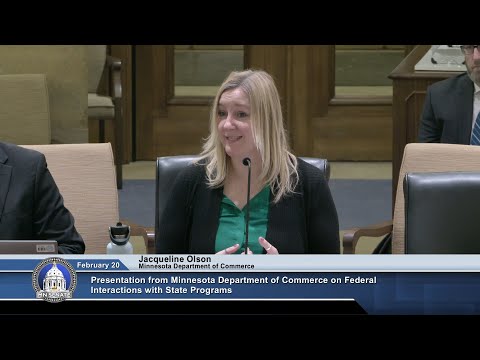
Jacqueline Olson, Enforcement Assistant Commissioner at the Minnesota Department of Commerce, described which Commerce teams already overlap with CFPB work and what will continue at the state level. Olson said Commerce’s multi‑industry team — which investigates collections, credit services, debt management, payday and consumer lending, money transmitters and student‑loan matters — opened about 1,000 investigations in 2024 and took 36 actions that year, assessing approximately $2,100,000 in civil penalties and $450,000 in recoveries for consumers. She said the department’s real estate, mortgage and title team opened 673 investigations in 2024 and took 53 actions with about $630,000 in civil penalties, and that the senior fraud team opened more than 1,000 investigations and placed holds on roughly $7,700,000 to prevent financial exploitation.
Olson warned that Commerce lacks jurisdiction over certain entities the CFPB typically regulates. “We do not have jurisdiction over Federal banks, which include credit card companies, we don't have jurisdiction over Federal credit unions or the credit bureaus,” Olson said. She added that when the CFPB handled those complaints, Commerce often accessed the CFPB complaint database to identify Minnesota complaints; loss of that database would limit Commerce’s ability to spot emerging statewide problems and likely increase the number of complaints the department handles.
Attorney General Keith Ellison said his office can take on some additional consumer work but cannot replace all CFPB functions. “The supervisory responsibility that the CFPB has for large banks, I don't have that authority,” Ellison said, describing the CFPB’s on‑site supervisory role — including examinations and subpoena power — that statewide attorneys general offices do not possess. Ellison urged coordinated state action and warned of broader market consequences if federal oversight remains paused: “Right now, our state‑chartered banks and credit unions are at a major disadvantage,” he said, and added that disparities in regulation can create competitive and systemic risks.
Two public witnesses described personal and student housing impacts they say the CFPB has helped address. Australia Ford, a parenting student at Metropolitan State University, recounted borrowing from a lender she later identified as predatory and said that CFPB enforcement and nonprofit assistance helped her regain footing. “This is why we need the Consumer Financial Protection Bureau,” Ford said, citing high interest and fees that trapped her in debt. Jacob Richter, a University of Minnesota student, told the committee that algorithmic rent‑setting and developer projects have pressured student housing markets in Dinkytown and elsewhere and that CFPB oversight of rental‑debt collection and unfair fees has mattered to renters. “If the CFPB is shut down, renters will have nowhere to turn,” Richter said.
Committee members asked Commerce staff for operational details. Olson said Commerce’s senior fraud team has three investigators, the multi‑industry team about seven, and the real estate team about eight; she said those civil investigators are not licensed police officers. Olson also said Commerce investigators are funded from the state general fund and that the department follows a hybrid work schedule.
Committee members and testifiers pointed to several immediate practical impacts if CFPB functions remain paused: loss of the CFPB complaint portal that the states use to identify problem trends, interruption of the CFPB’s civil penalty fund that compensates victims, and the potential for increased multi‑state litigation and inter‑agency collaboration among attorneys general and state regulators. Olson said Commerce staff are preparing to increase outreach and accept direct complaints to the Minnesota Department of Commerce if consumers cannot file with the CFPB.
No formal votes or legislative actions were taken at the hearing. Committee members said they will continue to coordinate with the Department of Commerce and the attorney general’s office to monitor federal developments and consider state‑level responses.
The committee recessed and later heard closing comments from Attorney General Ellison, who reiterated the need to defend the CFPB’s statutory tools and urged continued state collaboration on consumer protection.
Closing logistics: the committee posted a CFPB report with recommended state strategies on the Commerce website and adjourned the informational hearing.