Get Full Government Meeting Transcripts, Videos, & Alerts Forever!
Get email alerts on the Public Advocates Recommendations topic
No spam. Unsubscribe anytime.
Public Advocates Office urges four 'levers' to curb rising electricity bills
Summary
The Public Advocates Office presented four policy levers — scrutinize operating budgets in general rate cases, lower financing costs for capital projects, sunset non–cost‑effective programs, and redesign subsidies and rate structures — and provided estimates of potential savings.
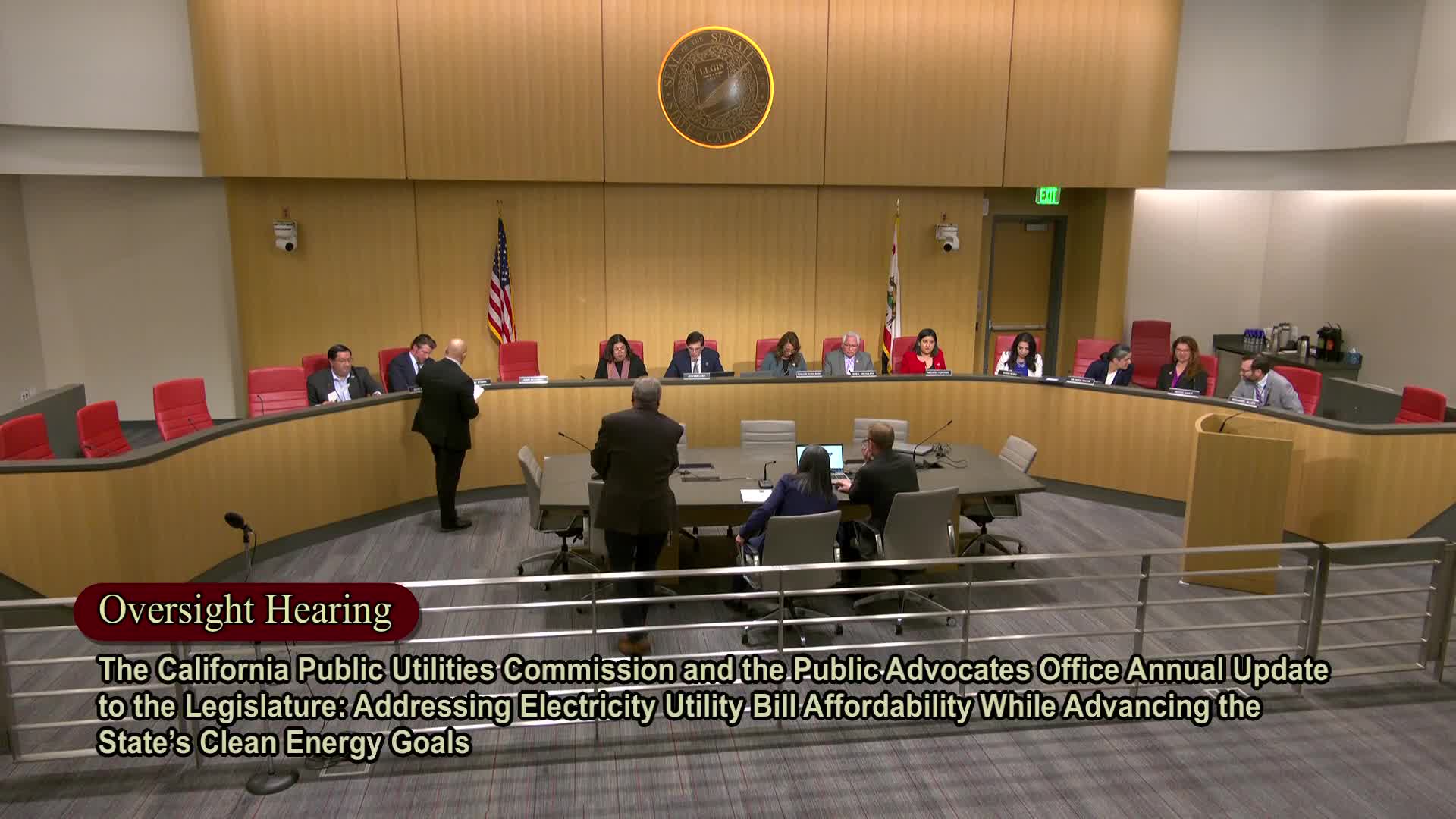
Linda Serizawa, the newly appointed director of the Public Advocates Office (CalPA), told the Senate Committee on Energy, Utilities and Communications that addressing electricity affordability requires pulling multiple policy levers at once.
"There are four policy levers that need to be pulled, and they all need to be pulled," Serizawa told the committee. She framed the four levers as: (1) reduce operations and maintenance costs through rigorous scrutiny in the CPUC's general rate case (GRC) process; (2) lower borrowing costs for major infrastructure projects through alternative financing (public debt, securitization, or other models); (3) phase out or sunset ratepayer funding for programs that are not demonstrably cost effective; and (4) reevaluate subsidies and rate structures, including the Net Energy Metering program and the California Climate Credit.
CalPA presented numbers intended to quantify the impact of targeting these levers. For example, the office estimated that using lower-cost financing for undergrounding could save customers roughly $41,000,000 in 2025 and about $310,000,000 annually by 2026 (conservative estimate). It also stated that existing rooftop solar incentives designed under earlier NEM rules amount to a subsidy on the order of "$8,500,000,000 annually" and that shifting those incentives or capping compensation could materially relieve ratepayer burdens.
Serizawa urged bringing more expenditure requests into the GRC process rather than allowing one-off memoranda and surcharges outside the primary budget forum: "When requests are in the GRC, parties can prioritize ratepayer funding and require utilities to present comprehensive proposals on how they intend to operate safely, reliably, and cost effectively." CalPA also recommended a temporary cap on energy efficiency program funding at 2020 levels and placing sunset dates on programs that cannot demonstrate cost effectiveness, measures CalPA said could provide immediate, direct savings to ratepayers.
The Public Advocates Office emphasized that its role is independent from the CPUC and focused on protecting customers: it intervenes in proceedings and offers alternative proposals that CalPA says frequently reduce utility requests.
Committee members pressed CalPA on the equity implications of any program changes; CalPA reiterated that program redesigns should include protections and alternative funding sources for public-purpose programs that serve low-income and vulnerable customers.
The committee requested additional written follow-up from CalPA to quantify how the four levers would affect different customer classes and how near-term savings might be achieved without compromising safety or clean-energy objectives.