Get Full Government Meeting Transcripts, Videos, & Alerts Forever!
Get email alerts on the Film Tax Credit topic
No spam. Unsubscribe anytime.
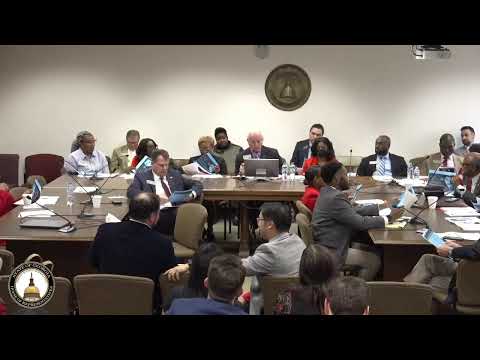
Georgia film officials and industry groups urge continued support for tax credit, cite statewide economic benefits
Summary
State film office officials, unions, studio representatives and trade groups briefed the House Economic Development & Tourism Committee on the film tax credit’s statewide economic impact, workforce programs and competitive threats from other states, urging continued legislative support.
Lee Thomas, of the Georgia Film Office, told the House Economic Development & Tourism Committee the state’s incentive program and related workforce initiatives have produced substantial growth in film and television production and a broad vendor base across the state.
“We are one small division of economic development,” Thomas said. She described the film office as a six-person unit within the Georgia Department of Economic Development that handles front-end certification for projects seeking the film tax credit and helps productions find locations, crew and stage space. Thomas said the Department of Revenue performs a “rigorous audit” on the back end to ensure expenditures and vendor qualifications meet program requirements.
Thomas and other speakers credited the tax-credit structure—originally enacted in 2005 and streamlined in 2008—with building a deep crew base and stage infrastructure in Georgia. She said production of shows such as Stranger Things has used more than 40 locations in the state, employed about 2,000 crew members and generated more than 15,600 room nights; the show used 561 vendors across Georgia, Thomas said.
Speakers provided statewide-level numbers to the committee. Thomas said Georgia’s direct production spend rose from about $135,000,000 in 2007 (pre-incentive) to a reported $4.4 billion in fiscal year 2022; she said the most recent year’s spend was about $2.6 billion, reflecting a partial industry contraction. Kelsey Moore of the Georgia Screen Entertainment Coalition cited a 2023 economic-impact study showing nearly 60,000 jobs tied to productions, roughly $3.54 billion in wages and benefits paid into Georgia households and a total economic impact of about $8.55 billion in a single year; the study calculated a $6.30 economic impact for every $1 spent on the industry.
Workforce training and retention were a recurring focus. Thomas described the Georgia Film Academy—developed as part of a statewide workforce initiative—as operating on more than 30 campuses, with about 15,000 students registered and roughly 1,250 having had hands-on training. The academy offers an overview course, concentrated tracks and paid on-set training opportunities, Thomas said. Thomas also highlighted a Camera Ready Community program that gives each of Georgia’s 159 counties a local designee (presenter said “59 counties”; committee discussion referenced 59 counties) to help identify locations and host productions.
Industry representatives emphasized the breadth of the supply chain. Brandon Reese of the Motion Picture Association said studios and streamers (Disney, Sony, Netflix, Universal, Paramount, Warner Bros. and MGM among those he listed) rely on Georgia’s combination of incentives, infrastructure and institutional knowledge. Misty Holcomb of Big Entertainment Network and Tucker Green of the same group said members include small, mostly Georgia-based businesses—lumber suppliers, truck rentals, post houses and other vendors—that benefit when productions locate in the state.
Wendy Clifton, representing Terminus Strategies on behalf of IATSE and the Teamsters, described labor’s role in building the state’s capacity. “IATSE represents about 7,500 members across the state of Georgia,” Clifton said; she added that roughly 2,000 Teamsters drivers work in the film industry. Clifton and other union representatives said the industry’s mobile production model complicates straightforward audit comparisons with fixed-location industrial projects, and they urged committee members to consider that when evaluating program rules.
Post-production and smaller vendors were another theme. Presenters showed a short clip and statements from post-production professionals highlighting editing, sound design and finishing work now done in Georgia. Misty Holcomb and others said Georgia now has nearly 5,000,000 square feet of stage space and growing post-production capacity, which keeps higher-value work in-state after principal photography concludes.
Committee members asked about competitive pressure from other states and national market contraction. Thomas and other presenters acknowledged that several states have expanded incentives and that industrywide production declined after pandemic-era growth and union actions; Thomas said exchange rates and a global contraction in production have also affected volumes. Committee member remarks emphasized vigilance: “We need to be aggressive in making sure that upstarts like New Mexico and Michigan… are kept in check,” one member said, urging continued incentive competitiveness.
Speakers closed by offering to provide more data and to host facility tours; the chairman scheduled field trips for committee members to visit studios and post houses. No formal committee vote related to the film presentations was recorded.