Get Full Government Meeting Transcripts, Videos, & Alerts Forever!
Get email alerts on the Policing Trends topic
No spam. Unsubscribe anytime.
Policy Forum: Milwaukee arrests, traffic and subject stops fell sharply over decade; committee hears multiple possible causes
Summary
At a Jan. 30 Milwaukee Public Safety and Health Committee hearing, the Wisconsin Policy Forum reported that MPD arrests and traffic/subject stops fell by more than 80% from 2012 to 2023. Committee members and MPD officials discussed staffing, the Collins settlement, priority calls and rising firearms purchases as possible contributors.
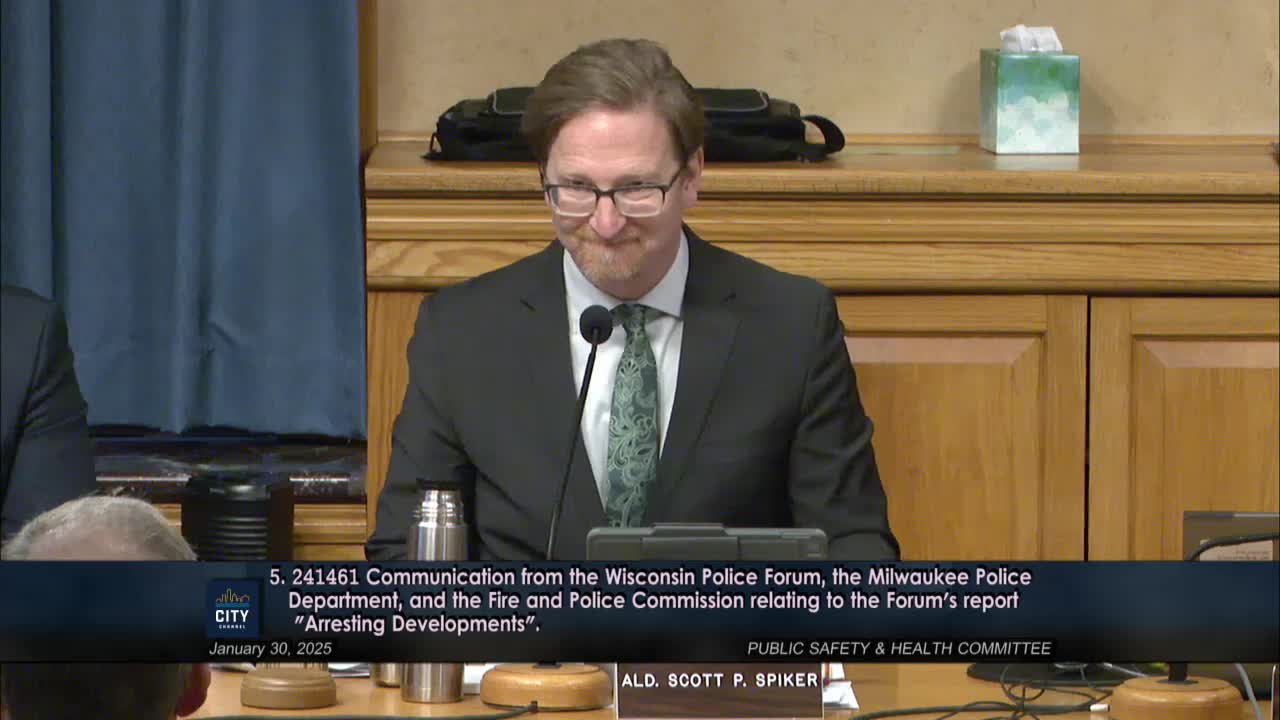
The Wisconsin Policy Forum told the Milwaukee Common Council Public Safety and Health Committee on Jan. 30 that arrests and street stops by the Milwaukee Police Department fell sharply over the last decade, and committee members pressed police and oversight officials on what those declines mean for public safety.
Rob Henkin, the forum’s immediate past president, and Ari Brown, a senior research associate, presented data showing a sustained decline across types of police contacts. "MPD made a little over 51,000 arrests in 2012, but just over 9,000 in 2023, which is a decline of 82.3%," Brown said. He also told the committee that traffic stops dropped from about 150,000 in 2015 to 27,715 in 2023, a decline of about 81.5%.
The forum’s presentation highlighted where the decreases were largest. The greatest proportional drop was in "summons and citation" arrests — cases where a person is cited and released with a court date — which the forum reported fell about 95.7% over the study period. Brown said the drop in arrests was not concentrated in a single year but reflected a consistent multi-year trend.
"We feel even more confident, than we did a year ago when we theorized that it's really a confluence of several factors," Henkin told the committee. Forum researchers said those factors include long-term declines in some property crimes, shifts in departmental priorities toward high‑priority calls (homicides, weapons offenses and auto theft), staffing declines and turnover, court charging patterns, and policy and procedural changes such as the 2018 Collins settlement.
Committee members and officials pushed the forum and Milwaukee Police Department (MPD) representatives to connect the data with residents’ experiences. "If you look at the satisfaction numbers... the percentage of respondents that said they're very or somewhat satisfied with MPD performance as it relates to enforcing traffic laws" has fallen, Brown said. Alderman Scott Speicher, committee chair, noted the apparent tension between fewer low-level arrests and continued resident dissatisfaction about enforcement and reckless driving.
MPD Chief of Staff Heather Huff told the committee the department has changed which tools it uses and how it documents stops. "Policing practices, not just in Milwaukee, but nationwide have changed," Huff said, adding that some contacts that previously resulted in arrests are now handled by outreach or health partners. Huff also described the administrative burden created by the Collins agreement and by departmental training and documentation requirements. "We have requested that they review all of their body worn cam before they write a report. That takes a lot of time to make sure that they get the report right," she said.
Forum researchers showed data indicating fewer officers on active duty and a sharp reduction in proactive policing time — activities such as traffic stops, targeted traffic enforcement and subject stops — while priority‑1 emergency calls rose. The presenters said the combination of fewer officers available for proactive work and more urgent calls reduces the department’s capacity to stop vehicles and conduct other discretionary enforcement.
Committee members asked whether reduced stop-and-frisk style encounters may have removed an avenue for discovering weapons. Brown and Henkin said their data show taken-into-custody arrests for weapons violations rose while some categories of police‑initiated stops fell, and they noted a spike in firearm background checks nationwide during 2020–21 that supplied more guns to the community. The presenters and some aldermen said that pattern could help explain why shooting levels spiked during the pandemic and have remained elevated compared with pre‑pandemic years.
Leon Todd, executive director of the Milwaukee Fire and Police Commission, spoke at the hearing and defended civilian oversight while acknowledging the effects of state law change. Forum presenters and commissioners discussed Act 12, state legislation that affects staffing caps and changes some local rulemaking authority. Forum members said Act 12 and other factors limit simple policy fixes and recommended a deeper review of how officers spend time and whether procedural tweaks could help free capacity for traffic enforcement or community engagement.
Aldermen asked the forum and MPD for more granular information. Several members requested tracking to show how often supervisors authorize alternatives to formal criminal referrals for repeat operating‑without‑a‑license cases, and more data on how officers spend shift time, including time spent reviewing video evidence and completing required reports.
The forum concluded by offering policy avenues for further inquiry: examine sworn staffing and recruitment strategies, consider targeted approaches to traffic enforcement, explore ways to reduce time officers spend on non‑patrol tasks, and expand partnerships (for example, mobile integrated health care and crisis response) to reduce non‑emergency calls. Henkin said the forum sought to prompt additional local discussion rather than prescribe a single policy change.
The committee placed the forum’s report on file for follow-up and requested additional data and briefings from MPD and the Fire and Police Commission.