Get Full Government Meeting Transcripts, Videos, & Alerts Forever!
Get email alerts on the Trade School Property Tax Exemption topic
No spam. Unsubscribe anytime.
Revenue committee advances bill to exempt for‑profit trade schools from property tax after amendments
Summary
Senate File 150, which would exempt for‑profit trade and vocational schools from property and tangible personal property taxes, passed the Revenue Committee after an amendment directing local county assessors to administer eligibility and auditing functions; the committee recorded a 3–2 roll-call vote.
The Senate Revenue Committee on Tuesday advanced Senate File 150, a bill that would exempt for‑profit trade and vocational schools from property tax and tangible personal property tax, and adopted a committee amendment shifting certain administrative duties from the Department of Revenue to county assessors.
Chairman McEwen opened the bill and invited testimony. Ken Gill of the Wyoming Department of Revenue, Property Tax Division, told the committee the bill "is pretty simple" and described the exemption language. He recommended moving eligibility determinations and certain administrative tasks to county assessors, saying "it might be better suited at the county assessor level because they're the ones that will actually be valuing these properties." Gill added that the department could still promulgate rules.
Converse County Assessor Dixie Huxtable said assessors were concerned the bill repeatedly assigned decision and audit authority to the department rather than to county offices. "All other exemptions come through the county assessor," Huxtable told the committee, and she pressed for clarifying language, including how workforce-development ties and accreditation would be verified.
Multiple witnesses representing trade schools, employers and industry groups testified in favor of the exemption. Cindy Barlow, testifying as a private citizen and employee of a technical school, presented workforce and fiscal projections and told the committee her organization tracked 645 job postings in Wyoming in a recent period. Barlow described program requirements in the bill, including placement and graduation thresholds, and said some trade schools are accredited and eligible for federal funds.
Representatives from the Wyoming Association of Community College Trustees voiced concern about the fiscal impact on institutions that receive property tax revenue through local mill levies. Erin Taylor said even a $3–4 million estimate of potential tax loss "matters" to colleges that depend on local revenue.
Industry witnesses — including Pat Joyce of the Wyoming Mining Association, George Arentz of the ASE Education Foundation, Ray Scazzari of a large automotive group, William Messer of Kenworth Truck Company, and Gary Michaud of Wyoming Catholic College — urged support, saying trade schools supply needed technicians and that tax relief could help expand programs and retain graduates in Wyoming communities.
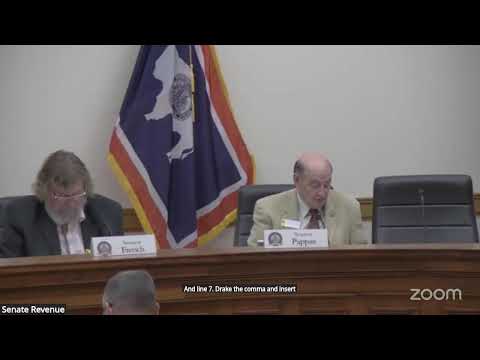
Senator Pappas moved amendments to remove references to "the department" on several lines and instead assign application, form consistency and certain auditing authority to county assessors; committee staff and Revenue Division staff discussed implementation. The committee adopted Senator Pappas's amendment by voice vote. Senator Hyde moved the bill; Senator French seconded. In a roll-call vote on the amended measure, Senator Case voted no, Senator French voted aye, Senator Eyde voted aye, Senator Pappas voted no and Chairman McEwen voted aye. The clerk announced "we have 3 aye and 2 no," and recorded that "Senate file 150 is past the revenue committee."
The transcript includes repeated committee concerns about how to define eligible trade schools, who determines workforce‑development need and how often exemptions should be renewed. County assessors and speakers said many schools rent facilities and that the exemption could apply to personal property rather than real property in some cases. The committee did not adopt a fiscal estimate in the transcript; one presenter offered a back‑of‑the‑envelope range of $3–4 million if all qualifying schools were exempted.
The bill, as amended, directs local assessors to administer eligibility and form processes instead of centralized Department of Revenue approvals; it passed the Revenue Committee and will proceed to the full Senate for further consideration.