Get Full Government Meeting Transcripts, Videos, & Alerts Forever!
Get email alerts on the Vehicle Safety topic
No spam. Unsubscribe anytime.
Advocates urge inclusion of motorcoaches in Massachusetts seatbelt law under S.2611
Summary
Sarah's Wish Foundation and UMass Transportation Center testified in favor of S.2611 to amend state seatbelt law and require motorcoach passengers to wear seatbelts, citing low current use rates and federal equipment standards requiring seatbelts on new coaches.
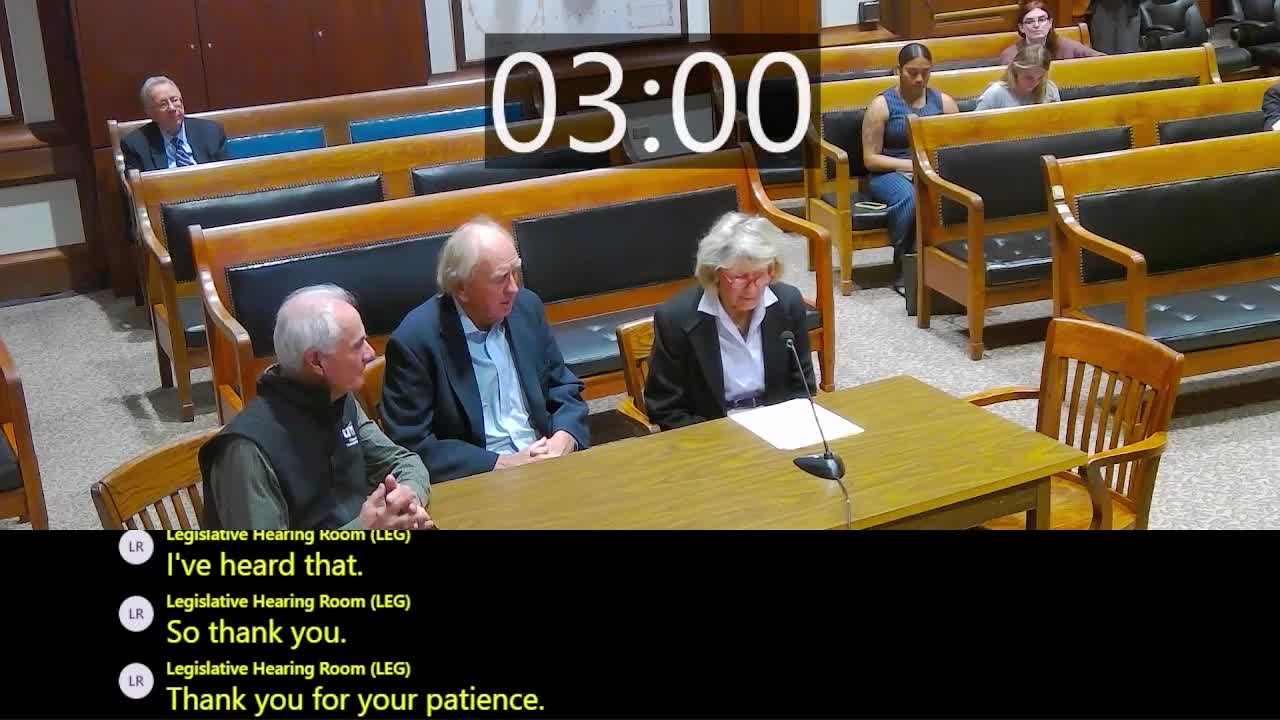
Ann Shuey and representatives of the UMass Transportation Center asked the Joint Committee on Transportation to amend state law to require motorcoach passengers to wear seatbelts under Senate Bill S.2611. Shuey, co-founder of Sarah's Wish Foundation, said the foundation’s work grew from her daughter's death in a motorcoach crash and that federal rules now require carriers to equip coaches with seatbelts.
“Our daughter, Sarah, died in a motor coach crash, and we've always felt that if she was wearing a seat belt, she would still be alive today,” Shuey said. She told the committee the foundation's research, supported by the National Safety Council and the National Highway Traffic Safety Administration and done with the UMass Transportation Center, found seatbelt use on many routes in Massachusetts is “extremely low, on the order of less than 5%.” She said that low usage means “if there are 40 passengers on a motor coach, only 1 or 2 passengers are buckled up.”
Shuey noted both New York and California already have motorcoach seatbelt laws and said S.2611 would amend the existing Massachusetts highway seatbelt law (chapter 90, section 1) to include motorcoaches. John Kalura of the UMass Transportation Center added that carriers have been equipping vehicles for years in anticipation of such rules and that S.2611’s effect would be to promote use rather than create new equipment requirements: “This bill essentially passed would just modify the existing state law to include motor coaches. There's no funding in the bill. It's just a matter of showing the commitment on the part of the commonwealth.”
Committee members asked about federal requirements and whether the bill would be redundant; witnesses replied federal rules require seatbelts on many coaches but that state law is needed to promote and require passenger use. The committee did not take a formal vote on S.2611 at the hearing.