Get Full Government Meeting Transcripts, Videos, & Alerts Forever!
Get email alerts on the School Safety topic
No spam. Unsubscribe anytime.
Senate committee backs bill requiring cardiac emergency plans, AED access in schools
Summary
The Senate Education Policy Committee on Feb. 24 approved a bill requiring school districts and charter schools to adopt cardiac emergency response plans, ensure AED access and train designated personnel, and it sent the bill to the Education Finance Committee.
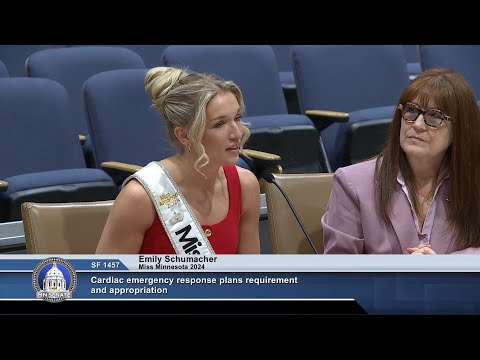
St. Paul — The Senate Education Policy Committee on Feb. 24 recommended passage of Senate File 1457, a bill that would require school districts and charter schools to adopt cardiac emergency response plans (CERP), ensure automated external defibrillators (AEDs) are accessible, and require training and simulation exercises for designated response teams.
Senator Westland, the bill sponsor, said more than 356,000 cardiac arrests occur outside hospitals in the U.S. each year and nearly 90% are fatal. “This is about keeping our kids safe,” Westland said. He said the proposal updates a 2024 approach — in which the commissioner of education made a model policy available — to require each school to have a plan in place for the 2026 school year.
Key requirements in the bill include:
• School districts and charter schools must develop CERPs and make them available on the school website and in paper form; • Each plan must identify members of the cardiac emergency response team and include clear response guidelines; • AEDs must be clearly marked and placed in unlocked locations within the athletic venue or within a 1‑ to 3‑minute walk; • Coaches, athletic staff and other identified personnel must be trained in CPR and AED use; • The response team must conduct a cardiac emergency simulation 30 days before the start of each school year and certify completion to the school board; • The Minnesota State High School League (MSHSL) is directed to adopt a SERP and ensure response teams are present at interscholastic events under its control.
The bill includes a $2,000,000 appropriation to help schools buy and maintain AEDs, fund CPR and basic first‑aid training, and provide educational materials.
The committee adopted a technical amendment changing instances of “automatic” external defibrillator to “automated” external defibrillator. The American Heart Association, Project ADAM, the Minnesota Athletic Trainers Association and other groups were listed in support during the hearing.
Supporters included family members whose relatives survived or died after sudden cardiac arrest. Kelly Ullen, whose 3‑month‑old daughter survived a cardiac arrest after immediate CPR, testified: “Even a minute or two delay in Emma’s receiving CPR could have led to a much different outcome.” Mike Schoonover of the Patrick Schoonover Heart Foundation described a statewide screening effort that identified hundreds of young people with heart conditions and said the foundation donates AEDs and provides CPR training at community events.
Representatives of schools and athletic organizations said many districts already have plans and AEDs but raised operational questions about staffing, training logistics and funding. Roger Arntzen, representing the Minnesota State High School League and a coalition of education associations, noted the league and partners have long run programs such as Anyone Can Save a Life and that coaches entering head‑coach roles already receive first‑aid and CPR training as part of initial licensing; he urged flexibility in how districts meet training and staffing requirements.
The committee voted to recommend the bill, as amended, be sent to the Education Finance Committee.
Why it matters: Sudden cardiac arrest is a leading cause of death on school campuses and survival depends heavily on immediate bystander CPR and quick access to AEDs. Supporters told the committee that planning, regular drills and access to equipment materially increase survival chances.
What’s next: SF 1457, as amended, moves to Education Finance for consideration of the appropriation and implementation details.