Get Full Government Meeting Transcripts, Videos, & Alerts Forever!
Get email alerts on the Water Infrastructure topic
No spam. Unsubscribe anytime.
Public Facilities Authority seeks state match, proposes grants for emerging contaminants and infrastructure needs
Summary
The Minnesota Public Facilities Authority told the Capital Investment Committee Feb. 20 that the governor's capital request includes roughly $99 million to unlock federal capitalization grants, and proposed increases to grant caps and a new emerging‑contaminant grant program to help municipalities address PFAS, manganese and other risks.
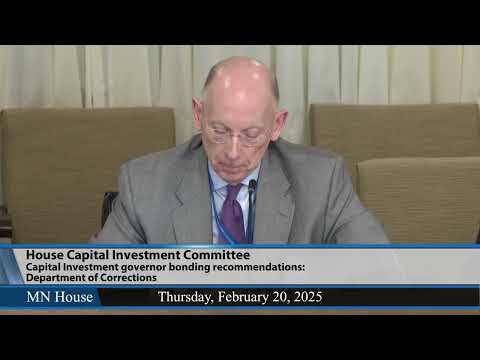
Karen Burkholtz, deputy director of the Minnesota Public Facilities Authority, told the Capital Investment Committee on Feb. 20 that the PFA's capital request tracks the governor's budget and seeks state match and grant funding to leverage federal capital grants and to fund several targeted programs for drinking water and wastewater infrastructure.
"The Minnesota Public Facilities Authority is a multi‑agency authority providing municipal financing expertise and infrastructure financing programs to enhance public health and the state's environmental quality and economic vitality," Burkholtz said in her opening remarks.
What the PFA asked for and why Burkholtz told the committee the governor's capital budget request for the PFA totals a little over $99,000,000, including state match for federal capitalization grants and funding for three other programs. She said $39,000,000 in state match would unlock roughly $215,000,000 in federal funds and that, after the Minnesota Pollution Control Agency and the Department of Health complete project priority lists (PPLs), the PFA will build intended use plans (IUPs) to present fundable projects.
Programs and figures explained at the hearing - Revolving loan funds: PFA manages the clean water and drinking water revolving funds, which use federal capitalization grants (requiring a 20% state match) to provide low‑interest loans and targeted grants. - Water Infrastructure Fund (WIF): State grant program that supplements loans for projects that would otherwise be unaffordable; PFA said the total estimated unfunded WIF needs (offset by IIJA principal‑forgiveness funds) are $64 million (drinking water) and $39 million (clean water) for identified projects on the 2025 PPLs. - Point Source Implementation Grant (PSIG): State grant covering components of projects that reduce specific pollutants; by statute PSIG covers 80% of eligible costs up to a cap (the PFA proposed raising the cap from $7 million to $12 million). Burkholtz said the estimated total unfunded PSIG grant need is approximately $124,000,000 for 26 projects and that the governor requested a little over $18,000,000 for PSIG in the capital budget. - Emerging contaminants (EC) program: The PFA described a new grant program to supplement federal IIJA funds for PFAS and manganese projects: proposed design would provide 80% grants up to $12,000,000 per project and PFA cited a Department of Health estimate that total statewide cost to address ECs could be about $450,000,000.
Federal pause and administrative updates Burkholtz told the committee the PFA experienced a brief pause in federal disbursements in early February after an executive order at the federal level; she said the pause was effectively lifted after litigation and notice from EPA on Feb. 3 and that PFA is proceeding with federal applications. She also noted staffing impacts at federal partners (anecdotal report of a 25% workforce reduction at USDA Rural Development in the state) that could affect timelines.
Affordability and lead service lines Representative Hansen raised concerns that Minnesota statute (cited in testimony as Minnesota Statute section 446A.072) sets an affordability calculation that can exclude some metropolitan area communities from grant eligibility. Burkholtz said the lead service line replacement program uses a different disadvantaged‑community calculation and that the PFA is working to honor the legislature's goal to replace lead service lines without cost to residents; she said the agency expects to return with requests for 2026.
Policy requests and caps Burkholtz recommended raising program grant caps (WIF from $5 million to $10 million and PSIG from $7 million to $12 million) to reflect inflation and project complexity. She also summarized the PFA's historical activity: since inception the authority has awarded more than $6.09 billion in state and federal financing (about $5.22 billion in low‑interest loans and $1.21 billion in grants), and in FY24 awarded about $363 million across 74 funding agreements.
Follow‑up and committee questions Committee members asked for additional detail on unspent balances, timing of expenditures from previous appropriations, and whether the PFA has authority to move funds between clean and drinking water programs. Burkholtz said the PFA has existing authority to transfer funds between those accounts and agreed to provide more detail on spending timelines and on coordination with partner agencies.
Ending Burkholtz closed by offering to provide technical follow‑up and to answer additional questions from the MPCA and MDH staff who attended the hearing. Committee members signaled further interest in emerging contaminant funding, lead service line replacement and affordability criteria.