Get Full Government Meeting Transcripts, Videos, & Alerts Forever!
Get email alerts on the Lead Service Lines topic
No spam. Unsubscribe anytime.
DC Water cost estimates, funding and public messaging draw scrutiny at council hearing
Summary
Advocates, residents and DC Water officials clashed over the authority's $1.5–$1.8 billion cost estimate for replacing remaining lead service lines, the pace and equity of removals, and whether the city should require a "filter first" public-health approach while replacements proceed.
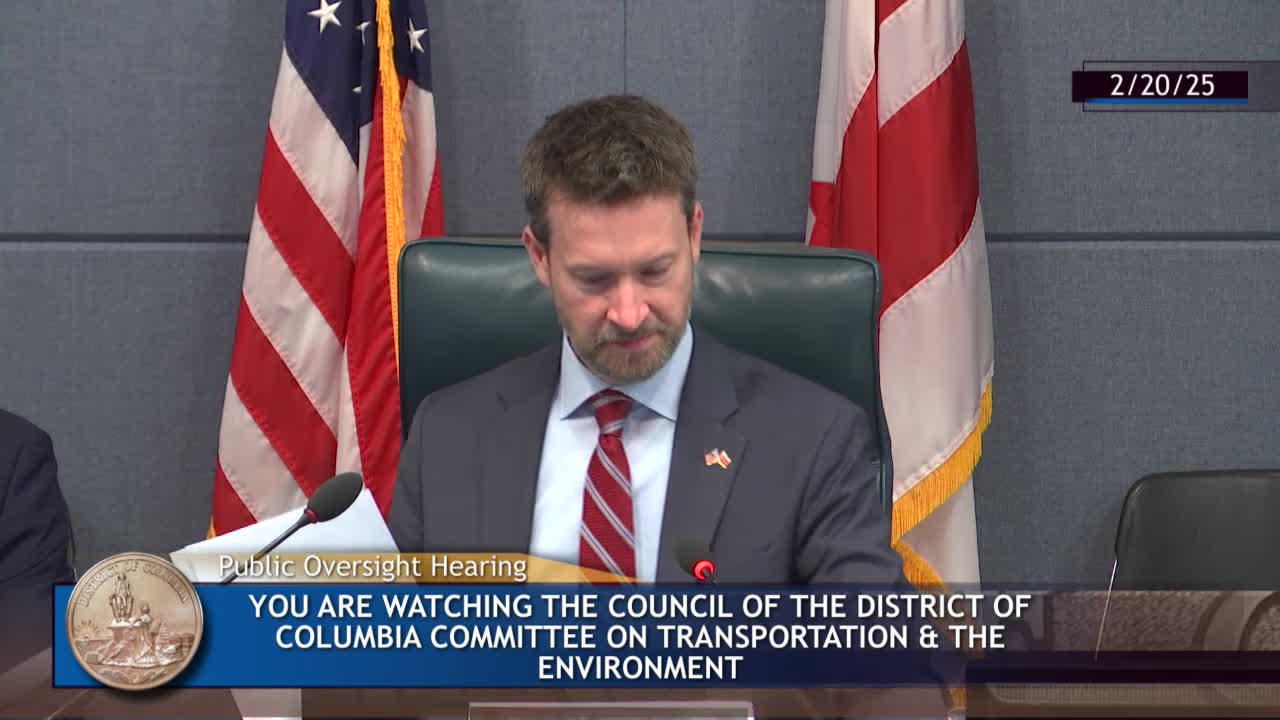
Ward 6 Council Member Charles Allen convened the Committee on Transportation and the Environment on Feb. 20 for a performance oversight hearing on the District of Columbia Water and Sewer Authority (DC Water). Public witnesses — including activists from the Campaign for Lead Free Water, NAACP DC, Sierra Club and neighborhood ANCs — pushed the committee to scrutinize DC Water's latest cost estimates for replacing lead service lines, to prioritize low‑income and East‑of‑the‑River neighborhoods, and to adopt a formal, “filter‑first” public‑health messaging campaign while replacements proceed.
The most contested figure at the hearing was DC Water’s revised total program cost. Witnesses Yana Lambrinidou and Paul Schwartz of the Campaign for Lead Free Water and others said DC Water’s estimate has risen from about $1.5 billion to about $1.8 billion, a change that produces an average replacement cost near the $40,000 range per service line. Lambrinidou told the committee the per‑line figure “is orders of magnitude higher” than other U.S. jurisdictions and independent assessments; she and others pointed the committee toward a September 2022 independent review by Safe Water Engineering that estimated per‑line costs closer to $12,000–$15,000 in the District.
DC Water leaders defended their budgeting methodology and provided a line‑item breakdown to the committee. Kirsten Williams, DC Water’s executive sponsor for Lead Free DC, said the authority’s program average is roughly $20,000 per replacement when public and private scope are combined, with the private (household) work averaging about $4,400 and public restoration averaging about $8,200. She also provided program‑level shares used in DC Water’s modeling: construction 56%; construction management and inspection 16%; procurement/design/other 8%; outreach 6%; permitting/design 5%; program controls and program management together about 8%; marketing 1%. Williams told the committee the district’s street‑restoration rules and permitting costs raise average per‑replacement costs compared with some other jurisdictions.
Witnesses and council members pushed DC Water to explain where savings could be found. Public commenters suggested reducing or waiving permitting and street repair fees, coordinating block‑by‑block replacements rather than one‑off repairs, and excluding brass service‑line replacements where scientific and regulatory guidance shows lead risk is lower. Several witnesses argued the authority should require and fund the use of certified point‑of‑use filters as a near‑term protection, especially for SNAP and WIC recipients. Paul Schwartz and others urged the committee to create an independent citizen advisory group to review costs, contracts and procurement practices; they also asked the council to reengage independent reviewers such as Safe Water Engineering.
DC Water officials acknowledged the estimate movement and said part of the gap reflects District‑specific factors: denser streets where mains sit under pavement (leading to curb‑to‑curb restoration), high local restoration standards, and program elements such as inspection, outreach and data systems that are not always included in simplistic per‑line comparisons. CEO David Gaddis told the committee DC Water has replaced 7,787 of the roughly 42,000 service lines it estimates remain and described the work as requiring close coordination with DDOT, DCRA and other agencies.
Several witnesses emphasized equity and pace. Members of the NAACP DC Branch, the Green New Deal for DC, and ANC commissioners pressed DC Water and the committee to prioritize Wards 7 and 8 and other historically underserved neighborhoods, to freeze or avoid passing large costs onto ratepayers, and to ensure low‑income tenants and renters do not shoulder replacement costs. DC Water testified it has prioritized outreach and block‑by‑block campaigns in areas of greatest need and described partnerships with DDOT, DC Health and the District of Columbia Housing Authority intended to accelerate work.
Why it matters: replacing lead service lines is a long‑term, multi‑hundred‑million‑dollar public‑health program. The committee pressed DC Water on transparency, cost drivers and how much of the price tag could transfer to ratepayers if federal grants are reduced. Several witnesses warned an unfunded mandate that raises bills would be inequitable and urged the council to fund replacements so residents are not charged for remediation.
Ending note: Council members signalled they will continue seeking detail on per‑line cost composition, pursuing interagency permitting efficiencies with DDOT and DCRA, and exploring legislative options to pair funded replacement requirements with a formal “filter‑first” public‑education campaign. The committee’s hearing record remains open through March 6, 2025 for written testimony.