Get Full Government Meeting Transcripts, Videos, & Alerts Forever!
Get email alerts on the Rezoning Auburn Ridge West topic
No spam. Unsubscribe anytime.
Brownsburg council rejects Auburn Ridge West rezoning on second reading after heated debate over traffic, wells and neighborhood connections
Summary
After extended public comment and council debate, the Town of Brownsburg rejected a rezoning ordinance for the Auburn Ridge West development on a 3-2 roll call vote. Residents raised concerns about traffic, well impacts and a proposed connector to Tilden Terrace; council amendments added nine-to-12 developer commitments before the vote.
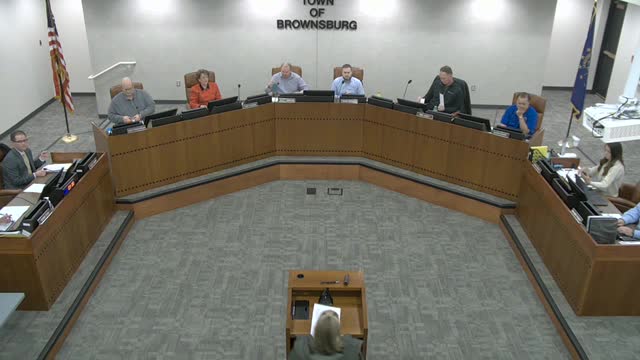
The Town of Brownsburg Town Council voted down a rezoning ordinance for the Auburn Ridge West subdivision on its second reading on Feb. 18, 2025, after lengthy public comment and hours of council discussion.
Supporters and opponents clashed over road access, groundwater impacts and neighborhood character. The council debated an amendment package from the applicant that added written commitments on lot count, buffers, road construction and home design; council members approved the amendments but ultimately rejected the ordinance on a 3-2 roll call.
The proposed rezoning would have changed the official zoning map from agricultural (AG) to R2 for the Auburn Ridge West site. The applicant and staff presented a set of commitments during the meeting intended to address neighbors’ concerns, including limiting the development to a maximum of 90 lots, providing a 50-foot buffer along the eastern property line adjacent to Tilden Terrace, and constructing an extension of Tilden Road to County Road 500 as a three-lane road with an 80-foot right-of-way and a 10-foot sidewalk or trail.
Residents spoke during the public-comment period and during the hearing on the ordinance. Emily Simmons, a nearby resident, criticized inconsistencies in the developer’s materials and asked the council to “hold firm on issues raised and send any revisions back to the APC,” adding, “I urge you to give an unfavorable vote tonight.” Mike Fouts, another nearby homeowner who relies on a private well, said, “I’m on a well. It scares me,” describing a neighbor’s well that went dry after construction near a retention pond. Brooke Firestein, president of the Tilden Terrace Homeowners Association, said, “Connecting it to a development with over 200 homes would dramatically increase traffic, creating serious safety hazards for our children.”
Town staff and the applicant responded with clarifications. Jenna Wertman, the town planner providing the Board of Zoning Appeals and Advisory Planning Commission report, told the council that earlier comments on a driveway relocation had been discussion items, not formal commitments, and that the town cannot require changes on property not part of the project. Jonathan Isaacs and Tim Westerfeld, representing MI Homes, said the applicant would comply with the new Unified Development Ordinance (UDO) requirements, preserve wooded buffers, and limit the final lot count to 90. Isaacs stated on the record that “the final number of lots will not exceed 90.” The developer also offered a $3,000-per-home contribution, to be applied at the town’s discretion toward future road work.
Council deliberations centered on infrastructure and timing for regional traffic projects. Several council members said they were reluctant to approve more housing in an area they identified as the town’s highest-crash corridor until long-term improvements are funded and designed. The town indicated it has provided traffic data to the state and that large projects such as a Green Street interchange remain several years from construction.
Council members approved a motion to add a package of commitments to the rezoning (including the cul-de-sac at the end of Tilden Terrace and amendment of the site map to show that cul-de-sac), but on the subsequent roll-call vote the ordinance failed. The roll call recorded Mr. Adams as opposed, Mr. Lacey in favor, Mr. Simpson opposed, Ms. Homan opposed and the presiding council president in favor; the motion to adopt the ordinance therefore failed (yes 2, no 3).
Votes at a glance - Ordinance (rezoning Auburn Ridge West to R2), second reading as amended — FAILED, roll call yes 2 / no 3. (Adams: no; Lacey: yes; Simpson: no; Homan: no; Council President: yes.) - Amendment to add 12 commitments to the ordinance (including buffers, cul-de-sac, lot cap and façade/garage commitments) — APPROVED by the council prior to the final vote (voice vote amendment passed). - Other council votes during the meeting (consent minutes and claims) — APPROVED (voice votes; standard procedure).
Why it matters: The debate highlighted local tensions between neighborhood preservation and housing supply. Neighbors pressed for enforceable, written commitments on home styles, buffers and road funding; council members split over whether the proposals addressed regional traffic and well-impact concerns sufficiently to allow approval.
What happens next: Because the ordinance failed on second reading, the rezoning does not take effect. Developers may revise the proposal and return to the Advisory Planning Commission and council for future consideration; residents and staff discussed seeking clearer, written documentation of commitments and follow-up study on wells and road funding before any new approval.
Reporting context: The rezoning item generated the meeting’s longest public comment period and the most extensive council discussion. The council took multiple procedural steps — accepting an amendment package, voting that amendment into the record, then conducting a roll-call vote on second reading that resulted in failure. No final agreement or binding schedule for additional studies was adopted at the meeting.