Get Full Government Meeting Transcripts, Videos, & Alerts Forever!
Get email alerts on the Criminal Justice topic
No spam. Unsubscribe anytime.
Marion County prosecutors detail challenges of prosecuting truck-stop serial killer Bruce Mendenhall
Summary
At a public Marion County Prosecutor's Office presentation, prosecutors described how a 2007 murder was tied to Bruce Mendenhall through evidence found in his truck, later DNA matches and multi‑jurisdiction cooperation, and explained courtroom limits on using evidence about other alleged killings.
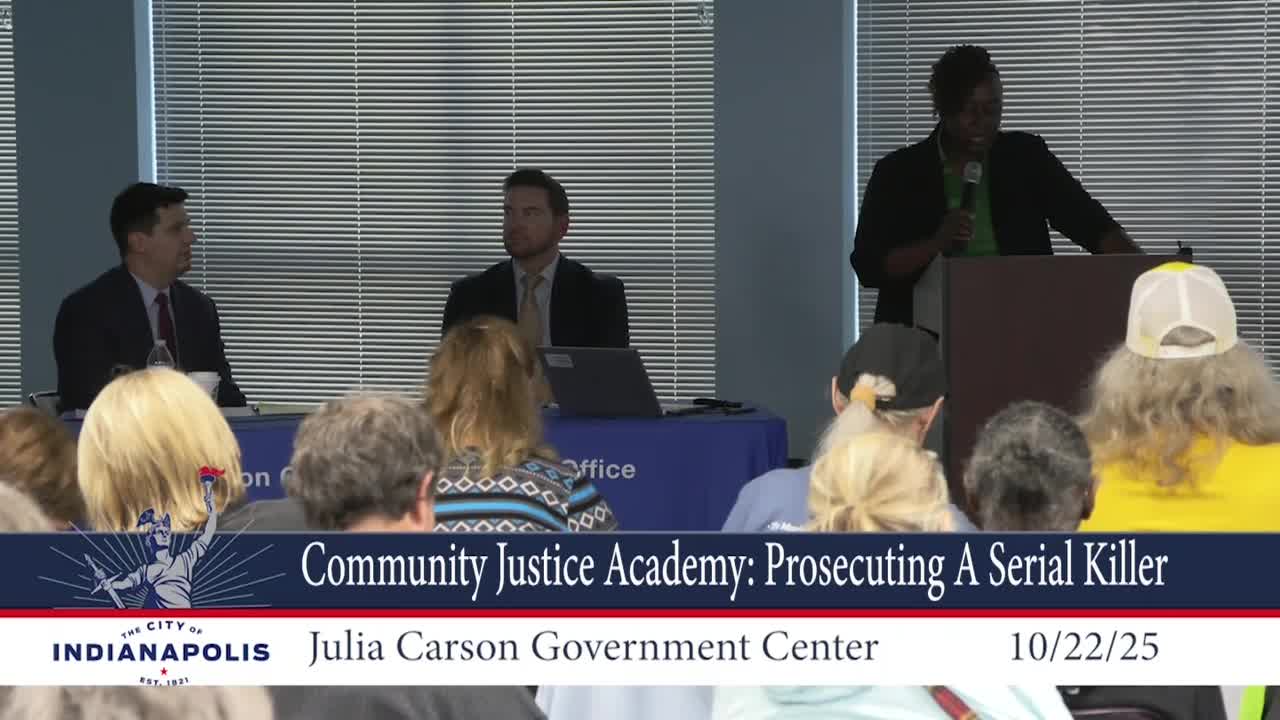
Marion County prosecutors Joe Cermak and Curtis Knight Smith told a public audience that prosecuting Bruce Mendenhall for a 2007 murder required piecing together evidence from multiple states and overcoming legal limits on what could be presented in court.
At the presentation, prosecutors said investigators found a bag of bloody clothing, an ATM receipt and a debit card in the cab of Mendenhall’s truck after his July 2007 arrest in Nashville. Surveillance stills showed the victim at a Flying J truck stop on Indianapolis’s south side, and DNA testing later linked the victim to clothing removed from Mendenhall’s vehicle, prosecutors said. Skeletal remains recovered in Kentucky in 2011 were later run through additional DNA searches after a change in laboratory policy, producing a CODIS hit that helped bring the Indiana case to trial, the presenters said.
Why the case mattered: prosecutors framed the case as an example of how cold evidence, interagency work and changes in DNA‑search policy can reopen long‑dormant investigations and lead to prosecution years later. They also emphasized limits placed by evidence rules on what juries may hear about a defendant’s alleged conduct in other states.
Prosecutors described the investigatory trail: Nashville homicide detectives who worked the earlier case identified a yellow truck on surveillance; a Nashville detective who had worked cold cases discovered blood and bloody clothing inside the cab when he approached the vehicle, the presenters said. Investigators recovered a victim’s clothing, a flip phone and ATM receipts showing a charge at a Flying J on July 11, 2007. Prosecutors said DNA from a sweater in the bag matched the victim’s profile.
The case later produced skeletal remains in a Kentucky ravine in October 2011. Forensic analysis at the University of North Texas Center for Human Identification initially produced no match under earlier procedures; after policy changes to expand database searches, prosecutors said the remains produced a CODIS hit in 2016 that allowed Indiana authorities to file charges.
Curtis Knight Smith, who described himself as lead counsel on the Indiana case, told the audience that evidence rules forced prosecutors to "try this case in a vacuum" because many of Mendenhall’s statements and evidence referred to killings in other jurisdictions. "We had to figure out how we were going to do this," he said, explaining that much of the defendant’s earlier statements could not be used because they referenced other alleged murders and therefore risked unfairly prejudicing a jury under Rule 404-type limits.
Both presenters described logistical hurdles of assembling decades‑old files and witnesses. Witnesses, laboratory personnel and investigators had retired or moved; some who helped on original investigations returned to testify. Prosecutors said multi‑jurisdictional cooperation included Nashville detectives, the Tennessee Bureau of Investigation, Kentucky investigators and the University of North Texas lab.
On the outcome, prosecutors said a jury convicted Mendenhall in January 2025. Prosecutors told the audience the jury returned a guilty verdict and that, during the presentation, they discussed a 65‑year sentence tied to the Indiana conviction; they also said Mendenhall was already serving two life sentences in Tennessee and that Indiana sentencing was scheduled for Feb. 13, where prosecutors said he could face an additional 45–65 years. Prosecutors stressed that they had not been able to use many investigative details at trial because those details implicated other states’ cases and would have required opening evidence from those matters.
The presenters gave the family a primary rationale for pursuing trial despite the passage of time: to give the victim’s family their day in court and a measure of accountability within the criminal justice system. "The family really wanted closure," a presenter said, adding that a criminal verdict does not bring a loved one back but can provide legal accountability.
The public event was part of a multi‑week Marion County Prosecutor's Office series. Organizers closed by thanking the prosecutors and noted the next session would cover a communication tool called the "blue envelope."