Get Full Government Meeting Transcripts, Videos, & Alerts Forever!
Get email alerts on the Open Space Bylaws And Mitigation topic
No spam. Unsubscribe anytime.
Lakeville Open Space Committee to send planning-board letter urging open-space bylaws; discusses police-station mitigation and conservation restrictions
Summary
The Town of Lakeville Open Space Committee approved meeting minutes and agreed to send a letter to the planning board urging adoption of open-space–focused subdivision bylaws. Members also discussed mitigation related to a proposed state police station parcel, monitoring of conservation restrictions and supporting an anti-dumping bylaw.
The Town of Lakeville Open Space Committee approved its minutes and agreed to send a letter to the planning board asking that the town consider bylaws to protect natural resources and encourage open-space subdivision design.
The committee’s draft letter, reviewed at the meeting, said recent development has fragmented the town’s open space and recommended that the planning board consider techniques such as allowing denser development within areas permanently set aside under conservation restrictions. The committee also discussed mitigation tied to a proposed state police station site on Equestrian Way off Pierce Avenue, monitoring of conservation restrictions, and support for a local anti-dumping bylaw.
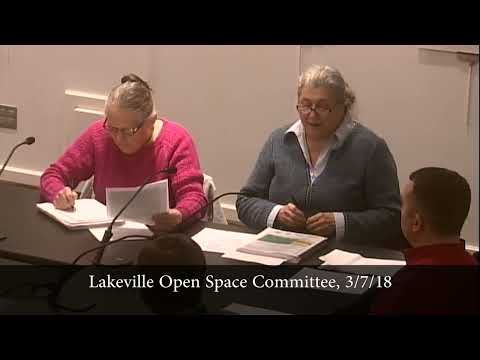
Patrick Marshall, chair of the Town of Lakeville Open Space Committee, opened the meeting and led approval of the minutes from the prior meeting. Committee members present included Linda Grubb, Jesse Medford, Joe Gladwell and Mike Schroeder; Brian Reynolds was absent. Joan Gladwell Morton was listed as the meeting recorder in the minutes that were read aloud.
Why this matters: the committee framed its recommendation as a response to ongoing development pressure that, they say, has reduced areas of natural habitat and scenic open space. The group wants the planning board to consider changes—described in the draft letter—so developers can preserve larger contiguous conservation areas through subdivision design and conservation restrictions.
Committee members reviewed text of the draft letter at the meeting. The draft states that, for lack of open-space bylaws designed to conserve natural resources, the town has “lost some areas rich in wildlife and natural beauty and risk losing more,” and urges the planning board to make introducing new bylaws a priority. The committee agreed that the letter could be sent to the planning board.
Members also discussed a parcel associated with the proposed new state police station at Equestrian Way and whether the town could or should place conservation restrictions on land the town owns. Committee members reported conflicting information on the parcel’s size: the assessor’s map listed roughly 8.5 acres while a town memo and a committee member indicated the property might be closer to 20 acres and contain upland areas. Committee members said the parcel is landlocked and noted that the town has not yet taken ownership, which affects what protections or restrictions can be applied.
On conservation restrictions (CRs), the committee reported that the Conservation Commission currently holds two private CRs but is not actively monitoring those properties. Committee members said they have previously suggested the Open Space Committee could assist with monitoring and said they will follow up with the Conservation Commission on how monitoring would be handled.
The Open Space Committee also discussed an anti-dumping and anti-littering bylaw recently highlighted by the attorney general’s office. Tracy (surname not specified in the transcript) had alerted the committee to the town’s Board of Health considering such a bylaw; the committee drafted a supportive memo and told meeting participants it would offer help to the Board of Health if requested.
Other items: members noted a February 15 grant deadline for recreational trails funding and discussed improved inter-board communication through a proposed biweekly town report that Nate (surname not specified) will raise with the selectmen. The committee set its next regular meeting for the first Wednesday in April (April 4 was proposed) and adjourned.
Votes and formal actions recorded at the meeting were procedural. A motion to approve the prior meeting’s minutes was made and approved by voice vote; the committee took a motion to adjourn and approved that motion by voice vote as well. Exact tallies were not specified in the meeting record.