Get Full Government Meeting Transcripts, Videos, & Alerts Forever!
Get email alerts on the Border Security topic
No spam. Unsubscribe anytime.
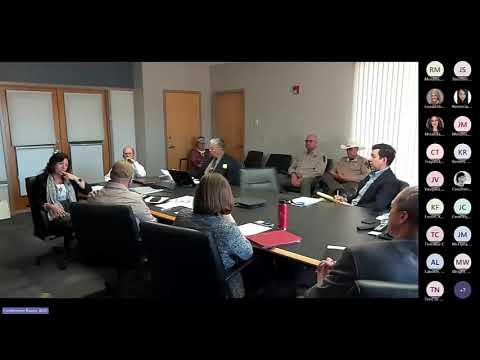
Cochise County sheriff briefs supervisors on presidential executive orders, grants and border operations; board votes to enter executive session
Summary
At a special Cochise County Board of Supervisors meeting, the sheriff described expanded federal activity and grants supporting local border operations, raised concerns about 287(g) designation and jail capacity, and the board voted to go into executive session for legal advice on the executive orders and Proposition 314.
At a special meeting of the Cochise County Board of Supervisors, the county sheriff briefed supervisors on President Trump’s recent executive orders on immigration and on local border operations, funding and operational risks, and the board voted to enter executive session to receive legal advice on the orders and Arizona Proposition 314.
The briefing matters because the sheriff told the board the county is already hosting large, state- and grant-funded border operations, and that some federal policy changes could affect how local deputies operate and how detention facilities would be used. Supervisors approved a motion to go into executive session under the state statute authorizing legal advice, and later reconvened and adjourned.
The sheriff told the supervisors that Cochise County’s border-operation activity is largely supported by grants and state partnerships rather than the county general fund and described recent federal and state engagement. “In 36 months, we booked 4,170 people ... border-related crimes,” he said, and said that figure had produced an estimated cost “of $14,400,000.” He said his office has brought in equipment and services through grants and partnerships — including aircraft, radios and four SECOM facilities — and that the majority of county border operations have been funded through state and other grants rather than county general-fund dollars. He added that only “about 1 to 2%” of recent funding was federal and that over the last 12 years roughly 12% of the more than $100 million in border-related funding he described was federally supported.
Sheriff representatives told the board that the Department of Defense had selected Cochise County as a DOD hub for a planned military contingent and that a force reduced in public reports from about 500 to roughly 350 personnel would bring a range of capabilities, from logistics and aviation to other support. The sheriff said he could not discuss operational details in an open meeting but said the presence would bring housing and local economic activity to multiple communities in the county, including Douglas.
The sheriff and other speakers discussed the 287(g) program and warned of trade-offs if local agencies accept full 287(g) designation. One participant said becoming designated under 287(g) effectively puts designated employees under federal direction and can create staffing and operational challenges; the sheriff said Cochise County had not adopted 287(g) and that statewide proposals to expand it raised concerns given the county’s jail condition and capacity.
The sheriff also sought state construction funding for a detention facility. He said he had asked state leaders for $40 million to offset construction costs, that $20 million had been set aside previously and that the combination would yield $60 million if the state contribution is approved. He said he had also pursued federal contributions and was discussing options with state legislative leaders.
On fentanyl and illicit drugs, the sheriff briefed the board on large volumes he said flowed through Arizona’s border counties: “just under 80,000,000 fentanyl pills,” he said, and compared that figure to other states’ totals. He warned supervisors that the county faces persistent trafficking and violence risks tied to cartel activity.
Board members asked operational and legal questions about whether deputies could use the executive orders to act before noncitizens cross into U.S. territory and about the scope of cross-border authorities. The sheriff and other law-enforcement speakers said they have long-standing interdiction practices and that some of the executive orders expand tools for federal and allied operations; they emphasized that any cross-border activity remains primarily the federal government’s responsibility and said local officers lack authority to operate in Mexico.
Before entering executive session, the board made an on-the-record roll-call list of officials who would accompany the sheriff into closed session, including Paul Larimer (sergeant), Elena Ybarra (finance manager), K. Pamela Leeman (chief of staff), Paul Watkins (operations commander), Daryl Capis (public information officer) and Joe Jury (captain). A supervisor moved and another seconded a motion to go into executive session pursuant to the Arizona statute authorizing legal advice; the motion carried on a voice vote with all in favor.
After the executive session the supervisors reconvened and adjourned the special meeting. The board planned a subsequent work session on the jail budget and planning update immediately following the special meeting.
This account is based on the sheriff’s briefing and the board’s on-the-record motion and vote to enter executive session; further details discussed in the closed session were not disclosed publicly.