Get Full Government Meeting Transcripts, Videos, & Alerts Forever!
Get email alerts on the Solid Waste Landfill topic
No spam. Unsubscribe anytime.
Cochise County outlines plan to stretch lifespan of Western Regional Landfill, citing high trucking costs
Summary
Public Works Director Jason Fazio described steps to maximize airspace at the Western Regional Landfill in Huachuca City — including stronger compaction, recycling removal, and use of a newly constructed cell — to extend the site's service life and reduce expensive long-haul trucking from outlying transfer stations.
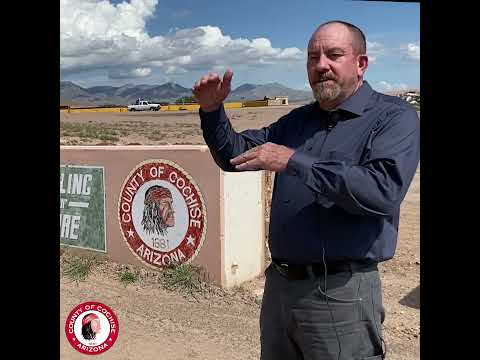
Jason Fazio, director of public works for Cochise County, described operations, costs and recent construction at the Western Regional Landfill in Huachuca City during a county site briefing.
Fazio said the county relies on a network of transfer stations in Benson, Wilcox, Bisbee, Douglas and Sierra Vista that truck material to the Western Regional Landfill, and that long hauls drive up operating costs. "We truck that material out here. We have a lot of challenges because we have to cover a lot of ground. Our trucking costs are super high because we truck material all the way from Wilcox and Douglas over to this landfill," he said, adding the drive is about 1—2 hours one way and can be a three-hour turnaround for drivers.
The county is pursuing several tactics to extend the landfill's lifespan and reduce required airspace. "The idea is that we're selling airspace," Fazio said. He described removing recyclables (steel, cardboard, aluminum and electronics) before burial, increasing compaction with a roughly 90,000-pound compactor and using GPS and quarterly drone flyovers to measure tons placed in each cell.
Fazio said the landfill is composed of 12 potential cells of roughly 9.9 acres each and that the operation is currently transitioning between Cell 4 and Cell 5. Cell 4 is at about 90% capacity; the county expects to begin using Cell 5 within weeks and plans to place "fluff" household waste at the bottom of the new cell to protect the liner. "Fluff material is material that's mostly household waste. It's bagged trash, usually fairly soft, and we put that in the bottom of Cell 5 to protect what they call a liner," he said. The liner sits about 12 to 14 inches below the surface.
Fazio said Cell 4 previously lasted about seven years under the county's current compaction practices, while earlier cells averaged about five years. He said the county is compacting material at approximately 1,200 to 1,300 pounds per cubic yard to conserve airspace.
Site geology is a constraint. Fazio said caliche deposits start at roughly 12 inches below the surface and vary in hardness; contractors must use heavy ripping equipment to excavate new cells. He described the Cell 5 procurement and construction timeline as taking several months: roughly three to four months to begin a contract and another three months for excavation. The county spent about $350,000 to prepare Cell 5, he said.
Fazio described a secondary protocol to remove large pieces of steel and other recyclables from waste already in the landfill, placing them into roll-off containers for recycling. He said recycling brings some revenue but the primary benefit is saving landfill airspace; the county still pays to truck recycled material to Tucson for processing.
No formal votes or actions were announced during the briefing. Fazio said the county will continue to use compaction, material separation and the newly prepared Cell 5 to extend the landfill's useful life and reduce long-haul truck trips from outlying transfer stations.