Get Full Government Meeting Transcripts, Videos, & Alerts Forever!
Get email alerts on the Land Use Zoning topic
No spam. Unsubscribe anytime.
Council tables Pine Hill master-plan amendment and related zoning and tree-permit requests after neighborhood opposition
Summary
A proposed rezoning and master-plan amendment for the Pine Hill site drew substantial opposition from nearby Grace Park residents. The applicant and staff agreed to pause the application so the developer can meet with neighbors; council tabled three items to an uncertain future date by unanimous vote.
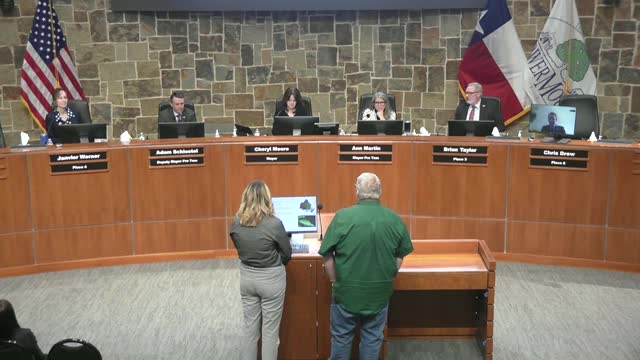
The Flower Mound Town Council on Wednesday voted unanimously to table three items related to the proposed Pine Hill development — a master-plan amendment (MPA24-005), a planned-development zoning request (ZPD24-007) and a tree-removal permit (TRP24-013) — after residents of the adjacent Grace Park subdivision raised concerns about lot sizes, tree loss and compatibility.
Lehi (planning staff) described the applicant's revised proposal and the planning history of the property. The site currently carries a PD (planned development) designation that had allowed a nursing or congregate-care facility in a prior approved plan. Lehi told council the new request would change the future land-use designation from low-density residential (15,000-square-foot minimum lots under the master plan) to medium-high-density residential, and would create 14 lots with minimum lot sizes of roughly 8,000 square feet within a project-specific PD.
The applicant, Jeff Westcott, said he and his team substantially reduced density from earlier proposals and emphasized tree retention and open-space increases compared with what had been previously approved for the property. "We saw an opportunity that we said OK, we can bring this to a more compatible use... we landed here today," Westcott told council, noting the project had been through months of staff review and revisions. He said the revised plan would preserve two large post oaks in the front and several additional protected trees and that the development would provide about 19.2% open space on the site.
Grace Park residents who spoke during the public hearing disputed the project's compatibility with the neighborhood they had purchased into as low-density residential. Dr. Aditi Banerjee, who said she moved into Grace Park last year, told council many neighbors bought homes expecting the adjacent land to remain low density: "We came to Grace Park because we felt it was open. It was beautiful. Our homes had lots of land around it... now just six months in moving in, if we know that it's a low or medium-density, that that's a concern to us." Adam Shear, a property owner immediately south of the site, told council he supports the 14-lot plan and described the lot as an "orphaned" parcel that has been undeveloped for years.
Planning staff reported the Environmental Conservation Commission recommended saving seven specimen trees and that the Parks Board recommended fees in lieu of parkland dedication totaling $100,800 plus park-development fees of $20,820. Lehi also explained that because a previous PD allowed an assisted-living facility, the site owner could, in theory, develop that prior approval if the current rezoning is not approved.
After public comment and council discussion, Councilmember Anne (last name not specified in transcript) and several other members said they wanted more direct engagement between the applicant and Grace Park residents before any final action. The council unanimously voted to table each of the three items to a future date uncertain; staff and the applicant said they would work to schedule neighborhood meetings and bring revised materials back to council.
Ending: Councilmembers instructed staff to facilitate dialogue between the applicant and neighbors and noted staff availability to host meetings with council or planning staff present. The items were tabled by unanimous roll-call votes so the developer could pursue additional outreach and adjustments.