Get Full Government Meeting Transcripts, Videos, & Alerts Forever!
Get email alerts on the School Facilities topic
No spam. Unsubscribe anytime.
Fairport Central outlines $72–74 million K–8 facilities plan, eyes fall 2025 referendum
Summary
Consultants presented a narrowed K–8 capital plan for Fairport Central School District that would use capital reserves and seek state building aid; estimated project cost is roughly $72–74 million with a planned public referendum in fall 2025 if the board approves advancing the proposal.
Fairport Central School District officials and their consultants presented a refined K–8 facilities plan at a board workshop that estimates total project costs of roughly $72 million to $74 million and would rely on the district’s capital reserve plus state building aid and bonds to cover the remainder.
The presentation summarized building-condition findings, a prioritized scope of work for each elementary and middle school, and a tentative timeline that would bring a public referendum in fall 2025 if the board decides to proceed. Matt Provanzano, the facilities planning presenter, said the board set parameters of “no additional cost to the taxpayers” beyond the use of capital reserves and state aid.
The consulting team described common-system upgrades across buildings — replacement of original HVAC air-handling units, upgrades to controls from pneumatic to direct-digital control (DDC), electrical-service improvements, fire-alarm and public-address system upgrades, and targeted classroom, toilet-room and cafeteria renovations. Troy Williams of LaBella highlighted the value of grouping similar work across multiple buildings to achieve economies of scale on bid day. Williams said the team sought to prioritize “life safety and…critical infrastructure like ventilation and air management.”
Consultants identified specific building needs in the presentation boards. Brooks Hill Elementary was listed for major interior renovations, including ceilings, lighting, toilet rooms, cafeteria upgrades and HVAC work; Brookdale was noted as having a single large HVAC unit that the team proposes to replace with three smaller units to reduce single-point failures. Consultants also flagged classroom partition/firewall conditions at Dudley Northside and proposed prototyping fixes for selected rooms to demonstrate good-faith remediation to state reviewers.
The district’s fiscal consultant, Christine Crowley of Fiscal Advisors, outlined the financing assumptions behind the estimates. Crowley said the district could rely on its capital reserve as a down payment and then borrow the balance; she explained that state reimbursement for aidable work is significant, saying, “the state of aidable scope will reimburse you 77.7¢ on every aidable dollar.” She and the team used assumptions including a 2.75% interest credit on building-aid payments and a roughly 4% borrowing rate in their model.
Consultants presented two illustrative scenarios: one showing a roughly $74 million project using about $14 million in capital reserves, and another roughly $72 million project using about $13.2 million in reserves. The presentation included contingency and escalation allowances to reflect expected bidding and construction timing; the team said bids are expected in spring 2027 under the current timeline, with construction layered into 2028–29 schedules to control local tax levy impacts.
On measures to address classroom comfort and recent legislation, the presenters noted the governor recently signed a law limiting classroom temperatures (referred to in the presentation as the “hot schools law”). Consultants said the team is considering where air conditioning provides the most value; for example, JP’s gym was proposed for air conditioning because of heavy community use, while other buildings may receive AC in large-group or cafeteria spaces where it provides the greatest utility.
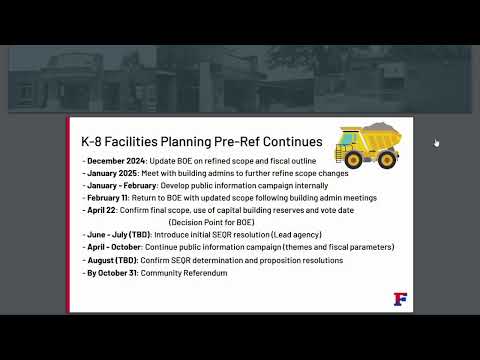
The presenters emphasized the next steps and decision points for the board: further building-level user-group meetings in January to refine scope, a return to the board with an updated scope in February, and an April decision point to confirm the scope, capital-reserve usage and a vote date. Provanzano said, “If the board continues to want us to move forward in April, confirm the scope, and the use of the capital reserves and and the vote date.” The team also noted that formal lead-agency (SECO) determinations and public information steps would be required before a fall 2025 community referendum (presenters referenced October 2025 dates as possible deadlines for referendum materials).