Get Full Government Meeting Transcripts, Videos, & Alerts Forever!
Get email alerts on the Library Staffing topic
No spam. Unsubscribe anytime.
Multnomah County Library outlines staffing plan tied to $387 million bond, to finalize plan in January
Summary
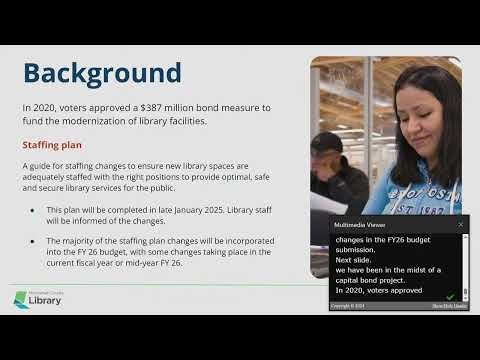
Library leaders updated the Multnomah County Board on progress toward a staffing plan required by a Dec. 2023 auditor’s report and connected to the library capital bond. The plan will be finalized in mid–late January and incorporated into the FY 2026 budget; most staffing changes will come from reallocations, not new net positions.
Multnomah County Library Director Annie Lewis and Interim Deputy Director Dave Ratliff briefed the county board on the library’s “future staffing initiative,” saying the final staffing plan will be completed by mid to late January and integrated into the FY 2026 budget.
The library’s planning is driven by a December 2023 performance audit from the Multnomah County Auditor’s Office, which included recommendations 9 and 10 directing the library to develop a staffing plan to fully staff facilities when construction from the 2020 capital bond completes. “The final staffing plan however will be complete by mid to late January because it's inextricably tied to our budgeting process and we'll be submitting the staffing plan changes within the FY 26 budget submission,” Lewis said during the briefing.
The 2020 voter-approved capital bond (reported by library staff as $387,000,000) will expand building space and services; library leaders said the staffing plan is intended to ensure locations can remain open, provide security/"person in charge" coverage, and support culturally and linguistically appropriate services once new spaces open. Ratliff said the library’s work builds on several years of classification and workforce planning and consultant analysis; he described a coming “blueprinting” phase to translate roles and workflows into specific position duties.
Library staff described several constraints and operational choices. Ratliff said the library has “no surplus revenue to support new net staffing,” so most changes will come from reallocating existing budgeted positions, using vacancies, and some limited-duration positions. He said the library expects to reassign or otherwise affect roughly 40–45 positions (some reassigned between work groups, some vacancies reclassified), with about five positions expected to be downwardly reclassified. The library reported a total of 643 budgeted positions systemwide.
The library also highlighted operational dependencies that will affect staffing feasibility: collective bargaining and market-rate adjustments with Local 88; nearly two-thirds of current staff have opted out of serving as the “person in charge” under the 2023 contract, which reduces available coverage; and new automated materials-handling technology that could shift work away from manual sorting and circulation tasks. Ratliff said the automation will “change the way staffing works in terms of materials movement” but that the net effect on headcount is still being analyzed.
On service priorities, the library identified four ordered priorities used to build FTE requirements: (1) provide spaces (buildings, collections, technology, direct customer service); (2) information and referral services (in-person and virtual); (3) maintain the library website and public access catalog; and (4) programs and activities (story times, literacy, classes). Lewis said the staffing plan incorporates an equity-centered approach called “targeted universalism” to allocate language and cultural skills to positions where patron demographics suggest need.
Board members asked about several operational details. Ratliff confirmed that “we have self check machines in every library location,” and said self-check improved workflow but did not reduce overall personnel needs; instead, it freed staff to perform different tasks. On substitute and last-minute coverage, staff said they are planning a small pool of roughly 19 positions dedicated to fill last-minute absences to avoid closures when multiple staff call out.
Library leaders gave a timeline: they will share the finalized staffing plan with library staff in mid–late January, do individual communications with staff whose positions will be impacted before public rollout, submit staffing changes to the FY 2026 budget, and implement the “organizational blueprint project” through 2025 and into FY 2026. Staff said some implementation steps will begin in July 2025 to prepare for openings, with the East County Library on track to open in late spring 2026.
Board members pressed on tradeoffs: staff said the audit’s recommendation to expand programming and outreach cannot be fully met immediately because of budget constraints; the library plans to prioritize keeping locations open, virtual customer service, and its website, and to reorient outreach and programming using equity criteria and community partnerships.
The briefing concluded with library staff offering additional engagement with the board as the plan is finalized and noting ongoing data work—an agreement with Portland State University’s Population Research Center to overlay patron use and population data, plus a patron survey planned for fall 2025—that could further refine language and cultural staffing allocations.