Get Full Government Meeting Transcripts, Videos, & Alerts Forever!
Get email alerts on the Transportation Infrastructure topic
No spam. Unsubscribe anytime.
Sacramento City Council backs staffrecommended Truxell Bridge concept, directs environmental and funding work
Summary
After more than a decade of study and a night of public comment, the council adopted staffrecommended Alternative 3B for the Truxell Bridge, directing staff to pursue environmental clearance and funding for the project and prompting calls from opponents to study a car-free alternative.
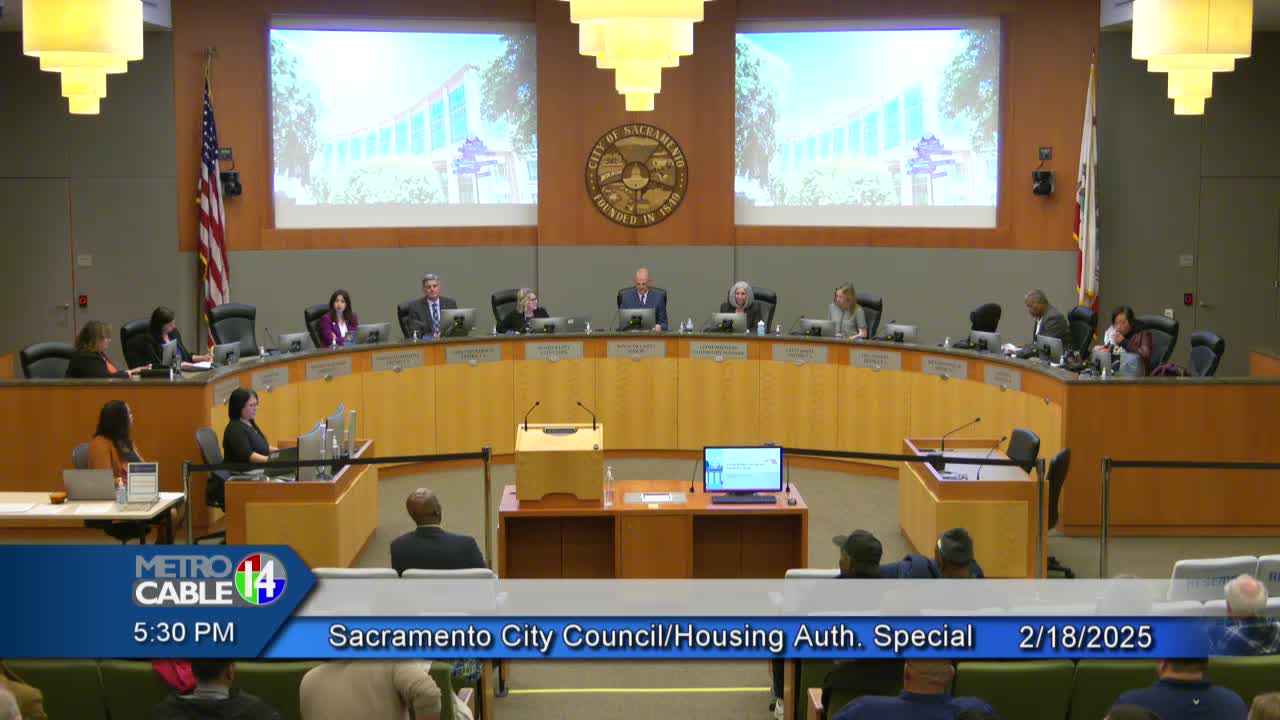
The Sacramento City Council on Tuesday voted to adopt staffrecommended Alternative 3B for the Truxell Bridge concept and feasibility study and directed the city manager to pursue environmental clearance and funding for the next phase.
The vote followed a lengthy public comment period and more than an hour of council discussion about tradeoffs between a multimodal bridge that would carry cars, light rail, buses, bikes and pedestrians and a narrower, transit- and pedestrian-only crossing. Vice Mayor Talamantes moved to adopt the staff recommendation; Council Member Pluckettbaum seconded. The motion passed with Council Member Kaplan voting no, Council Member Vang abstaining and the remaining members voting yes.
Supporters including construction unions and business groups said the chosen alternative balances multimodal access and job creation. "We are in favor of the staff's recommendation," said Kurt Ferreira, a business agent for the NorCal Carpenters Union. Several union representatives told the council the project would bring local, union construction jobs.
Opponents, including active-transportation advocates and river-conservation groups, urged the council to study a car-free option before committing to a design that includes general-purpose vehicle lanes. "I believe tonight will be an opportunity lost we were never given the chance to seriously compare a car free option," said Isaac Gonzalez, vice chair of the Active Transportation Commission. Multiple speakers cited costs, ongoing maintenance and environmental impacts to the American River Parkway.
City staff presented the study and recommendation at the start of the meeting. "Staff's recommendation is Alternative 3B," said Fedolia Harris of the Public Works Department, who identified herself by the nickname "Sparky". Harris told the council the concepts grew from a purpose-and-need established in 2013 and from subsequent general plan guidance; the staffrecommended configuration places transit between separated bike facilities and vehicle lanes and was developed after public outreach and traffic and hydraulic analyses.
Cost estimates were a recurring theme. A public commenter identified as Kay Crum of Strong SacTown cited the study's figures, saying "the cost of a transit and active transportation option is estimated about $135,000,000, but including cars on that bridge would raise that to the $228,000,000." Several speakers also highlighted long-term maintenance obligations mentioned in the presentation, and others questioned whether the project would meaningfully reduce vehicle miles traveled.
Staff said the next step would be to pursue environmental clearance and preliminary engineering and that the city had applied for federal grant funding to start that phase; staff expected an answer on that application by summer. Harris and other staff said the city is also coordinating with regional partners including the Sacramento Area Council of Governments and Sacramento Regional Transit District on funding and transit integration.
Council members split on the balance between near-term connectivity and long-term climate and parkway protections. Vice Mayor Talamantes, representing North Natomas interests, emphasized the need to connect communities north of the river to jobs, health care and downtown amenities, and cited emergency access and evacuation considerations. Council Member Vang abstained from the final vote, noting she did not have enough information.
The meeting record includes dozens of public speakers on both sides of the question, and staff recorded 58 signed public commenters during the item. City staff and the council noted the environmental review (CEQA/NEPA) process will evaluate alternatives, including assessment of a car-free option as part of the formal environmental document, and County-level approvals will be required to amend American River Parkway mapping if the project proceeds with motor vehicle lanes.
Votes at a glance
- Motion: Adopt the Truxell Bridge Concept and Feasibility Study and designate Alternative 3B as the preferred alternative; direct the city manager to identify an action plan to pursue environmental clearance, preliminary engineering and funding. - Mover: Vice Mayor Talamantes. Second: Council Member Pluckettbaum. - Vote: Kaplan No; Dickinson Aye; Vice Mayor Talamantes Aye; Pluckettbaum Aye; Maple Aye; Mayor Pro Tem Guerra Aye; Jennings Yes; Vang Abstain; Mayor McCarty Aye. Motion passed.
What happens next
If the city secures funding for the next phase, staff said the environmental clearance and preliminary engineering stage could take roughly three years and would be followed by rights-of-way steps, detailed design and construction. Staff briefed council that the American River Parkway plan and related state law could require a mapping amendment at the county level before motor vehicles could be added to a crossing in the parkway area; staff said they are already consulting with county staff and regional partners in anticipation of those processes.
The decision sets a course toward a federally eligible, multimodal crossing while preserving the requirement that formal environmental review analyze alternatives and mitigation. Several council members and many public speakers said they intend to press for robust consideration of a transit- and pedestrian-only crossing during the environmental review.