Get Full Government Meeting Transcripts, Videos, & Alerts Forever!
Get email alerts on the Animal Welfare topic
No spam. Unsubscribe anytime.
Tulsa Animal Services outlines 2025 plan: shelter build, microchipping in the field and expanded outreach
Summary
At a Jan. 13 Tulsa Animal Commission meeting, Tulsa Animal Services presented a multi-pronged 2025 plan that emphasizes policy updates, a new shelter build, field microchipping to boost return-to-owner rates, school outreach and expanded fundraising.
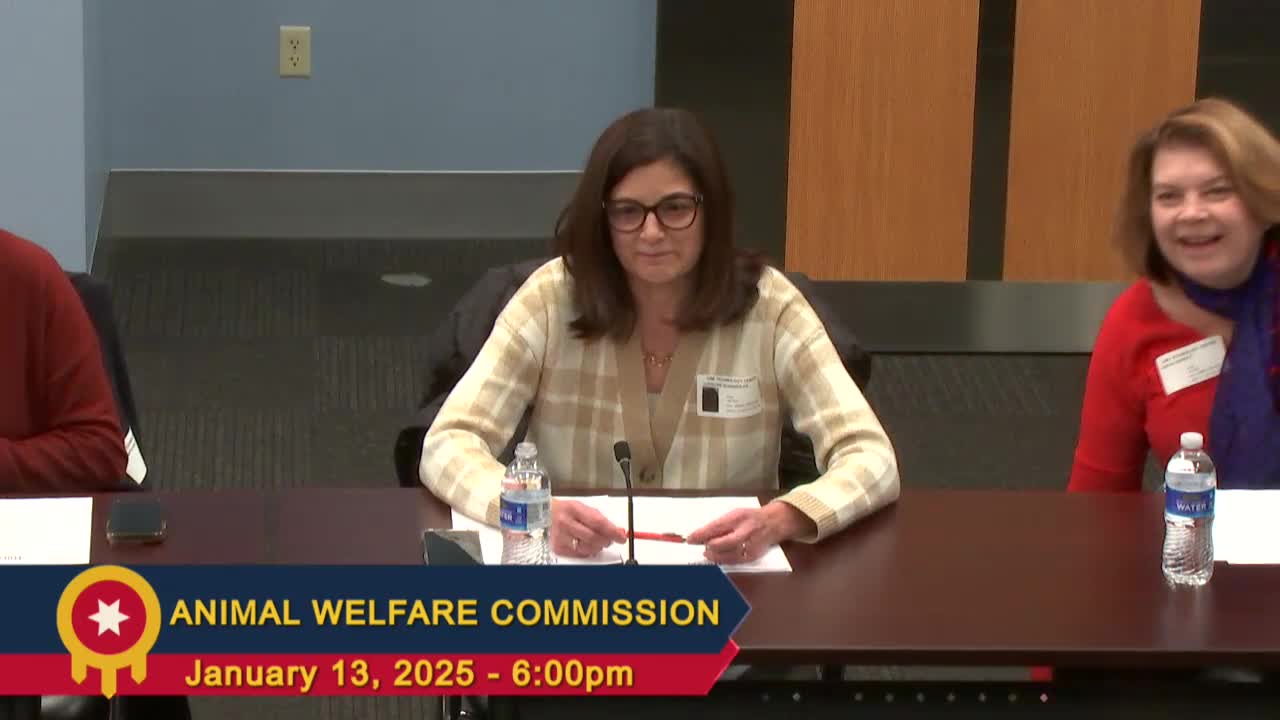
At its Jan. 13 meeting, the Tulsa Animal Commission heard a detailed presentation from Tulsa Animal Services Manager Sherry Carrier on the department's goals for 2025, including monitoring construction of a new shelter, expanding return-to-owner work through field microchipping, strengthening diversion and foster programs, and pursuing new funding and community outreach.
The plan is meant to reduce owner surrenders and stray intakes, improve staff support and training, and make the shelter more sustainable. Carrier told commissioners the department is pursuing policy updates — including confiscation, shelter capacity and euthanasia policies — while seeking funding for spay/neuter and vaccination clinics, rental deposit assistance for tenants with pets, and targeted advertising to boost adoptions and fostering.
Carrier highlighted recent operational successes. “I think she was able to divert, like, 90 animals in 3 months, which is I mean, that's a lot,” Carrier said of the shelter’s new diversion coordinator, and the department plans to invite that coordinator to a future meeting to present more detailed findings. Commissioners were told that the data on top reasons animals are surrendered will be used to direct diversion and support services.
Operations and field work are central to the agenda. Colton Jones, the department’s operational manager, described a new field microchipping approach: “We actually carry them on the truck and we would just be able to do a field impound as a microchip and then RTO that back to the owner.” Under that model, officers would microchip animals on scene, register the chip, and return the animal to the owner without the animal entering shelter intake, a practice the department said could speed re-unifications and reduce shelter load.
Staffing and schedules: Carrier said the department will resume seven-day-a-week animal control coverage starting Feb. 2 and will stagger shifts to align ACOs with school start times at identified problem schools. The department has requested an adoption counselor in this year's budget to provide more pre-adoption counseling and reduce returns; Carrier said that role would help “find the best fit match” between animals and adopters.
Shelter construction and fundraising: Carrier said the new shelter remains under close monitoring and, if construction stays on target, could be finished “potentially, May early May 2026.” Commissioners and attendees discussed fundraising ideas including merchandise and community partnerships; one commissioner asked for cost details for adding an estimated 42 kennels to an area of the new building, and Carrier agreed to share the department’s cost sheet.
Training and staff support: The department plans policy and operational updates, more mental-health and compassion-fatigue training (the department is working with the city’s chief mental health officer and a consultant, Kreos), expanded fear-free training for kennel staff, and monthly recognition and incentives for employees.
Community programs and services: The 2025 agenda includes expanded partnership work with schools (education at identified campuses), increased neighborhood sweeps in stray-heavy areas, a larger pet pantry and efforts to provide pet supplies (leashes, collars, ID tags) and rental-deposit assistance to help keep pets with their families. Carrier said the department is researching proposed fees for voluntary owner surrenders and will report back after comparing practices in other jurisdictions.
Animal health and wildlife: The department has requested funds to contract with a wildlife provider to handle time-consuming calls (raccoon, wildlife-related rabies or distemper concerns), citing a recent incident in which an ACO was bitten. Carrier said that such calls can occupy ACOs for multiple hours and divert resources from other priorities.
Performance targets and metrics: The department set targets for 2025 that include increasing return-to-owner (RTO) rates (a stated goal of adding about 4 percentage points to yield roughly 300 more RTOs), reducing return/adoption failures by about 100 animals annually, and reducing owner surrenders by about 10 percent (roughly 180 animals), with several of the department’s planned programs aimed at reaching those goals.
Next steps and public engagement: The department plans to bring the diversion coordinator's findings to a future commission meeting, share detailed cost estimates for shelter additions, continue coordination with the mayor’s office and city council for funding, and pilot field microchipping and pet-ID/tag distribution as part of RTO and outreach work. Carrier and staff said communications work with the city’s communications office will guide social media and advertising strategy.
Votes at a glance: commissioners approved the meeting minutes from Dec. 9 (motion recorded and announced as passed; the transcript did not include a roll-call tally or the names of the motion’s mover and seconder).