Get Full Government Meeting Transcripts, Videos, & Alerts Forever!
Get email alerts on the Health Records topic
No spam. Unsubscribe anytime.
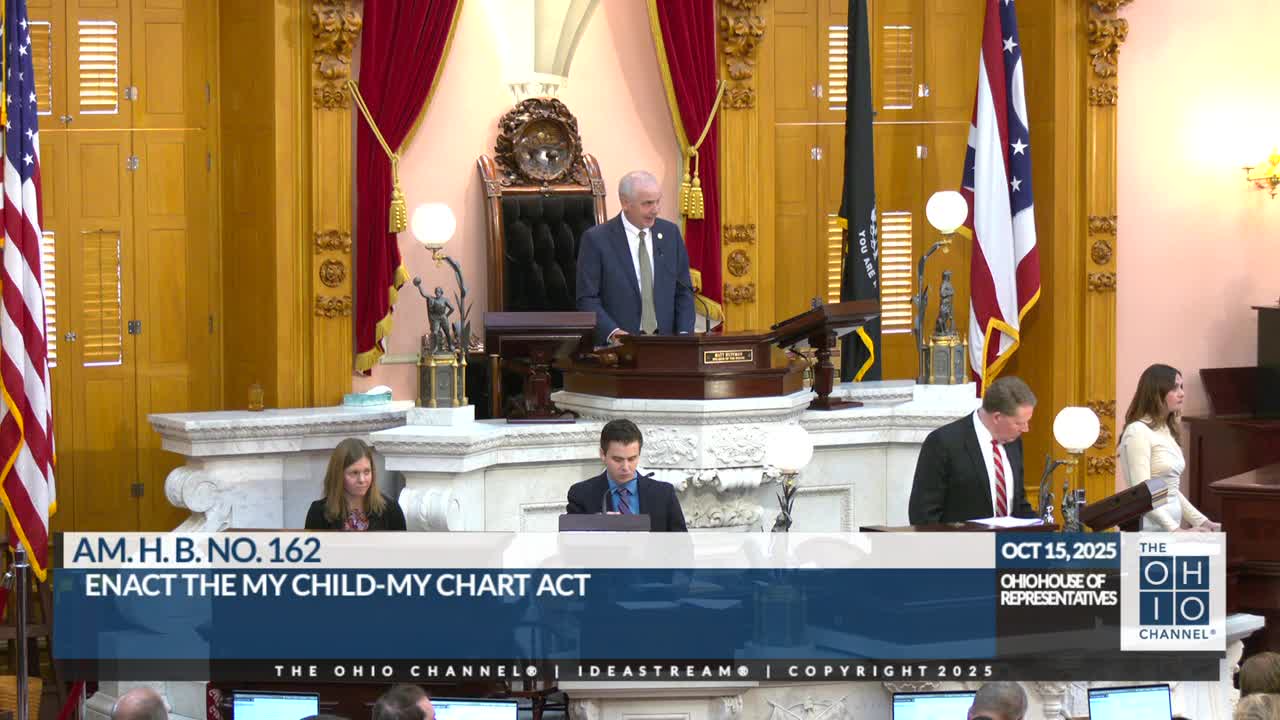
Ohio House passes 'My Child, My Chart' after debate over EMR segmentation and HIPAA compliance
Summary
The Ohio House approved House Bill 162, the 'My Child, My Chart' Act, by a vote of 87-6 after supporters said it restores parental access to many minors' electronic medical records and opponents warned the measure may force providers into costly or impractical electronic medical record segmentation and risk HIPAA conflicts.
The Ohio House of Representatives passed House Bill 162, the "My Child, My Chart" Act, on Oct. 14, 2025, by a vote of 87-6, after lawmakers debated whether the measure's requirements are technically and legally feasible for health systems.
Supporters, led on the House floor by Representative Click, said the bill addresses real-world cases in which parents unexpectedly lost access to children's MyChart records and were unaware of services their children received. "I was turned over to a collection agency because I didn't pay a bill, and I didn't know I had the bill because I didn't have access to my child's MyChart," Click said, describing constituent examples that prompted the legislation.
The bill requires providers who see children on an ongoing basis to annually notify parents about eight types of care that minors may obtain without parental consent and to ensure parents can access records for care to which they have consented. "This bill assures that parents have access to the electronic medical records of care to which they themselves have consented," Representative Baker said in support, adding that the measure is intended to promote parental involvement while preserving minors' access to certain services.
Opponents warned the statute could create implementation problems and unintended privacy or legal risks. "I'm concerned that parts of this bill may unintentionally be asking providers to put themselves in danger of violating HIPAA privacy rules," said Representative Simani, who rose in opposition. Simani said the bill's prior requirement to segment electronic medical records "is not possible with the current electronic medical record or EMR systems," would be costly, and could harm patient care by preventing providers from seeing complete records.
Lawmakers said the final bill removed the explicit technical segmentation requirement and narrowed which providers must comply, exempting clinicians who see children only episodically. The sponsor and several supporters said they plan further conversations in the Senate about implementation details, including reminders to parents and distinctions between custodial and noncustodial access.
The House vote was 87 in favor and 6 opposed; the clerk announced the bill "has received the required constitutional majority" and the measure was passed and entitled. The House also agreed to the bill's title without objection.