Get Full Government Meeting Transcripts, Videos, & Alerts Forever!
Get email alerts on the Rural Ems Funding topic
No spam. Unsubscribe anytime.
House committee advances bill to create long-term grant structure for rural EMS; A2 amendment adopted
Summary
The committee adopted an A2 amendment to House File 337 and laid the bill over as amended; testimony stressed operating deficits in Greater Minnesota ambulance services, workforce shortages and the need for a sustainable funding mechanism.
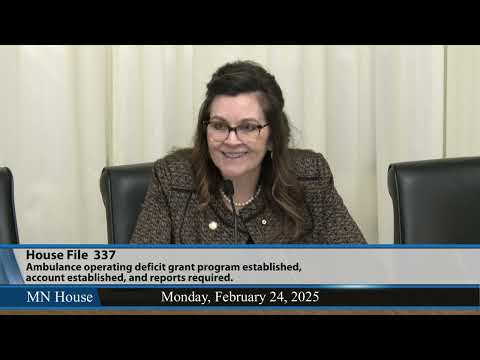
The House committee adopted an A2 amendment to House File 337 and laid the bill over as amended for possible inclusion in the omnibus bill, after hearing testimony that rural ambulance services across Greater Minnesota face persistent operating deficits and staffing shortfalls.
The bill’s author, Representative Zalesnikar, told the committee the proposal would create a new coding method and a pathway to identify ambulance services with operating deficits, require audited financials for those providers and establish a grant program to direct funds where data show they are needed.
"As we go forward, we are clear that Greater Minnesota is having an operating deficit," Representative Zalesnikar said. She told members the bill would make larger population centers — the seven-county metro, Duluth, Mankato, Rochester and St. Cloud — ineligible for grants under the program as drafted, and that the proposal remains under development.
In testimony supporting the bill, Eric Simonson, representing the Coalition of Greater Minnesota Cities, said the measure "picks up where last session's one-time aid bill left off" and that it would create a clean formula to distribute grant dollars and allow the Office of Emergency Medical Services to audit grant applications. Simonson said data from the 2023 reporting period showed nonmetro services registered deficits totaling more than $30,000,000 when calculated using the bill’s formula.
Mike Warner, Fire Chief for the City of Red Wing Fire Department, described a local funding gap driven by a payer mix dominated by government reimbursements. "Our payer mix for Red Wing is 72% government funded," Warner said. He said the city responded to 3,818 ambulance calls in 2024 and that government reimbursement typically covers only about a quarter of the actual cost, requiring subsidies from local taxpayers.
Tim Meyer, senior director for Sanford Ambulance, said low-volume services are particularly at risk as volunteer staffing declines and agencies are forced to pay staff to maintain 24/7 coverage. "Without financial support like this bill provides, the long term viability of many services is in jeopardy," Meyer said.
Nathan Zacharias, technology policy analyst for the Association of Minnesota Counties, and Kevin Lee, EMS relationship specialist for North Memorial Health, also testified in support, citing rising operating costs, staffing shortages and stagnant Medicare and Medicaid reimbursement rates.
During committee questions, Representative Purcell raised concerns about eligibility for communities that straddle metro boundaries (for example, cities divided between metro and nonmetro counties). Eric Simonson answered that, as drafted, the bill treats primary service areas as eligible if the PSA is mostly outside the seven-county metro. Representative Hewitt pressed on local control, citing mayors' and city councils' desire to retain control over purse strings; Chief Warner confirmed the City of Red Wing owns its PSA and local officials hold municipal leaders accountable for service outcomes.
Representative Reyer asked whether the bill would address revenue recapture as part of replacing current funding mechanisms; Representative Zalesnikar said the bill is in an early stage and that all options remain under consideration, including revisiting funding sources.
Procedural actions in the hearing included the author offering and moving the A2 amendment, specifically to divide the amendment after line 1.19 and adopt lines 1.2 to 1.19; the committee chair announced the motion prevailed and those lines of the A2 amendment were adopted. The committee then laid House File 337 over as amended for possible inclusion in the omnibus bill.
The hearing left key policy questions unresolved: the bill as amended does not yet identify a revenue source, and several members urged further work on local control, statewide eligibility boundaries and how to replace or supplement existing mechanisms such as revenue recapture. The author and several testifiers said they would continue discussions to develop a sustainable, long-term funding approach for ambulance services statewide.