Get Full Government Meeting Transcripts, Videos, & Alerts Forever!
Get email alerts on the Land Use Development topic
No spam. Unsubscribe anytime.
Encinitas council approves revised Piraeus Point plan, removes two prior conditions
Summary
After public comment about habitat, traffic and rooftop lighting, the City Council approved changes to the previously permitted Piraeus Point condominium project that reduce unit count and expand open-space preserves and removed two earlier conditions tied to the project.
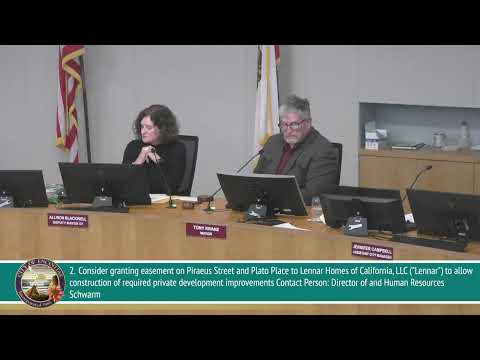
The Encinitas City Council on Dec. 4 voted to approve revisions to the previously permitted Piraeus Point condominium project, including a reduction from 149 to 134 townhome units, and to remove two earlier conditions of approval.
The revised plan reduces the development footprint by about 0.59 acres, lowers the number of buildings from 15 to 14, increases preserved open space from 5.51 acres to 6.41 acres (on- and off-site combined), and retains 14 deed-restricted affordable units. Esteban Danna, project planner, told the council the proposal "reduces 0.89 acres of impact to Diegan coastal sage scrub" and reduces impacts to Southern mixed chaparral while slightly increasing coastal sage scrub impacts; the revisions also change retaining-wall heights in some locations.
The project revisions arise from a settlement agreement between the applicant, the city and the Endangered Habitats League. Danna said staff prepared an addendum to the previously certified final environmental impact report under CEQA Guidelines section 15164, concluding the changes do not trigger a subsequent EIR under CEQA Guidelines section 15162.
Why it matters: The project sits adjacent to Interstate 5 south of La Costa Avenue and has drawn repeated public concern about impacts to sensitive habitat, visual character, traffic flows in the nearby neighborhood and fire safety in an area the city identifies as very high fire hazard severity.
Council discussion and public comment: Dozens of residents urged the council to delay the vote, raised concerns about the adequacy of public notice and about loss of habitat and visual impacts; speakers also criticized rooftop decks and added nighttime lighting, and urged stronger fire-safety conditions. One commenter, Donna Westbrook, asked the council not to approve the item that night and to give residents more time to review settlement materials.
Council members and staff discussed an incentive request tied to the SCOOP opportunistic beach‑fill program. Council members asked whether project-generated sand could feasibly be tested and moved to local beaches rather than to a landfill; city staff estimated testing and permitting costs in the range of $200,000–$300,000 and hauling and landfill alternatives could be on the order of $1.2 million depending on disposition, distance and truck counts. Marco Gonzalez, counsel for Lennar, estimated additional testing and agency coordination "about $200,000 to $300,000" and said Lennar could balance sand between its projects in the region to avoid landfill disposal.
Formal action: The council adopted the staff recommendation to approve the revised project and removed conditions labeled SCB21 and SCC5 from the prior approval. The motion carried unanimously with Council Member Ehlers absent.
Background and next steps: Earlier approvals for the Piraeus Point project included certification of a final EIR, adoption of findings of fact, a mitigation monitoring and reporting program, and a statement of overriding considerations. The council resolution approving the revisions includes conditions requiring corrections to the fire-protection plan and landscape plan before issuance of grading or building permits and requires a homeowners association before occupancy to ensure ongoing fire-safety maintenance.
Council members directed staff and noted interest in continuing to evaluate opportunities to bring SCOOP‑eligible sand to local beaches and to work with the applicant during construction plans to explore feasibility. If construction permits are issued, subsequent ministerial approvals and plan-check steps will follow the conditions in the resolution.