Get Full Government Meeting Transcripts, Videos, & Alerts Forever!
Get email alerts on the Community Warning System topic
No spam. Unsubscribe anytime.
Board approves committee assignments but will reassess community warning system after public concern
Summary
The Contra Costa County Board of Supervisors approved annual committee assignments and minor corrections, and agreed to revisit oversight of the county’s community warning system after public comment and supervisor discussion.
The Contra Costa County Board of Supervisors approved annual committee appointments and minor corrections to prior appointees, and the board agreed to revisit where oversight of the county’s community warning system should sit after public comment and supervisor discussion.
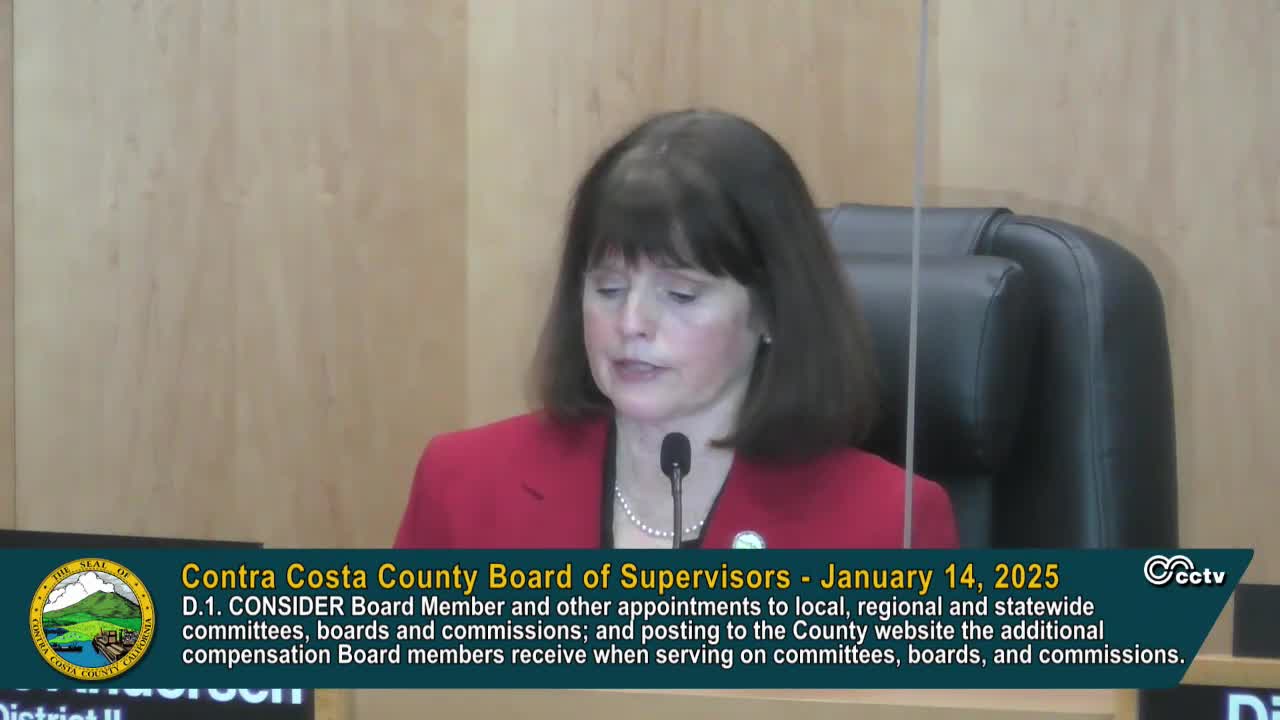
At the start of the business portion the board passed its consent calendar (items C1–C109) unanimously and then turned to board appointments. Chair Candace Anderson said she placed herself on the Industrial Safety Ordinance (ISO) and community warning system committee because she wants to focus on warning-system improvements countywide. She said she hoped the new District 5 supervisor, Chanel Scales Preston, would later be involved because many refineries are in Scales Preston’s district.
Several members of the public urged that District 5 be explicitly represented on the ISO committee because, they said, most refinery-related incidents and warnings affect communities in Martinez, Richmond and other districts that adjoin refinery sites. Gigi Crowder, CEO of NAMI Contra Costa, told the board that lived experience for communities near refineries makes District 5 representation “important” for responding to refinery incidents and safety concerns. Heidi Taylor of Healthy Martinez said Martinez residents had experienced an unexplained white dust event in November 2022 and urged supervisors to ensure refinery-neighboring districts are included in ISO and warning-system work.
Supervisor John Gioia proposed a joint referral so both the Industrial Safety Ordinance committee and Public Protection could work on the community warning system. Gioia argued that most warning-system notifications historically have come from refinery-adjacent areas and that those communities need a direct voice. Chair Anderson said she prefers a single committee to avoid conflicting recommendations and proposed keeping assignments as made now but bringing a board-level discussion back on the community warning system; the board agreed to schedule that discussion.
Adjustments the board adopted during the appointments discussion included making Tanya Polito the alternate for the North Richmond mitigation-fee committee, clarifying Urban Counties Caucus representation (Diane Burgess listed as primary Urban Counties representative, Anderson as alternate) and correcting the Contra Costa Law Library appointee to Joshua Klein, a change dating to November.
County administrator staff noted a separate, earlier change to the auditor-controller recruitment language in the staff report to require candidate validation of minimum qualifications prior to recruitment; that administrative update was discussed as part of the consent calendar process.
Votes at a glance - Consent calendar (C1–C109): motion to approve moved by Diane Burgess; passed unanimously (5–0). - Board committee appointments (D1) with adjustments (North Richmond mitigation-fee alternate, Urban Counties Caucus roles, Contra Costa Law Library appointee corrected to Joshua Klein): motion moved by Chair Candace Anderson; passed unanimously (5–0).
Why it matters: the community warning system and the Industrial Safety Ordinance affect how the county notifies residents about hazardous releases and how local governments and industry implement safety measures. Public commenters asked the board to ensure direct representation from refinery-impacted communities; supervisors agreed to bring the issue back to the full board for a dedicated discussion.
Ending: The board approved appointments as proposed with the noted corrections and will return with a staff briefing and a full-board discussion about whether the community warning system should be assigned to a single committee or remain a joint referral.