Get Full Government Meeting Transcripts, Videos, & Alerts Forever!
Get email alerts on the Administrative Citations topic
No spam. Unsubscribe anytime.
St. Paul public hearing draws long line of renters, workers calling for charter change to allow civil administrative citations
Summary
City Council opened a public hearing on a charter amendment to allow civil administrative citations to enforce municipal ordinances; speakers — renters, labor groups and small-business owners — urged the change and council members laid the proposal over for final action on Jan. 22.
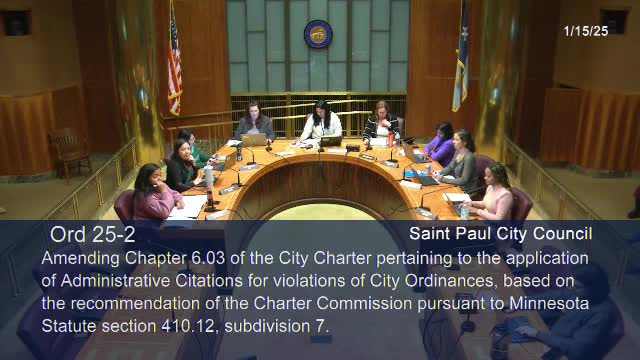
The St. Paul City Council opened a public hearing on Jan. 15 on ordinance 25-2, a proposed charter amendment to allow the city to use civil administrative citations to enforce local ordinances such as minimum wage, earned sick and safe time and wage-theft rules.
Supporters told the council they want a faster, noncriminal enforcement tool that would recover wages and compel property owners and employers to comply with city rules. Council President Jalali said the charter change would correct an oversight in the charter and that any uses of the new authority would require subsequent, ordinance-specific public processes.
Advocates described the change as a practical enforcement tool. "It's time that we put teeth into these ordinances that we have passed together to ensure a faster resolution to the health, welfare, and safety of every Saint Paul worker, renter, and resident," said Arlene Dachoo, an Isaiah leader from Ward 2. Unite Here Local 17, labor unions, tenant organizers and neighborhood groups also testified in favor of civil penalties as an alternative to criminal enforcement.
Council President Jalali told the room the charter amendment would not immediately permit fines; it would only allow the council to adopt specific civil-penalty ordinances later with requirements such as notice, appeal rights and equity considerations. "This is a charter change because what we're trying to do is correct an oversight in language that was written in 1854," Jalali said, describing the change as necessary to give the city a tool to hold large, out-of-state landlords and employers accountable.
Council members and public speakers repeatedly urged built-in equity safeguards. Several neighborhood associations and community speakers asked for an ability-to-pay review and a fund or other off-ramps for residents who cannot afford fines. Council Member Yang said she favors letting voters decide on major changes and asked that the council consider whether the question should go to the ballot; others pressed forward with the charter amendment pathway while promising robust equity protections to be written into implementing ordinances.
Action: The council closed the public hearing and laid the ordinance over to Jan. 22 for final adoption. The hearing closure and layover were approved by the council during the Jan. 15 session.