Get Full Government Meeting Transcripts, Videos, & Alerts Forever!
Get email alerts on the Land Use Zoning topic
No spam. Unsubscribe anytime.
Howard County public hearing draws hundreds as residents press council to restrict W.R. Grace plastics research near homes
Summary
Howard County Council held a legislative public hearing Feb. 18 on CB 11-2025 (ZRA 2-11), drawing hundreds of residents who urged the council to restrict research-and-development uses such as a proposed W.R. Grace plastic recycling pilot near homes in Cedar Creek and nearby neighborhoods.
Howard County Council held a legislative public hearing Feb. 18 on CB 11-2025 (ZRA 2-11), a zoning regulation amendment proposed by Councilmember Deb Young that would limit certain research-and-development operations in Planned Employment Center (PEC) districts where they abut homes. The session drew large numbers of residents from Cedar Creek, River Hill and nearby neighborhoods; many testified in favor of the amendment and against a proposed W.R. Grace plastic recycling pilot facility adjacent to new housing in Columbia.
The measure was introduced Feb. 3; the council scheduled a final legislative session for March 3 at 7 p.m. in the Banneker Room for consideration of legislation that received public testimony. The hearing on Feb. 18 opened with an announcement that roughly 148 people had signed up to speak and that testimony slots would run until 11 p.m., with a continuation scheduled for Feb. 19 if needed.
Why it matters: Testimony focused on public health, land-use separation and trust in the permitting process. Residents said the proposed pilot — described in regulatory filings as an R&D process that opponents and some regulators say meets the definition of an incinerator or pyrolysis unit — would operate close to homes and schools and could release volatile organic compounds, dioxins and other hazardous air pollutants. Supporters of the ZRA argued the amendment would protect families and preserve the county’s residential character; opponents and a company representative said the technology could advance recycling of plastics.
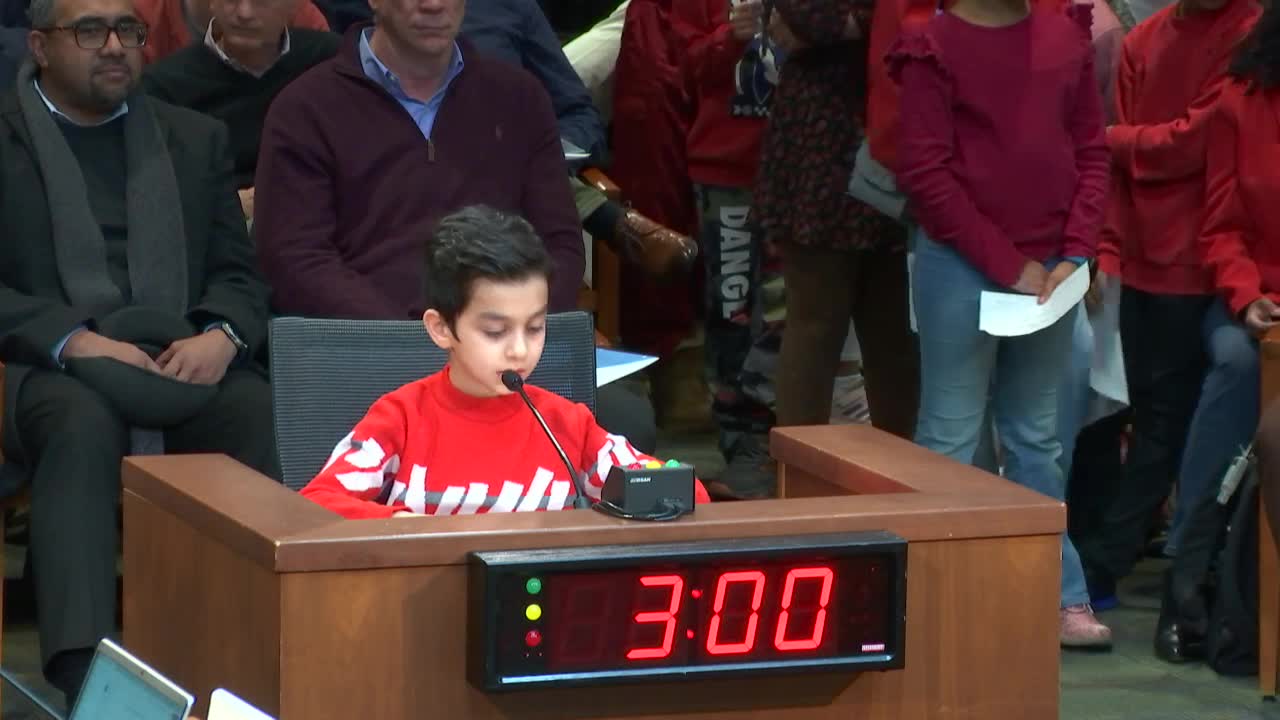
Most speakers were Cedar Creek residents who described children and seniors in the area and asked the council to adopt a rule that would prevent the pilot from operating next to neighborhoods. “Home is more than just a place to live. It's where we rest after a long day, feel safe, and be with the people we love,” said Mbasher, a Cedar Creek resident who testified early in the hearing and added, “I urge you to pass CB 11 20 25.” Several youths and parents described worry about respiratory disease, cancer risks and the psychological effects of living next to an industrial pilot plant.
Medical and scientific witnesses pressed the council on health effects. Dr. Zan Kazi, a physician and parent residing in Cedar Creek, testified in support of CB 11-2025 and said the neighborhood’s children face “direct danger” if a fire, explosion or toxic leak occurred. Pediatrician Padmaswami told the council that pollutants such as VOCs and PFAS “irritate the lungs of growing children and increase their risk of asthma.” Sarah Morell, who said her home is about 70 meters from the proposed project, told the council the permit describes a “16 hour per day operation, 5 days a week for years to come” and characterized the process as “an incineration process as labeled by the MDE and the EPA, which Grace refuses to admit.”
Residents also raised trust and outreach concerns. Multiple speakers said they were not informed directly by W.R. Grace about the proposal and instead learned from neighbors and local online groups. Several witnesses cited Grace’s past litigation and cleanup settlements in other jurisdictions as reasons to restrict industrial experiments near homes.
Company and business perspectives: A representative who identified herself as a Grace employee, Renee Paris, said she supports the effort to develop new recycling technologies and called the proposed process a potential “paradigm changing technology” that could reduce plastic in landfills. “I enthusiastically support this project and ask you to vote no on the resolution to not stand in way of valuable innovation that can make our world better for our children,” Paris said. Her remarks were echoed by a smaller number of speakers who emphasized economic or technological benefits and urged regulators to rely on existing permitting rules.
Government voices: State Delegate Opal Jones (District 9A) said the bill “creates a vehicle or avenue to look at this issue” and urged the council to consider wider implications before acting. The county’s Planning Board had recommended the ZRA (the Planning Board vote was referenced during testimony), and speakers cited that recommendation when urging council approval.
What the ZRA would do and next steps: CB 11-2025 (ZRA 2‑11) would restrict certain R&D laboratory uses in PEC zoning where such operations would be sited next to residential districts. No final council vote occurred during the Feb. 18 hearing; the council recorded the testimony for consideration and set the final legislative session for March 3, when members may vote on the ZRA or amendments. During the Feb. 18 session speakers on both sides said they expected additional public comment and possible follow-up hearings.
Discussion vs. formal action: The Feb. 18 event was a legislative public hearing to receive testimony. There was no motion or final vote recorded on the ZRA during the hearing. The council noted the process timeline and forthcoming budget/pay-plan steps tied to other administrative reorganization bills on the agenda.
Community context and turnout: The hearing included a large number of youth speakers, several medical professionals, homeowners’ association members and civic leaders. Speakers repeatedly cited Cedar Creek, River Hill and Robinson Overlook as neighborhoods directly affected. Several witnesses urged the council to require larger buffer distances or to direct additional state-level scrutiny of permits for pyrolysis or incineration-like processes.
The council will consider the public record along with planning staff reports and the Planning Board recommendation before acting at the March 3 legislative session.