Get Full Government Meeting Transcripts, Videos, & Alerts Forever!
Get email alerts on the Election Enforcement topic
No spam. Unsubscribe anytime.
House committee approves substitute to let Ethics Commission seek out-of-state evidence in election probes
Summary
The House Governmental Affairs Committee voted to approve a substitute for House Bill 414 to allow the Georgia Ethics Commission to perfect requests for out-of-state evidence and designate Fulton County as venue for enforcement actions, sponsors said.
The House Governmental Affairs Committee approved a substitute for House Bill 414, a measure sponsors said would let the Georgia Ethics Commission obtain evidence held by out-of-state vendors in election-related investigations and, when needed, perfect those requests through Georgia courts.
Representative Todd Jones, who presented the substitute, said the bill is meant “to ensure that there is a level playing field” for participants in Georgia elections. Jones told the committee that current subpoenas by the Georgia Ethics Commission “end at the state line,” and the substitute would define nonresidents and give the commission a process to obtain necessary evidence when vendors or consultants are located outside Georgia.
The substitute incorporates the state’s long-arm concept for nonresidents and outlines a two-step process in which the commission seeks records and, if a nonresident does not comply, the commission may ask a Georgia superior court to find the requested material “pertinent or necessary to further the investigation or enforcement action authorized by this chapter,” Jones said. He said the bill also designates Fulton County as the venue for any perfected action.
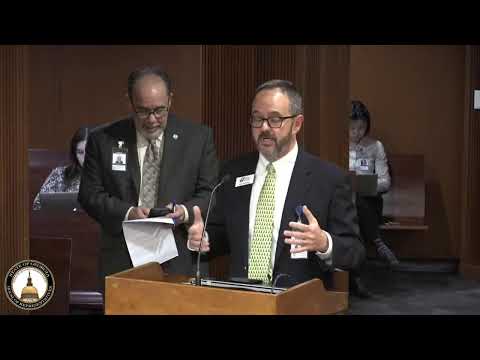
David Amati, executive director of the Georgia Ethics Commission, joined Jones at the table and answered technical questions from committee members. Amati emphasized that the substitute does not expand the commission’s substantive authority to investigate or prosecute violations; rather, he said, “What we're doing here is giving them the ability to perfect the ability to get the information they need.” He added that the court step preserves due process and is not intended to permit fishing expeditions.
Committee members asked how the substitute would apply to out-of-state consultants. Representative Adesanya asked whether a consultant based in another state who worked on a Georgia election would be covered. Jones and Amati replied that Georgia’s election laws do not require mens rea — a person can violate the law even if unaware — and that the bill’s purpose is to allow the commission to obtain evidence held out of state, not necessarily to assert that an out-of-state consultant is automatically the target of a violation. Jones summarized: such vendors are often “a source of evidence.”
Representative Bernal asked about court backlogs and whether requests would require immediate resolution in an election. Jones said timing would depend on the circumstances; in a mid-election investigation, the commission could request an expedited hearing, but there is no automatic shortcut for every case. Committee counsel and staff discussed why the substitute references Georgia’s long-arm framework to clarify when a person is a nonresident for the statute’s purposes.
After questions, a member moved and the committee recorded a voice vote. The motion carried and the substitute was forwarded, with committee leadership instructing that a signed copy be delivered to the rules office.
The committee did not adopt new substantive investigatory powers in the substitute, according to Jones and Amati; instead, it adds a procedural mechanism to facilitate access to evidence when that evidence is controlled by vendors or consultants physically located outside Georgia.