Get Full Government Meeting Transcripts, Videos, & Alerts Forever!
Get email alerts on the Active Transportation topic
No spam. Unsubscribe anytime.
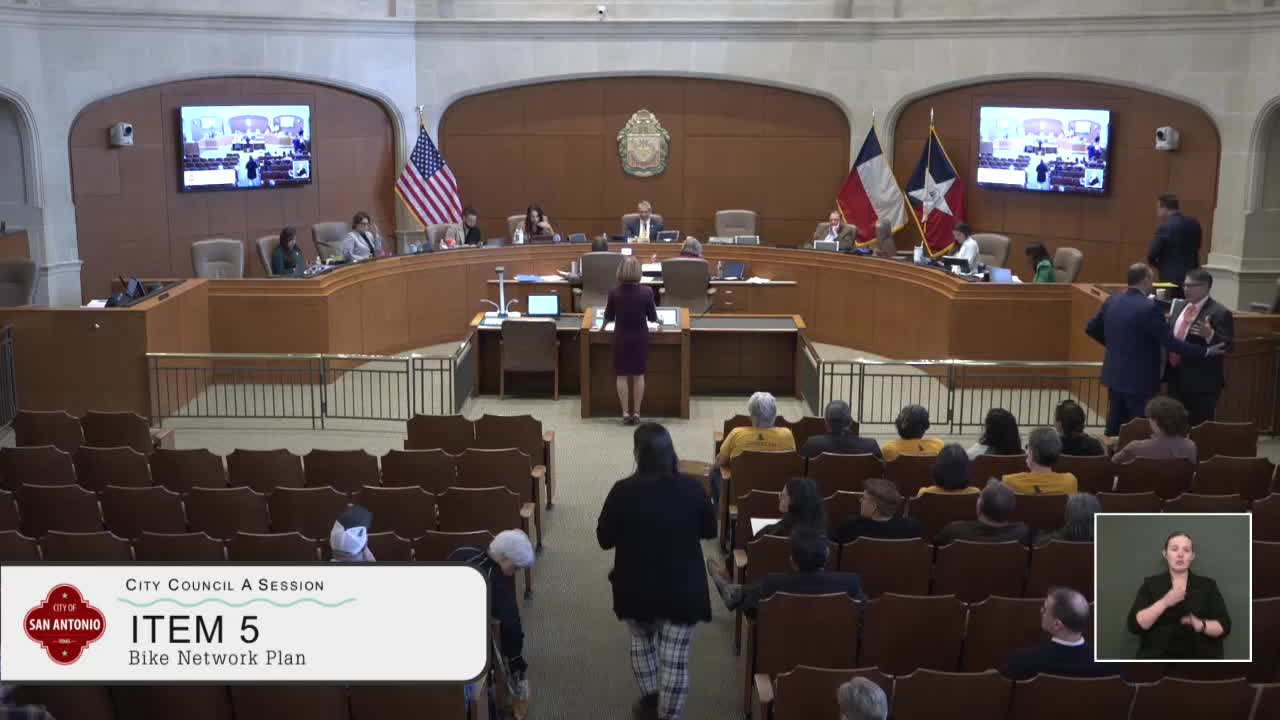
San Antonio council adopts 25-year Bicycle Network Plan amid calls for swift implementation
Summary
The City Council adopted a 25-year Bicycle Network Plan to build a 600-mile network of bikeways and pedestrian connections; councilmembers and advocates urged faster rollout and a standing advisory body to oversee implementation.
The San Antonio City Council on Jan. 30 adopted a 25-year Bicycle Network Plan intended to create a connected network of roughly 600 miles of bikeways and pedestrian links across the city.
The plan, presented by city transportation staff, proposes a three-phase approach: community engagement (completed 2023), network design and prioritization, and implementation with performance measures and funding strategies. Staff said outreach produced about 3,600 survey responses and input from community groups, schools and bicycle advocates.
Why it matters: City officials and advocates said the plan will expand safe travel options for households without cars, improve public-health outcomes and reduce vehicle emissions. Councilmembers urged the city to move rapidly from plan adoption to on-the-ground projects and to secure federal and other funding to pay for both construction and long-term maintenance.
City transportation staff described design standards tied to street context, including buffered and protected bikeways, intersection treatments and ADA-compliant connections. The plan prioritizes routes that connect residents with schools, jobs, transit and commercial areas and envisions phased implementation that could take decades without outside funding.
Advocates and residents who testified described near-misses, injuries and fatalities involving cyclists and pedestrians, and pushed for protected lanes, clearer maintenance responsibilities and daily debris removal. Speakers included cycling advocacy groups, transit organizations, senior-advocacy groups and residents who said bicycling is their primary means of travel.
Council debate focused on safety and on how projects will be selected, funded and communicated to neighborhoods. Councilmember [last-name used in transcript] Peláez offered an amendment to require, rather than merely “explore,” creation of a standing advisory committee to guide implementation; the council approved that change before voting on the plan.
Vote: Council approved the Bicycle Network Plan. The final vote included one recorded abstention (Councilmember White). Councilmembers who spoke in favor cited equity and safety; some also warned that detailed project-level outreach, funding and maintenance plans must follow adoption for riders to benefit.
Implementation and funding: Council members and staff said the city will pursue federal grants and other external funding; staff noted existing limited local funds and cautioned that buildout without grant support could take decades. Councilmembers asked staff to return with clearer, project-level timelines and public engagement plans for each corridor.
The council’s action establishes planning-level guidance and policy direction; council and staff will oversee the next steps that convert the plan’s prioritized corridors into funded design and construction projects.