Get Full Government Meeting Transcripts, Videos, & Alerts Forever!
Get email alerts on the Goal Setting topic
No spam. Unsubscribe anytime.
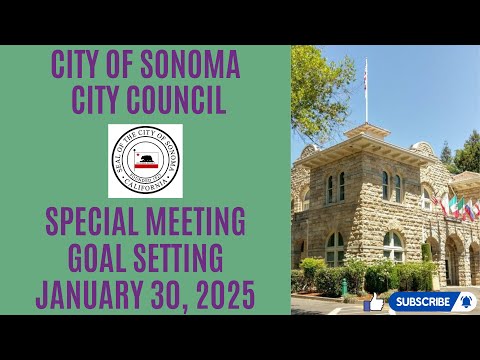
Sonoma council holds goal-setting retreat; housing, plaza, climate, finance and valley ties rise to top
Summary
At a full-day retreat, the Sonoma City Council and staff worked to translate public input and council interviews into draft priority “buckets” for 2025, emphasizing housing, parks/plaza revitalization and parks-and-rec services, climate and green infrastructure, financial stability and regional cooperation with Sonoma Valley communities.
The Sonoma City Council spent a daylong retreat reviewing 2024 work and shaping draft priorities for 2025, focusing council and staff attention on housing, economic development and financial stability, a parks-and-recreation/plaza revitalization effort, climate mitigation and adaptation, and increased coordination with neighboring unincorporated parts of Sonoma Valley.
City Manager David and facilitator Jen Kavanaugh framed the session as working-level planning rather than final decisions. “This is not a win and done. This is really the first part of this conversation,” facilitator Jen Kavanaugh told the council at the start of the session. Kavanaugh led council members through a public comment period, a review of 2024 accomplishments, and small-group exercises to convert priorities into possible measurable actions.
The retreat was billed as a working session to feed the March budget and to guide staff’s implementation work. City Manager David told the group that staff would use the council’s direction to refine work programs and budgets: “On the housing front, we did not solve housing last year,” he said, adding that staff had focused the past year on capacity building — hiring planners and a new building official — and streamlining processes to prepare for larger projects and the housing element implementation required by state law.
Why it matters
Council members said the exercise is intended to produce a short list of 3–6 prioritized goals that staff can translate into work programs and budget requests. Council and community speakers repeatedly framed housing and workforce housing as the top ongoing problem shaping Sonoma’s future, and many speakers tied other priorities — the downtown plaza, parks and active-transportation corridors, and climate resilience — to the city’s ability to retain workers, seniors and families.
Public input and recurring themes
More than a dozen community organizations and residents addressed the council during the public comment period. Service providers urged continued funding for homelessness response and food programs: Madeline Agramonte, speaking for Sonoma Overnight Support and the Unity Kitchen, said, “23% of the people that we feed are from HAS, and that equals to a hundred and $9,250.” Speakers from Sonoma Splash urged city support to sustain the community pool and its scholarships: “Since inception in October 2022, we have sold over 25,000 passes,” Sonoma Splash board representative Jane Hanson said, outlining scholarship and youth programs reliant on public funding and partnerships.
Local nonprofit and commission leaders pressed the council for more concrete, measurable approaches. Climate Action Commission and Parks and Recreation Commission members emphasized integrating “green and blue” infrastructure — trails, stormwater management and tree plantings — into the general plan and future public projects. Climate Action Commissioner David Morrell described a joint effort with the Chamber of Commerce to align business and environmental goals, including EV charging and bus/shuttle plans.
Council discussion and draft priority buckets
After public comment and staff presentations, council members and the facilitator worked to convert community input into draft buckets staff could act on in 2025. The council coalesced around five interrelated priority areas for staff to further define: - Housing and affordability: continue housing element implementation, explore funding and incentives for workforce housing, and develop clearer targets or milestones for housing production and the Affordable Housing Trust Fund. The council asked staff to return with options for trust-fund policy and revenue strategies. - Economic development and finance stability: pursue a business-attraction strategy, address empty storefronts and rebuild a more diversified revenue base; consider an expert blue‑ribbon audit or advisory group to examine long‑term fiscal options. - Parks, recreation and plaza revitalization: plan for a parks-and-recreation organizational model and a plaza master plan. Council members requested near‑term maintenance work on the plaza and a process to develop a conceptual master plan that can be implemented incrementally and aligned with the general plan. - Climate mitigation, adaptation and green infrastructure: further develop the Climate Action Commission’s proposals, assess staffing or consultant support to coordinate citywide climate work, and fold fire resilience and tree-canopy planning into both short‑term maintenance and longer‑term design work. - Sonoma Valley coordination (unification/annexation and shared services): direct staff to pursue structured coordination with county leadership and new county supervisors on shared-service approaches, and to scope realistic first steps (data, service agreements, or targeted annexations) rather than immediate full annexation.
No formal votes were taken at the retreat; the council planned to ask staff to return with refined goal language and budget implications ahead of the March budget update so council can finalize priorities.
Details staff will return with
Council members asked staff to return with concrete next steps and cost estimates. Specific directions mentioned during the retreat included a request for: a funding plan and policy options for the Affordable Housing Trust Fund; a parks-and-recreation organizational analysis tied to Measure T spending; a scoped RFP and community process for a plaza conceptual/master plan that can be implemented in phases; and an assessment of whether staffing (a coordinator) or consultant support is needed to advance the city’s climate, resilience and green‑links goals.
What’s next
City staff said they would take the council’s draft buckets and public input and produce a refined set of priorities and suggested work programs for review during the March budget update. The council emphasized this retreat was the start of a year-long conversation and asked staff to keep the public informed about where ideas land in the budget and general plan processes.
Community reaction
Speakers at the meeting urged urgency and specificity. Architect Victor Conforti and former mayor Larry Barnett urged measurable targets for the housing trust fund and suggested specific funding tools. Multiple community groups — including Sonoma Splash, Sonoma Valley Collaborative and homelessness-response partners — asked for clearer city support and near-term decisions about program funding and implementation.
Ending
The retreat ended with council members affirming the five draft priority areas and directing staff to return with costed options and policy language for council review. Facilitator Jen Kavanaugh closed the working session by reminding the council and the public that the retreat was a step in an iterative process: "This is not a win and done. This is really the first part of this conversation."