Get Full Government Meeting Transcripts, Videos, & Alerts Forever!
Get email alerts on the Educational Accountability topic
No spam. Unsubscribe anytime.
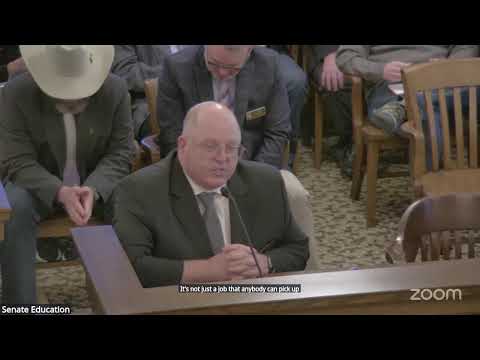
Senate Education Committee hears testimony on proposed Educational Bankruptcy Act; committee to revisit bill after public comment
Summary
Senate File 173, a proposal to create an "educational bankruptcy" process for chronically underperforming districts, drew extensive public testimony. Witnesses urged caution and noted existing accountability statutes and support structures; the committee kept the bill on the agenda for further consideration and public testimony.
Senate File 173, introduced by Senator Scott on Feb. 3, would create a statutory mechanism by which the state could intervene in chronically underperforming school districts through a court-ordered "educational bankruptcy" and trustee model. The committee heard testimony from the Wyoming School Boards Association, district superintendents, teachers and parents before deciding to continue consideration and take further public input.
What the bill proposes Senator Scott told the committee the measure targets the very worst-performing districts and is modeled in part on bankruptcy procedures. The draft sets thresholds for eligibility (for example, a stated threshold such as 60% or more of grade 3 students scoring basic or below on the English language arts portion of the state assessment, and specified thresholds for grade 8 and grade 10 results). If the state superintendent determines a district meets criteria and that bankruptcy would be beneficial, the department could petition the district court to appoint a trustee, terminate the local superintendent and place the district under trustee oversight for a period while reforms are implemented.
Public testimony and main critiques Bridal (Brad) Farmer, Executive Director of the Wyoming School Boards Association, recommended against the approach in the current draft and urged the committee to consider the Wyoming Accountability and Education Act (the state's current accountability framework) and the statewide system of supports before pursuing a punitive takeover model. Farmer cited national research that shows state takeovers do not reliably improve academic outcomes.
Multiple educators and local leaders echoed caution. Mark Christensen (Campbell County trustee) and Chase Christiansen (superintendent, Sheridan County School District No. 3) emphasized local solutions: small class sizes, community involvement, adequate staffing and funding, and local continuity. Kim Eamon, president of the Wyoming Education Association and a veteran teacher, warned of student harm from overreliance on a single test and urged emphasis on growth measures and supports rather than punitive sanctions.
Supporters' framing Senator Scott said the proposal is aimed at districts that have consistently and severely underperformed and that, in his view, some form of radical change will be necessary for those rare cases. He suggested the bill includes cultural exceptions for reservation districts and that the measure should be on the legislative agenda for future refinement.
Committee action and next steps After testimony — which included teachers, district leaders, parents and association executives — the committee closed public testimony and agreed to continue consideration, with members indicating the bill would be revisited Wednesday to allow additional input and deliberation. No formal vote to advance the bill occurred on Feb. 3.
Ending Committee members requested additional expert input and further analysis of existing accountability provisions and state supports before considering the Educational Bankruptcy Act for advancement.