Get Full Government Meeting Transcripts, Videos, & Alerts Forever!
Get email alerts on the School Finance topic
No spam. Unsubscribe anytime.
Senate Education Committee passes amendment shifting school capital construction to local communities with mandatory state equalization
Summary
The Wyoming Senate Education Committee amended and approved Senate Joint Resolution 6 to return school capital construction financing to local communities while including mandatory state equalization; supporters said the change restores local control, opponents warned it could create inequities and raise taxes.
The Wyoming Senate Education Committee on Feb. 3 passed Senate Joint Resolution 6, a proposed constitutional amendment that would return primary responsibility for school capital construction financing to local communities while providing mandatory state equalization.
Senate Joint Resolution 6, introduced and explained in the committee by Senator Scott, would overturn parts of the Campbell-era court guidance on state responsibility for school capital construction and revive a bond-based system with a mandatory equalization feature. "The bill is School Capital Construction Constitutional Amendment," Senator Scott said when outlining the measure to the committee.
Why it matters: Backers said the existing framework has become unsustainable after the loss of historic federal coal lease bonus revenues used for capital projects. Senator Scott argued the state must restore a local financing mechanism while ensuring equalization so districts without local wealth are not left behind. Opponents — including school board and district officials — said the change risks creating two classes of taxpayers and could shift substantial costs to local voters.
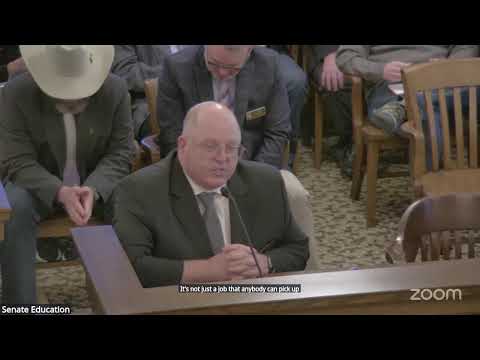
Committee testimony and concerns Ken DeCarriere of the Wyoming School Boards Association testified in opposition. DeCarriere told the committee that the Campbell decisions required capital construction to be based on statewide wealth, and he warned the proposed change would create inequities among taxpayers and between districts that previously received state-funded projects and those that had waited.
Jeremy Smith, business manager for Sheridan County School District No. 1, said Wyoming has long-standing advisory bodies (State Construction Department, School Facilities Commission, Select Committee on School Facilities) and argued the state has not followed their long-term guidance. "We don't need this, we just need to actually do the good work that's been advised by very, very smart Wyoming folks for the last 20 plus years," Smith said.
Several local superintendents and school board members described the scale of deferred maintenance and the difficulty of asking voters to pass bonds for basic needs. Charles Lasky, superintendent of Johnson County School District No. 1, told the committee his district faces approximately $25 million to $30 million in roof and HVAC work to maintain existing buildings. Casey Tillard, a Glenrock board member, said his district is a net contributor under the recapture system and expressed doubt a local bond would pass to cover needed projects.
Amendments adopted Committee members adopted multiple amendments offered during the hearing to clarify ballot language and to emphasize the financing responsibility shifts to local communities. One adopted amendment changed the ballot summary language to read, "This amendment shifts the obligation for building schools from the state to local communities." A second adopted amendment inserted the phrase "the responsibility to finance" school capital construction and replaced the word "system" with "communities," producing the revised language: "This amendment will return the responsibility to finance school capital construction to local communities with mandatory state equalization aid."
Vote and next steps After public testimony and debate, the committee voted to pass SJR 6 as amended. The roll call recorded three ayes and two nays; Senator Brennan, Senator Olson and Senator Scott voted aye; two members, including Chairwoman Schueller, voted no. Senator Brennan will carry the measure to the Senate floor.
What was not decided or remains unclear Testimony raised several legal and practical questions that were not resolved in committee: whether state-authorized charter schools can legally seek bond elections for capital projects, how equalization would be funded if the Legislature did not appropriate a specific source, and whether shifting capital responsibility would impair the constitutional guarantee of an equitable education. Those questions were noted repeatedly by witnesses and committee members but were not settled in committee action.
What's next Senator Scott will carry the resolution to the full Senate. Committee members and several witnesses said they expect further work, including potential statutory adjustments and clarifying language if the amendment proceeds to a ballot.
Ending The committee left the record open for related budget and statutory discussions; Senator Scott said mandatory equalization was essential to make the bond system sellable to investors and voters, while opponents urged caution about timing and equity given concurrent property tax policy debates in the Legislature.