Get Full Government Meeting Transcripts, Videos, & Alerts Forever!
Get email alerts on the Homeowner Exemption topic
No spam. Unsubscribe anytime.
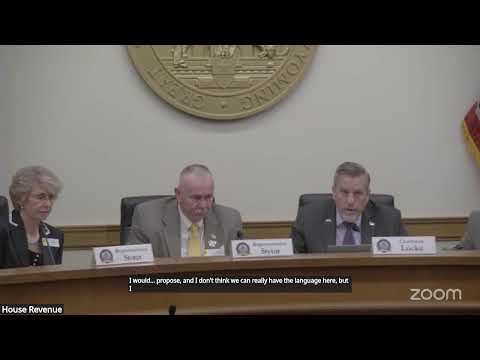
Committee advances bill to give targeted homeowner relief — 50% exemption up to $200,000 of structure value, funding debated
Summary
The House Revenue Committee advanced House Bill 130, a two‑year homeowner tax relief proposal that would reduce assessed structure value for primary residences by 50 percent up to a $200,000 cap and includes an active‑duty carve‑out; committee members also removed a proposed clawback of energy matching funds and added non‑duplication language.
The Wyoming House Revenue Committee on [date] advanced House Bill 130, a two‑year homeowner tax relief proposal that would apply a 50 percent exemption to the fair market value of a primary residence — capped at $200,000 of structure value — and include an active‑duty military carve‑out. The committee adopted multiple amendments and voted to remove a section that would have clawed back energy matching funds to help pay for the program.
Majority Floor Leader Representative Heiner introduced the bill as “another arrow in the quiver” of property tax relief options. Heiner described the measure as a two‑year, immediately effective relief program for tax years 2025–26 with a $200,000 ceiling (structure value only) and a 50 percent reduction of assessed value on the structure portion. He said the proposal would cost roughly $80.85 million per year and that the two‑year appropriation in the bill was $176 million.
The bill defines a primary residence as a single‑family residential structure the owner occupies for not less than eight months of the year; Representative Heiner said he chose an eight‑month threshold to reduce the risk that people who claim residency in other states would also claim Wyoming relief.
Heiner also included language to protect active‑duty service members, saying an active‑duty member of the armed forces or an immediate family member who is legally domiciled in the home would qualify even if deployment prevented meeting the eight‑month presence test.
Department of Revenue testimony echoed earlier concerns about administration. Ken Gill said an owner‑occupied verification will require an application and that assessors would likely need to collect roughly 175,000 applications statewide if the owner‑occupied element were enforced for tax year 2025 — making immediate implementation difficult. Gill said counties must issue assessment notices by the fourth Monday in April; with the bill’s timeline, assessors would have little time to gather and verify applications for 2025.
Funding and amendments
The bill initially proposed paying for the relief with a combination of reversions and a clawback of energy matching funds that the state had set aside for energy projects. Representative Heiner said about $182 million was unencumbered before session and that reverting some of those funds could finance the program. After testimony from Rob Krieger of the Wyoming Energy Authority and Peter Obermuehlen of the Petroleum Association of Wyoming, who warned that the energy matching funds had been used to leverage private and federal investment in energy projects, the committee voted to delete the bill’s Section 3 (the proposed clawback of energy matching funds).
The committee also adopted an amendment, moved by Representative Storer, to make clear that a person cannot receive both this homeowner exemption and the existing long‑term homeowner exemption in the same tax year (the bill incorporates the language referencing WS 39‑11‑105A). Committee members asked LSO to draft language that would allow the bill to be implemented in 2025 for structure‑only relief while phasing in owner‑occupied verification in 2026 if counties cannot complete application processing in time.
Public testimony included county assessors and stakeholder groups. Dixie Huxtable, Converse County assessor, told the committee she supported the bill’s focus but said implementing an owner‑occupied application for 2025 is not feasible; she recommended a delay or a phased approach. Kelly Carpenter of the Wyoming Farm Bureau Federation said her group supports the bill’s targeted approach as it minimizes community fiscal impacts compared with broader splits of property classes. Representatives of municipalities and citizens noted that local governments rely on property tax revenue for services and matching funds for grants and said any state relief should consider local backfill.
Committee action and next steps
The committee voted to delete the proposed energy matching fund clawback and to add the non‑duplication language about long‑term homeowner exemptions. Members asked LSO to craft final language to permit a phased implementation that allows structure‑only relief in 2025 and owner‑occupied verification in 2026 if necessary.
On final consideration the committee passed House Bill 130 as amended by roll call (7‑1 with one excused). The bill will proceed for further action with the committee’s amendments on funding and implementation timing.