Get Full Government Meeting Transcripts, Videos, & Alerts Forever!
Get email alerts on the Property Tax Assessment topic
No spam. Unsubscribe anytime.
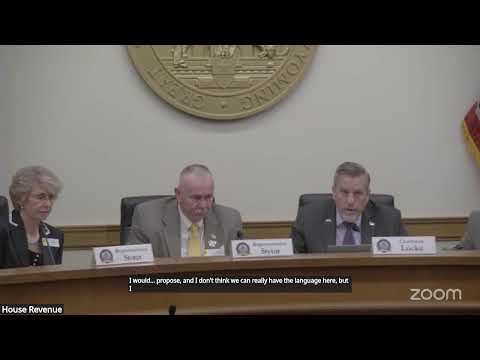
House Revenue Committee backs bill to set residential assessment rate at 8.3% to implement Amendment A
Summary
The Wyoming House Revenue Committee on [date] voted 7‑1 to advance House Bill 328, which creates a separate residential property class and sets the assessed fraction for residential real property — including owner‑occupied primary residences — at 8.3 percent to implement 2024’s Amendment A.
The Wyoming House Revenue Committee on [date] voted 7‑1 to advance House Bill 328, setting a residential assessed value of 8.3 percent and creating a separate fourth class for residential real property, including an owner‑occupied primary residence, as an implementation of the 2024 constitutional Amendment A.
Committee Chair Representative Locke, the bill’s sponsor, said the measure “is really just an attempt or a, an implementation really of the amendment A that was passed in this last election.” He explained the proposed 8.3 percent assessment level was calculated to remain within constitutional constraints compared with the industrial tier and to reflect the intent of Amendment A.
Ken Gill of the Wyoming Department of Revenue’s Property Tax Division told the committee the department supports the bill’s goal but offered an amendment to align definitions with current administrative practice. Gill said residential property in the State Board of Equalization abstract is defined as up to three family units (not four) and recommended removing a fixed “up to 35 acres” phrase and excluding mobile homes/trailers as those are treated as personal property.
The department also flagged a major administrative challenge: an owner‑occupied subclass will require an application process. Gill told the committee assessors would likely need to process roughly 175,000 applications statewide to identify owner‑occupied homes, which he described as “pretty much impossible to do in 2025” given statutory deadlines for assessment notices.
That practical constraint shaped committee action. The committee adopted the Department of Revenue’s amendment to: change the residential threshold from four families to three; delete the "up to 35 acres" phrase so residential is described as “associated residential land where the dwelling is located”; replace a comma with "or" in one clause; and remove mobile homes/trailers from the property definition. Representative Lane moved adoption of the department amendment; the motion was seconded and the amendment passed.
Public testimony included county assessors and local officials. Dixie Huxtable, Converse County assessor, told the committee she supports the department’s amendments and said the change to "associated land" is easier for assessors to administer across parcels larger than 35 acres. Kelly Carpenter of the Wyoming Farm Bureau Federation said the federation opposes splitting residential from commercial and agricultural property in principle and worries about unintended consequences and shifting tax burdens. Mayor Matt Murdock of Pinedale and others testified that any reduction in assessed value without state backfill will force local governments to consider service cuts or local tax increases.
Representative Lien and others asked whether the bill could increase special‑purpose levies (local surtaxes) or push localities to replace lost revenue. Representative Locke and witnesses acknowledged the possibility but said the local responses would be policy choices for local governments.
On final action, the committee approved House Bill 328 on a roll call vote with seven aye votes, one no (Representative Store), and one excused member. Representative Locke said the bill’s fiscal note shows a substantial revenue reduction and that the bill gives a preview of how Amendment A may affect local and state revenues.
What’s next: the bill will move from committee to further floor consideration with the department’s adopted language. The committee record shows the department’s amendments and the vote tally; local officials signaled concern about administrative timing and local revenue impacts, and the department warned that a separate owner‑occupied application process is probably not operational for 2025.