Get Full Government Meeting Transcripts, Videos, & Alerts Forever!
Get email alerts on the Compensation And Pay Plan topic
No spam. Unsubscribe anytime.
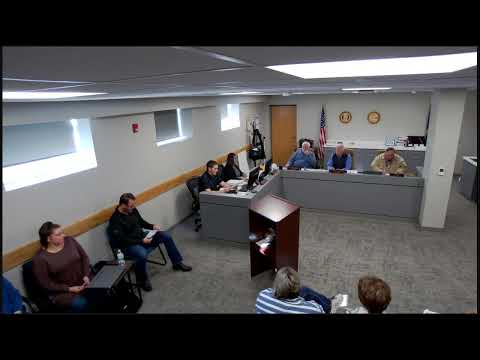
Dickinson County commissioners untable 2025 pay plan; ask for more detail after public questions and legal concerns
Summary
The Dickinson County Commission voted to remove the 2025 compensation plan from the table but paused final action after public commenters and commissioners raised procedural and financial questions. Staff and the Arnold Group consultant were asked to return with more detailed cost and benefits data at the next meeting.
The Dickinson County Board of County Commissioners voted to take the 2025 compensation plan off the table and reopen discussion, but commissioners did not adopt the plan and asked staff and the county's consultant to return with more detailed cost, benefits and implementation options at the next meeting.
The motion to untable the pay plan passed without a recorded roll call vote after a voice vote in which commissioners answered “aye.” The meeting then shifted to public comment, where multiple residents urged caution about large across-the-board raises and asked for transparency about long-term budget impacts.
Why it matters: Commissioners heard that the proposed changes could have significant budget implications and that Robert’s Rules of Order and county procedural requirements may affect whether the untable motion was valid. Commissioners directed the consultant and staff to provide a fuller, printed report of options and costs before any final vote.
The commission began the discussion by moving the previously tabled item back onto the agenda. Dave Simon announced that “what’s now is on the agenda is to untable the motion regarding the 2025 compensation plan,” and the motion to remove it from the table was seconded and carried by voice vote.
During the public comment period, residents urged caution. "I have no problem with people being paid fairly ... I do have a little bit of a problem with just graduating people up just because they've been here so many years," said Don Neville, a Dickinson County resident, who asked commissioners to weigh employee performance and budget sustainability. Greg Wilson, another resident, said he believed a new motion was required under parliamentary procedure if a tabled item had been tried unsuccessfully before. Marla Reiser cited Robert’s Rules of Order and said a question laid on the table “remains there and can be taken off from the table during the same session,” but that if not taken in that session it may be “no longer viable.”
The county's consultant, identified in the meeting as Dwayne of the Arnold Group, outlined two principal options presented to commissioners. He said both options began with a 3% cost-of-living adjustment (COLA) meant to reduce the number of employees below minimum scale and then proposed different approaches to correct long-standing wage compression.
Dwayne said the model that commissioners had discussed would allocate roughly $242,000 for an initial 3% COLA and about $130,000 to raise 39 employees to a scale minimum. He described an option that applies a $6,000 cap (a “limiter”) on individual increases as one way to spread available funds: that approach would make a portion of the compressed employees “whole” immediately and delay some adjustments for a future year. "Plan C would unpack 50% of your compressed employees and make them whole," he said. The consultant advised that if the commission adopted a multi‑year approach, the commission should consider freezing the 2025 pay scale to avoid “moving the goalposts” in later years.
Commissioners and staff raised several follow-up questions about benefit cost-loads, how many employees take county benefits, and the presentation of detailed line items. Assistant County Administrator and Finance Director Marcus Rothschild said the county would be able to calculate benefit-load percentages and later reported that about 104 employees participate in county health insurance in some form; he also said switching the county's health insurance plan (referred to in the meeting as “PKD”) produced some cost savings that staff would quantify for future budget work.
Several commissioners said they did not support adopting the full plan “overnight.” One commissioner summarized the prevailing view as preferring a stepwise or multiyear correction rather than a single large increase. The board did not adopt either pay plan at the meeting; instead, members asked the consultant to return with printed, itemized reports showing exact cost impacts, benefits breakdowns and options (including a narrower “Plan C” variant or a governor/limiter applied uniformly) at the commission’s next meeting.
On procedure: multiple residents and at least one commissioner cited Robert’s Rules of Order and contended the motion to untable might not be procedurally valid because the question had previously failed. Commissioners said they had sought legal advice; some said two attorneys had advised the commission the compensation plan and the earlier complaint (a “coma violation” referenced during discussion) were not tied together and that proceeding would not necessarily be a violation. At one point a commissioner said they would be willing to “undo the motion” to remove the item from the table if that clarified the legal position. Ultimately, commissioners agreed that a new motion could be required and that clearer legal guidance would be supplied if needed.
What was decided: The commission agreed to continue the matter to the next meeting and to request a detailed, printed cost and benefits analysis from the Arnold Group and staff. Staff were asked to calculate benefit loads and present the precise dollar impact of the proposed options. The commission also discussed whether any pay adjustments could be made retroactive to the next payroll cycle if approved in time.
The board distinguished between discussion (options and public comment), direction (requesting more data and a printed report), and formal action (the voice vote to untable the plan earlier in the meeting). No final adoption of a compensation plan occurred at this meeting.
What’s next: The consultant and staff will return with the requested detailed reports and cost breakdowns at the commission’s next meeting so commissioners can consider a formal motion to adopt, amend, or reject a pay‑plan option.