Get Full Government Meeting Transcripts, Videos, & Alerts Forever!
Get email alerts on the Education Human Trafficking Screening topic
No spam. Unsubscribe anytime.
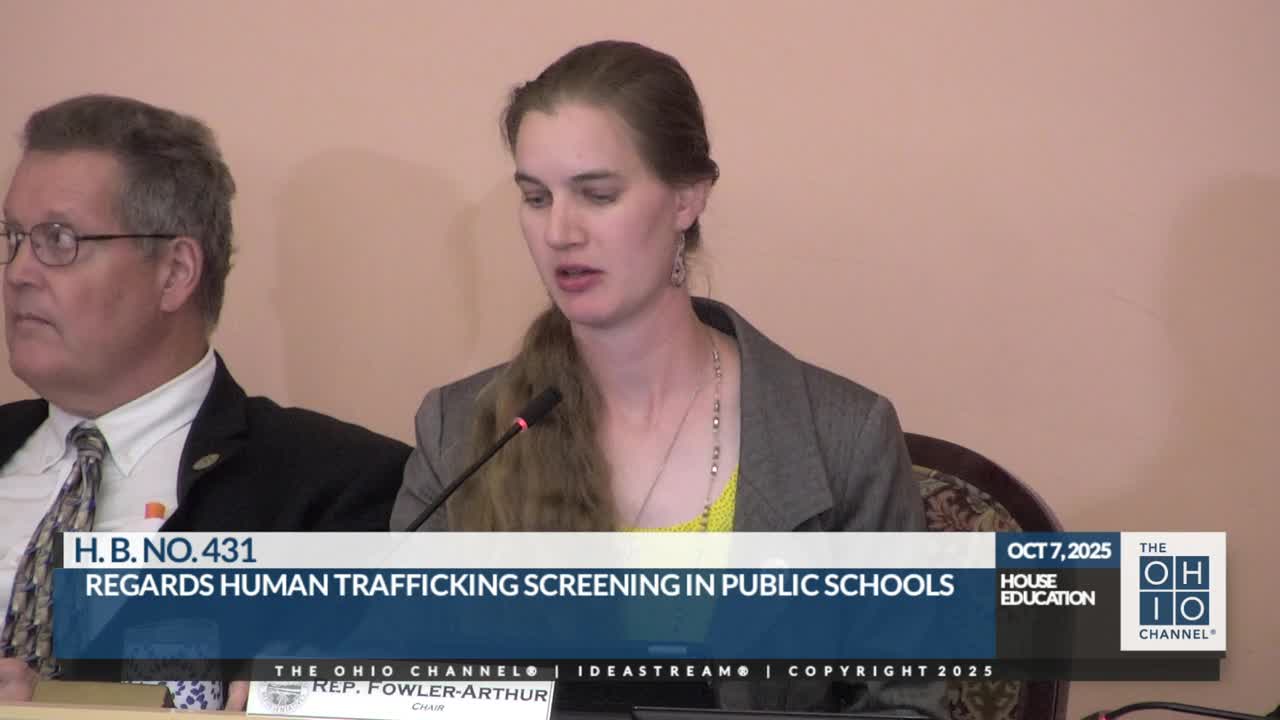
Committee hears sponsor testimony for bill to place anti‑trafficking screening tool in schools
Summary
Representative Williams presented sponsor testimony for House Bill 431 to require Ohio public school districts to administer a depersonalized youth trafficking screening tool developed by the University of Toledo and report aggregated results to a state portal.
Representative Williams presented sponsor testimony for House Bill 431, which would authorize school districts to use the University of Toledo’s FOCUS Youth Screening Tool to identify students at risk of human trafficking and report depersonalized, aggregated results to a central portal for analysis.
Williams said the FOCUS questionnaire is "a trauma informed evidence based questionnaire designed to help identify students who may be at risk of or currently experiencing human trafficking," developed by the University of Toledo’s Human Trafficking and Social Justice Institute with support from the Attorney General’s office. The sponsor described pilot uses in youth-detention settings and said the bill would fund training for school staff and an online portal to display aggregated, depersonalized data so local leaders and the public can see areas with elevated risk.
Committee members pressed sponsors on privacy, opt‑out, age appropriateness, scope and cost. Williams said the tool as drafted would return aggregated, depersonalized results to the portal and that educators remain mandatory reporters when individualized indications require intervention. "It's not the idea to particularize one child. It's to get aggregated data where we can see that there's an increased hotbed," Williams said. He also described recruitment pathways for minors, saying online recruitment and family-member involvement are two primary channels.
On scope, members asked whether private schools should be included; Williams said the draft limits the requirement to public-school students because of constitutional and legal considerations but that he is open to discussion. He described the appropriation language in the bill as an initial $10 million over two years (sponsor: "It's 10,000,000 over 2 years. $55,000,000 to annual" — sponsor explained a biennial/longer funding plan and anticipated higher initial costs with reductions after the portal and training infrastructure are established).
Members also asked about feasibility and scale; Williams said he and university proponents envision phased regional rollouts and training that would certify districts to deliver the screener. University proponents were expected to present in later committee hearings and to provide the instrument and additional data in follow-up testimony. The hearing included only sponsor testimony and committee Q&A; no vote was taken.