Get Full Government Meeting Transcripts, Videos, & Alerts Forever!
Get email alerts on the Land Use topic
No spam. Unsubscribe anytime.
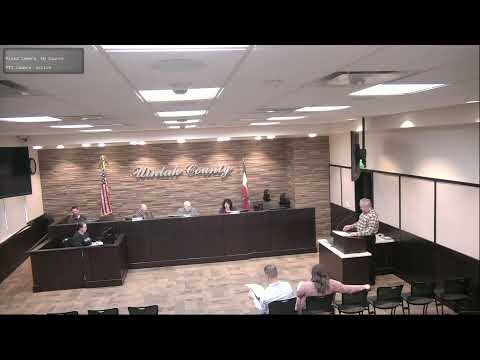
Commission adopts site-plan amendments allowing milled asphalt and treated gravel in certain industrial zones
Summary
The commission approved an amendment to site-plan rules that exempts some I‑1, I‑2 and MG‑1 uses from enclosure and allows milled/recycled asphalt and magnesium‑chloride‑treated gravel for required access in specified circumstances.
The Uintah County Commission approved an amendment to Title 17 site-plan requirements that exempts certain industrial zones from some enclosure and paving standards and allows milled or recycled asphalt — and, by the approved version, gravel or dirt treated with magnesium chloride — as acceptable hard surfaces for required access in I‑1, I‑2 and MG‑1 zones under specified conditions.
Deanna Nyberg, community development staff, told commissioners the ordinance (identified in the meeting as 01‑22‑2025‑01) would exempt dumpsters and certain parking-surface requirements in the I‑1, I‑2 and MG‑1 zones unless the property’s use is one normally allowed in the C‑1 commercial zone. Nyberg said the county prepared two versions after a series of work sessions: one that allowed only milled or recycled asphalt as a hard surface, and an alternate (the version the commission approved) also allowing gravel or dirt surfaces treated with magnesium chloride for required access.
Nyberg summarized concerns raised by the road department. "His concerns were that it is still muddy. His — he had concerns about the mag chloride in the buildings, that it's not a safe chemical to have in and out of places like that, that it needs to be reapplied," she said, describing Scott Hardman of the road department's worries about dust control, ongoing maintenance and enforcement difficulties.
Commissioners discussed compromises focused on required accesses: mandating a hard surface where the primary access meets the county road or the office/parking area, while leaving other secondary accesses eligible for lower‑cost options. One commissioner said the approved language applies to required access and that the road-encroachment code (handled by the road department) could address additional accesses.
A motion to adopt "version 2 as presented by Deanna Nyberg" passed. Commissioners agreed to reevaluate the ordinance’s effects after a trial period (one commissioner suggested 90 days) and to coordinate with the road department on enforcement and any separate encroachment requirements.
The ordinance text, as adopted, states that dumpsters or collection systems need not be enclosed in I‑1, I‑2 and MG‑1 zones unless the use is one permitted in C‑1; and that milled or recycled asphalt — and gravel/dirt surfaces treated with magnesium chloride under the adopted version — may count as hard surfaces for required access in those zones, except where the property’s use is one allowed in C‑1.
The commission did not read a roll-call vote into the meeting transcript; the outcome was recorded as adopted with qualifying discussion.