
Milwaukee health department briefs Youth Council on domestic violence prevention, local trends
Get AI-powered insights, summaries, and transcripts
Subscribe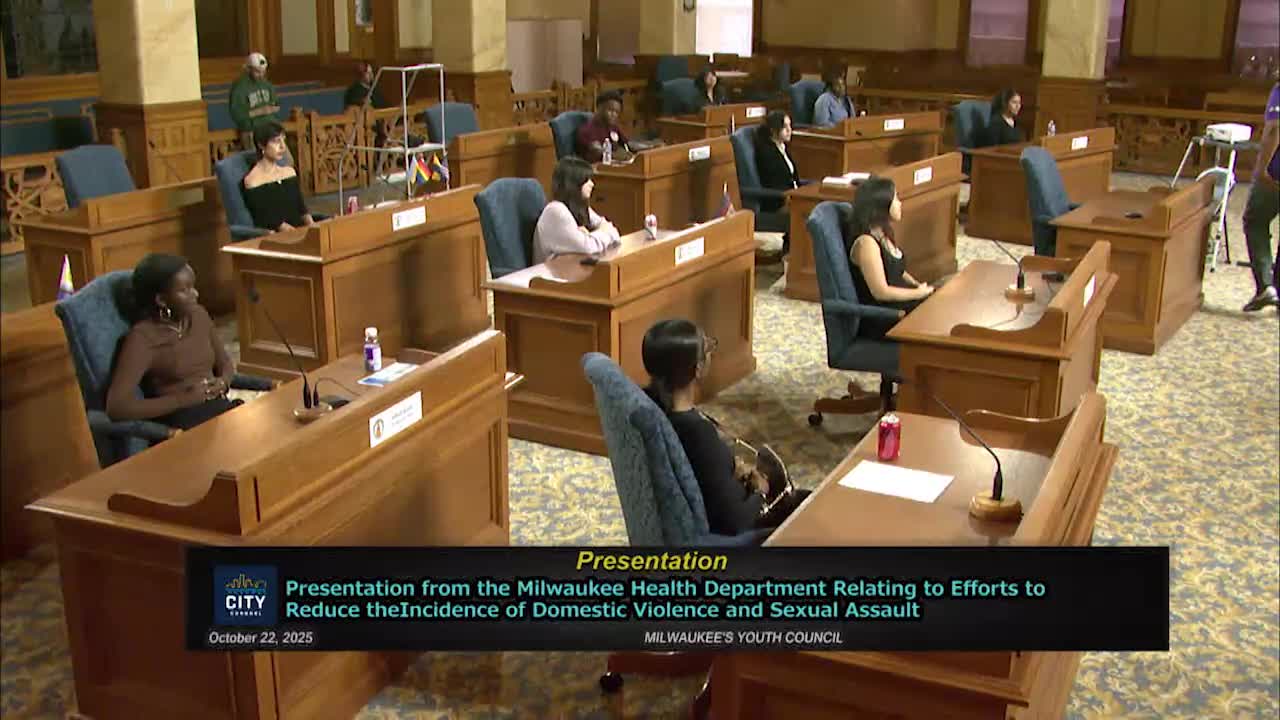
Summary
The City of Milwaukee’s Office of Community Wellness and Safety presented domestic violence and sexual‑assault prevention programs, local data and referral options to the newly seated Milwaukee Youth Council on Oct. 22, 2025, highlighting service gaps, diversion programs and culturally specific resources.
MILWAUKEE — Liza Herbst, the family violence prevention manager for the City of Milwaukee’s Office of Community Wellness and Safety, and Adrianna Watkins, program coordinator, briefed the Milwaukee Youth Council on Oct. 22 about the office’s programs, referral pathways and local trends in intimate‑partner and family violence.
Herbst told the council the office — recently moved into the Department of Administration and into new quarters on 13th and Maple — includes three divisions: a family violence division, a community division focused on gun‑violence and de‑escalation, and a clinical team contracted through the RECAST program to serve people who have experienced or are at risk of trauma.
The presentation framed domestic violence broadly to include emotional and financial abuse as well as physical violence. "Being told negative things... That is a form of violence," Herbst said, illustrating the office’s emphasis on nonphysical harms. She cited national and international authorities, including the World Health Organization and the Centers for Disease Control and Prevention, for prevention frameworks and statistics.
Why it matters: presenters said Milwaukee has recent increases in domestic‑violence incidents and related shootings and that service capacity is strained. The office identified practical gaps — insufficient shelter capacity, climbing rent costs that force some survivors to return to unsafe homes, and barriers related to immigration status and cultural responsiveness — and outlined efforts to connect callers with culturally competent partner agencies.
Key programs and referrals
- EMPOWER diversion: Herbst described EMPOWER, a diversion program used in partnership with Milwaukee Police Districts 2 and 3 that can route certain alleged offenders to treatment and services at partner agencies such as the Benedict Center instead of immediate arrest, when the referred person agrees to participate.
- Emergency relocation and supports: the office provides emergency relocation, security‑camera and lock replacement services, and housing referrals in coordination with community partners.
- Commission and partners: Herbst said she and Watkins are reconstituting the Milwaukee Commission on Domestic Violence and Sexual Assault (created by the Common Council in 1979) and have reduced its working membership to 19. She listed commission partners that include Sojourner Family Peace Center, Gerald L. Ignace Indian Health Center, Legal Action of Wisconsin, the Milwaukee Police Department, United Way of Greater Milwaukee, Diverse and Resilient, the Hmong American Women’s Association, the Muslim Women’s Coalition and others.
Local trends and risks
Presenters cited several data points and risk indicators: on a national level, they referenced CDC findings that about 1 in 4 women and 1 in 9 men experience severe intimate‑partner violence in their lifetime and that the presence of a gun in a domestic‑violence situation substantially increases homicide risk. For Milwaukee specifically, Herbst said, "As of Aug. 2 there have been 33 gun‑violence incidents where domestic or intimate‑partner violence was identified as the primary factor," with 23 nonfatal shooting victims and 10 homicides. She also told the council that in early 2024 the Milwaukee Police Department observed domestic‑violence case counts already outpacing totals for 2023.
Outreach to youth and culturally specific work
Herbst described recent outreach and education efforts, including the annual Love Without Violence conference (streamed on the office’s Facebook page), a youth panel at the conference, and planned projects with Milwaukee Public Schools and charter schools to focus on youth violence prevention. The office emphasized connecting survivors to culturally specific agencies (for example, UMO (Umos), the ASHA Project, the Muslim Women’s Coalition, Gerald L. Ignace and Diverse and Resilient) and tailoring referrals by language and cultural needs. Herbst said staff will ask callers about language preferences and can arrange translated conference calls when necessary.
Questions from Youth Council members covered confidentiality of third‑party referrals, services for youth survivors and indicators of human‑trafficking grooming. Herbst said the office attempts discreet follow‑up when a family member asks for help on behalf of someone else, offering options such as mailed resources or outreach phrased in a way the family agrees to. On trafficking signs, presenters said grooming, being "extra friendly," and requests to skip school or change behavior are red flags.
Resources and next steps
Herbst and Watkins distributed brochures and resource bags to council members and urged students to consult the office website and social channels. They listed contact points for the Office of Community Wellness and Safety and said the office’s social accounts include: Facebook — City of Milwaukee Office of Community Wellness and Safety; Instagram — @mke_community_wellness_and_safety. The presentation concluded with an offer of follow‑up and technical assistance for grassroots organizations.
Ending
The presentation closed with an invitation for council members to view the Love Without Violence conference recording on Facebook and with a reminder that the office is coordinating the reconstituted commission and additional youth‑focused work in partnership with schools and community agencies.