Get Full Government Meeting Transcripts, Videos, & Alerts Forever!
Get email alerts on the Legislation topic
No spam. Unsubscribe anytime.
Utah House passes a slate of bills on elections, housing, energy and public safety; key votes and summaries
Summary
The Utah House on Feb. 10, 2025 advanced and passed a series of bills addressing campaign disclosure searchability, short-term rental enforcement, transmission technologies, waste classification, insurance and wildfire mapping, among others. Vote tallies and brief descriptions of each bill are listed.
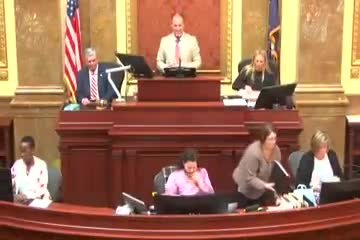
The Utah House of Representatives completed a full floor session on Feb. 10, 2025, passing a series of bills on campaign disclosure searches, municipal zoning for short-term rentals, energy transmission technologies, waste classification, insurance regulations, wildfire mapping/accountability and multiple other technical and programmatic changes.
In total, the chamber voted on and passed more than a dozen bills during the afternoon session. The measures included changes to election disclosure searchability, municipal zoning provisions for short-term rentals, state support for advanced transmission technologies on the electric grid, and additions to the controlled substances schedule. Several bills included technical fixes or clarifications requested by state agencies.
Votes at a glance (bill — short description — final outcome and tally):
- First Substitute HB 59, Fireworks Modifications — A definitional cleanup in fireworks law requested after enactment; the House concurred with Senate amendments and passed final passage. Outcome: approved; 71 yes, 0 no.
- Second Substitute HB 95, Campaign Contribution Revisions — Requires the lieutenant governor’s office to upgrade the campaign disclosure website to allow backward searches by a contributor (corporation) name so users can see where that corporation gave money. Representative Peterson said the change "requires our lieutenant governor's office to upgrade the ... disclosures website" so contributors can be searched. Outcome: approved; 74 yes, 0 no.
- First Substitute HB 256, Municipal Zoning Amendments (short-term rental provisions) — Gives municipalities and counties flexibility over local short-term rental rules while allowing local governments to use short-term rental website listings as evidence alongside other information to enforce local ordinances and, in some cases, require a platform to remove a listing. Representative Walter described the bill as allowing local governments to "monitor what's happening on a short term rental website." Outcome: approved; 48 yes, 23 no.
- First Substitute HB 212, Advanced Transmission Technologies — Encourages electric utilities and the Public Utilities Commission to evaluate and, where cost-effective, deploy software and hardware solutions that increase the effective capacity of existing transmission lines, reduce congestion and potentially lower costs and wildfire risk. Outcome: approved; 74 yes, 0 no.
- HB 254, Waste Classification Amendments — Aligns Utah’s definitions of some radioactive waste classifications with federal standards; sponsor said the change does not allow the facility to accept waste it is not currently permitted to accept. Outcome: approved; 58 yes, 14 no.
- First Substitute HB 264, Tax Incentives Amendments — Repeals certain expired tax-credit language and adjusts the duration of a corporate clean-energy incentive so it terminates after 10 years for new credits; sponsor described technical cleanup and a 10-year sunset. Outcome: approved; 62 yes, 10 no.
- First Substitute HB 184, School Trust Land Amendments — Clarifies responsibilities for the School Children’s Trust Section at the State Board of Education, adds training on the Open and Public Meetings Act, expands who receives training, and refines compliance review and reporting. Outcome: approved; 70 yes, 1 no.
- HB 204, Stipends for Future Educators Grant Program Amendments — Technical and operational adjustments to the pilot stipends program, including requiring participating teachers to sign an affidavit indicating intent to teach in Utah and clarifying stipends for some coaching roles. Outcome: approved; 72 yes, 0 no.
- First Substitute HB 23, Insurance Modifications — Technical cleanups and policy updates for insurance reporting and captive-regulation funding; the House adopted amendments before final passage. Outcome: approved; 74 yes, 0 no.
- Second Substitute HB 48, Wildland-Urban Interface Modifications — Requires insurers to use state wildland-urban-interface mapping (rather than national mapmakers) and establishes a future program to assess and fund mitigation work; sponsor said an estimated "280,000 homes" are classified differently by national mappers than by state maps. Outcome: approved; 75 yes, 0 no.
- Second Substitute HB 160, Professional License Degree Amendments — Aligns certain professional licensing education requirements with higher-education offerings for architects, environmental health scientists, land surveyors and geologists. Outcome: approved; 73 yes, 0 no.
- First Substitute HB 258, Medicare Supplement Insurance Amendments — Allows certain enrolled Medicare beneficiaries to change within the same carrier to an equal or lower tier without medical underwriting, to give seniors more flexibility. Outcome: approved; 73 yes, 0 no.
- HB 111, Workers’ Compensation Amendments — Narrows a prior workers’ compensation requirement to the bill’s intended target of self‑administered services so other businesses are not unintentionally covered. Outcome: approved; 73 yes, 0 no.
- HB 175, Housing Construction Amendments — Treats certain triplexes and quadplexes as residential for building-code purposes so they can use residential fire protections (sheetrock firewalls) rather than commercial sprinkler requirements; sponsor said the change can reduce cost per unit. Outcome: approved; 71 yes, 1 no.
- First Substitute HB 84, Vaccine Amendments — Specifies that intentionally administered vaccines delivered through food for human consumption must be treated and labeled as drugs (not food); sponsors and several members framed the bill as forward-looking to ensure appropriate labeling and regulatory oversight. Outcome: approved; 73 yes, 0 no.
- HB 173, Controlled Substances Act Amendments — Adds two substances (including phenibut and tieniptine) to the schedule because committee review found no accepted medical use and potential for harm. Outcome: approved; 74 yes, 0 no.
Other floor actions and notes: several bills were circled for further drafting or amendment during the session (for example, HB 281 was circled for a tweak). Representative votes and procedural motions (uncircle/call the question/waive summations) occurred repeatedly as the House advanced the calendar. Late in the day the House announced the assignment of SB 88 back to the Rules Committee for fiscal impact review.
The House adjourned after completing the listed business and will reconvene as scheduled. The measures passed on Feb. 10 will be transmitted to the Senate or the relevant state officials as required by procedure.