Get Full Government Meeting Transcripts, Videos, & Alerts Forever!
Get email alerts on the Long Term Care topic
No spam. Unsubscribe anytime.
Committee approves repeal of nursing-home certificate-of-need after competing testimony
Summary
The Labor, Health & Social Services Committee voted to advance House Bill 289 to repeal the state's certificate-of-need law for nursing homes after testimony from the Department of Health, providers, and advocates; committee members debated workforce, quality and reimbursement concerns.
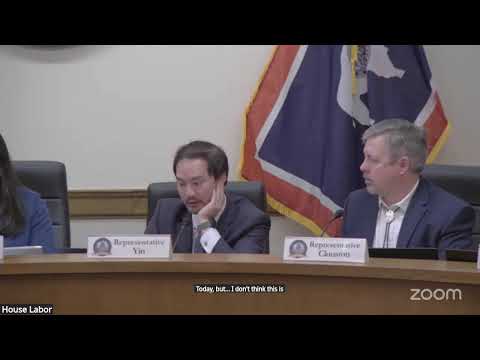
The Labor, Health & Social Services Committee on Friday voted to advance House Bill 289, which would repeal Wyoming’s certificate-of-need (CON) restrictions for nursing-home construction and bed expansion. The committee approved the bill after hearing testimony from the Department of Health, nursing-home operators, trade groups and advocacy organizations.
Representative Rob Garinger, sponsor of HB 289 and representative for House District 42 in southwest Laramie County, told the committee the repeal would remove what he described as “arbitrary” limits that can block facility growth and noted the Department of Health would still enforce health and safety standards and report back to the Legislature by 2029.
Why it matters: The CON statute determines when new nursing facilities or expansions may proceed by applying geographic and occupancy thresholds. Supporters said repeal would increase access and competition; providers and trade groups warned repeal could worsen workforce shortages, destabilize rural providers and shift higher-margin post-acute care away from low-margin long-term custodial care.
Key details and testimony
• Department of Health data: Stefan Johansen, director of the Wyoming Department of Health, told the committee that since February 2009 the department received 18 requests for new construction; 11 were approved and 7 were denied. Two requests for expansion were approved and only one facility expanded. Johansen said statewide nursing-home occupancy fell during the pandemic and has “somewhat stabilized” and provided a recent statewide average occupancy near 74%.
• Supporters: Americans for Prosperity’s Tyler Lindholm argued that CON laws stifle competition and cited national studies linking CON rules to higher Medicare and Medicaid spending per enrollee. Jeff Daugherty (Cicero Action) said competition “breeds excellence” and urged the committee to repeal the restriction.
• Providers and trade groups: Nursing-home operators and associations urged caution. Leah Lowe, regional vice president for Empress Health Care (which operates six skilled nursing centers in Wyoming), said the state’s skilled nursing centers average about 67% bed occupancy statewide and that facilities face workforce shortages, higher acuity of residents and delayed Medicaid reimbursements. Eric Connell, CEO of North Bighorn Hospital District and nursing-home administrator, testified that capital flows to higher-margin post-acute services in free markets and that repeal could leave low-margin custodial Medicaid residents at risk.
• Financial context: Eric Boley (Wyoming Hospital Association / LeadingAge Wyoming) explained Medicaid pays a majority of long-term care days in the state and described the Medicaid financing mechanism: Wyoming’s federal Medicaid match (FMAP) for nursing-home care is roughly 50/50. Boley and others said recent rate increases narrowed but did not eliminate a gap between reimbursement and provider costs.
Amendments, votes and committee action
Representative Wasserburger offered an amendment to delay the bill’s effective date from July 1, 2026, to July 1, 2027, to allow additional study; the amendment failed on a voice/show-of-hands call. The committee then approved the bill to advance to the House floor. The clerk recorded the final committee vote as 8 ayes and 1 excused.
Discussion points and committee concerns
Committee members asked about: the statutory formulas (30-mile radius and 85% occupancy threshold), the number and reasons for prior denials, whether repeal would lead to closures or two-tiered markets, and whether the Department of Health’s three-year reporting requirement (report due by September 1, 2029) would provide enough data to evaluate the repeal. Director Johansen said the department can produce a substantive report but cautioned that Wyoming’s small population may limit statistical power for definitive conclusions.
Quotes
"This repeal will increase access to care by making it easier to expand facilities and add nursing home beds," Representative Garinger said.
"Centers are barely making ends meet with the current funding and regulatory requirements," Leah Lowe, regional vice president for Empress Health Care, told the committee.
"Capital will flow to the high-margin services; it will be very difficult, if not impossible, to find somebody interested in coming in and providing low-margin care," Eric Connell, CEO of North Bighorn Hospital District, said of a potential repeal.
Next steps
The bill will be carried by Representative Garinger to the full House for consideration. Several committee members urged additional work on quality measures and workforce supports; others said repeal will put market pressure on providers and could spur new investment.