Get Full Government Meeting Transcripts, Videos, & Alerts Forever!
Get email alerts on the Outcomes Based Contracting topic
No spam. Unsubscribe anytime.
Louisiana Department of Education outlines outcomes‑based contracting to expand high‑dosage tutoring
Summary
The Louisiana Department of Education described an outcomes‑based contracting (OBC) approach that ties a portion of vendor pay to student growth for an optional additional 10‑week cycle of external high‑dosage tutoring; the session explained model design, case studies and how school systems can register interest by Oct. 10.
The Louisiana Department of Education held an information session on outcomes‑based contracting (OBC) for accelerated high‑dosage tutoring, describing a procurement model that ties part of vendor payment to student outcomes and inviting school systems to express interest by Oct. 10.
Glenn Colvin, chief of staff for the literacy division at the Louisiana Department of Education, said, “Outcomes based contracting or OBC is a procurement strategy that shifts the focus from inputs, like the number of hours delivered, to actual outputs, such as student growth.” He said the contracts are typically split into a base payment and an outcomes‑based payment — in the example shown during the session the base payment was “around 60% of the total contract value” and the outcomes portion about 40%.
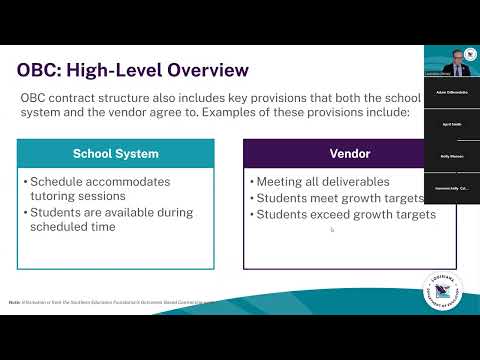
The session described how OBC would apply only to external tutoring providers already contracting with a school system and would fund an additional 10‑week tutoring cycle. Colvin said a portion of a vendor’s compensation would be “directly tied to achieving predetermined outcomes,” and that schools and vendors must agree on clear provisions, including scheduling and attendance responsibilities for schools and instructional quality commitments for vendors.
The department presented two case studies. In Denver Public Schools, more than 1,000 qualifying students were served in math tutoring under an OBC model in which “more than half the contract value was contingent on student outcomes,” and the district reported significant math growth and improved student confidence. In Ector County Independent School District in Texas, officials served more than 5,000 third‑through‑eighth graders in ELA and math, with 20% of vendor compensation tied to growth on the NWEA assessment; about half of participating students showed strong growth, prompting that district to expand OBC in other areas.
Colvin and department staff walked attendees through four major steps to engage in OBC: (1) identify student metrics and system goals and confirm vendor participation; (2) construct a pricing strategy and develop a rate card that balances incentives and realistic expectations; (3) renegotiate contracts so outcomes and data requirements are explicit; and (4) collaborate during implementation to monitor progress and make continuous improvements. The example rate card shown separated achievement metrics and specified what portion of payments were base versus outcome payments.
Holly Manson, who said she “works on and oversee[s] all of our tutoring programs” at the department, reiterated that the example figures were illustrative and that final outcomes, metrics and payment splits are negotiated between each school system and vendor. April Smith, a tutoring support specialist, and Adam Divinadetto, director of academic innovation, were introduced as points of contact who will support systems through the process.
The department asked interested systems to complete an interest form accessible via a QR code or link and noted the form “is only intended to capture interest and does not serve as an official sign up or commitment to participate.” The deadline for the interest form was announced as Oct. 10. The department said it will coordinate with approved external tutoring providers to gauge vendor interest and will publish the presentation deck on the Department of Education website; staff offered a department email for questions: tutoring@la.gov.
This session was informational; no contract awards or formal approvals were made during the call. Department staff said they will assist systems that are awarded funding to extend tutoring with an external provider and that further steps will follow for systems that indicate interest.
A copy of the presentation and contact details will be posted on the Louisiana Department of Education website and linked in the department newsletter, the presenters said.