Get Full Government Meeting Transcripts, Videos, & Alerts Forever!
Get email alerts on the Energy topic
No spam. Unsubscribe anytime.
Committee tables bill that would require on‑site disposal of decommissioned wind turbine blades
Summary
House Bill 89, which would have required on‑site disposal of decommissioned wind turbine blades and towers with limited exceptions, was tabled after extensive testimony from state agencies, industry and local governments about coal‑mine disposal, private‑land impacts and federal land authority.
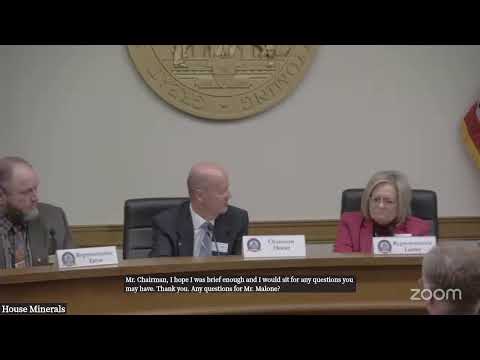
The Minerals, Business & Economic Development Committee voted to table House Bill 89 after a broad public and agency discussion about how best to handle disposal of decommissioned wind turbine blades and towers.
Sponsor Representative JR Riggins introduced HB89 as an effort to require new wind‑energy siting applications to include a disposal plan that would ensure decommissioned turbine blades and towers are disposed on the project site, with specified exceptions such as on‑site recycling and disposal at mining sites in accordance with mining statutes and agency rules. Riggins told the committee the intent is to ensure solid‑waste plans are in place for utility‑scale projects and to reduce reliance on municipal landfills.
Agency witnesses described options and concerns. Department of Environmental Quality Director Todd Parfitt and Solid and Hazardous Waste Administrator Suzanne Ingalls recommended conforming the bill’s language to place permitting and disposal authority in the Solid and Hazardous Waste Division (Title 35, article 15, in their drafting notes) rather than the mining article, and they explained how construction/demolition permits would be used if the bill moved forward. They also noted that landfill siting, groundwater protection and closure standards would apply.
Acting Director Jason Crowder of the Office of State Lands and Investments raised concerns about private‑landowners and existing lessees on trust land, saying that mandatory on‑site disposal could create easements or encumbrances that reduce property value and complicate lease consents with grazing, recreational or other preexisting users.
Several witnesses told the committee the Office of Surface Mining had recently approved a program amendment allowing disposal of blades and towers in coal mining sites after a multi‑year review; industry witnesses and the Wyoming Mining Association said coal mines offer large capacity, existing permitting and potential economies of scale and therefore urged the committee to rely on existing statutes and rules that govern disposal at mine sites. The Wyoming Energy Authority also urged the committee to simplify language and cross‑reference existing coal‑mine statutes and rules rather than create new on‑site mandates.
Opponents said mandatory on‑site disposal could amount to an uncompensated taking for private landowners, could shift disposal burdens to municipalities or private landowners that lack capacity, and could create conflicts on mixed‑ownership project footprints (federal/state/private land). Testimony opposing the bill in its current form came from municipalities, county officials, agriculture groups and conservation organizations; some supported using coal‑mine disposal where feasible but opposed mandatory on‑site burial as drafted.
After testimony, Representative Lolli moved to table HB89 and Representative Larson seconded; the committee adopted the motion to table by voice vote. Committee members said more work is needed — particularly given the recent Office of Surface Mining action and the range of stakeholder concerns — before the committee should advance statutory changes.
The bill’s sponsor and multiple agencies signaled openness to amendments addressing exceptions, jurisdictional language, bonding, easement/encumbrance treatment and effective dates.