Get AI Briefings, Transcripts & Alerts on Local & National Government Meetings — Forever.
DeKalb water and sewer overhaul: board defers vote on multi‑year rate plan as residents call for audits
Loading...
Summary
DeKalb County commissioners on Jan. 28 deferred a proposed multi‑year water‑sewer rate plan and related bond authorization and asked the administration to provide further detail at a special PWI session after residents demanded independent audits and clarified assistance protections for vulnerable customers.
DeKalb County commissioners on Jan. 28 deferred consideration of a substitute resolution that would set a multi‑year water and sewer rate plan and authorize a bond issuance for major sewer and water rehabilitation work. County leaders said the substitute, which staff revised in the days before the meeting, would move the county from an earlier 8% annual proposal to a proposed 10% annual rate increase for 10 years and enable a larger bond issuance. Commissioners moved the substitute to a special PWI meeting scheduled for Thursday morning to give staff time to provide additional detail and to hold public outreach sessions.
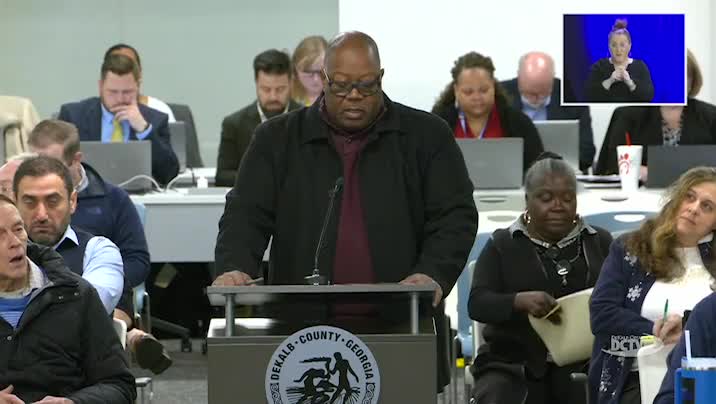
Public comment at the meeting included broad calls for independent reviews of the county’s wastewater planning. Clarence Williams, a resident, urged the board to order “an independent forensic financial audit on both a departmental and individual basis, and we need an independent special master to review the story that was told to judge Grunberg yesterday,” citing operational concerns at the Snap Finger wastewater treatment plant and the county’s communications with state and federal regulators.
Earlier public commenters raised technical concerns about the county’s dynamic hydraulic model for sewer planning and alleged the model was inaccurate or suppressed; those concerns were echoed by speakers who said county officials had told state and federal environmental regulators the model had not been used. In public comment, Steven Binney criticized the outgoing CEO’s Dec. 31 letter to federal environmental officials and said the Department of Justice requested a status conference following that letter.
County staff told commissioners a substitute resolution has been prepared to include a set of accountability measures: an operational audit of the Watershed Department, a customer‑assistance program to offset impacts on low‑income and senior households, and the creation of a customer‑advocate office. Staff also said the substitute would be followed by public town‑hall meetings (north, central and south) and that administrators would provide detailed projections showing the effect of the rate plan on typical bills and how assistance programs would work.
Board actions at the Jan. 28 meeting included: - Deferral of the substitute rate and bond item (agenda item 2025‑1326) to a special PWI meeting for a more detailed presentation (motioned by Commissioner Robert Patrick, seconded by Commissioner Ladina Bolton). The board also asked county staff to publish a PDF of the substitute for the record and to provide scenario detail at the special session. - Approval of a smaller watershed item: the Cougar Court (Ellenwood) septic‑to‑sewer petition (Watershed item 1502), which staff said met qualifications and will allow installation of approximately 360 linear feet of sewer line to connect the neighborhood.
Commissioners and staff stressed the county intends to pursue additional outreach and financial options. The administration said it continues to pursue grants and other external funding but that long‑term, stable revenue would be needed to meet large consent‑decree driven infrastructure requirements. The Department of Justice and the EPA were referenced multiple times during public comment and speaker exchanges about the county’s modified consent decree and the accuracy of the county’s planning model.