Get Full Government Meeting Transcripts, Videos, & Alerts Forever!
Get email alerts on the Environment topic
No spam. Unsubscribe anytime.
Committee advances annual solid‑waste cease & transfer funding report; 14 projects remain
Summary
The committee unanimously approved House Bill 14, received a status update from the Department of Environmental Quality on the Solid Waste Municipal Cease and Transfer program, and heard that 14 projects remain on the priority list with roughly $23.5 million left in the program account.
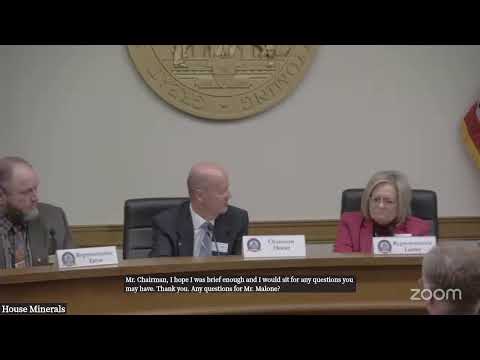
The Minerals, Business & Economic Development Committee unanimously approved House Bill 14, the annual Solid Waste Municipal Cease and Transfer Funding bill, after hearing an update from the Department of Environmental Quality on the program’s status and remaining projects.
DEQ Director Todd Parfitt and Suzanne Ingalls, administrator of the Solid and Hazardous Waste Division, summarized program history and finances. They said the program was established in 2013 and originally listed 52 eligible projects with an estimated combined cost of about $96.2 million. Legislative deposits to the program total approximately $69.9 million (split between grants and loans), and as of the agency’s September 2024 update, 37 projects had received funding: 13 transfer stations, 23 landfill closures and one carcass management project.
Ingalls told the committee there are 14 projects remaining on the priority list — six transfer station projects and eight closure projects — and that returned funds and loan repayments have contributed to the account. "Including those funds that have been returned, there's a remaining balance of approximately $23,500,000 — $16.4 million in grants and $7.1 million in loans," she said.
Committee members asked about closure procedures and long‑term monitoring. Ingalls explained that landfill closures require closure permits with groundwater monitoring and a statutory post‑closure oversight period that can last up to 30 years; communities operating closed landfills remain responsible for post‑closure monitoring and any extended care if contamination persists.
Representative Lolli moved the bill and Representative Riggins seconded; the committee approved the measure by roll call 9‑0. Members noted this is the program’s regular annual report and that DEQ will return to the Legislature if revised cost estimates require additional funding in future years.
The Wyoming Association of Municipalities’ executive director Ashley Harpstreet testified in support and described how WAM represents municipal interests on local governance and infrastructure funding matters.