Get Full Government Meeting Transcripts, Videos, & Alerts Forever!
Cambridge reviews first year of universal preschool as enrollment, provider strain prompt policy questions
Summary
City and school officials reviewed Cambridge Preschool Program (CPP) data four months into year 1, reporting strong family matches and satisfaction but flagging supply-demand mismatches, provider financial stress, limited extended-day options and next-step policy choices on pay parity, workforce credentials and serving 3‑year‑olds.
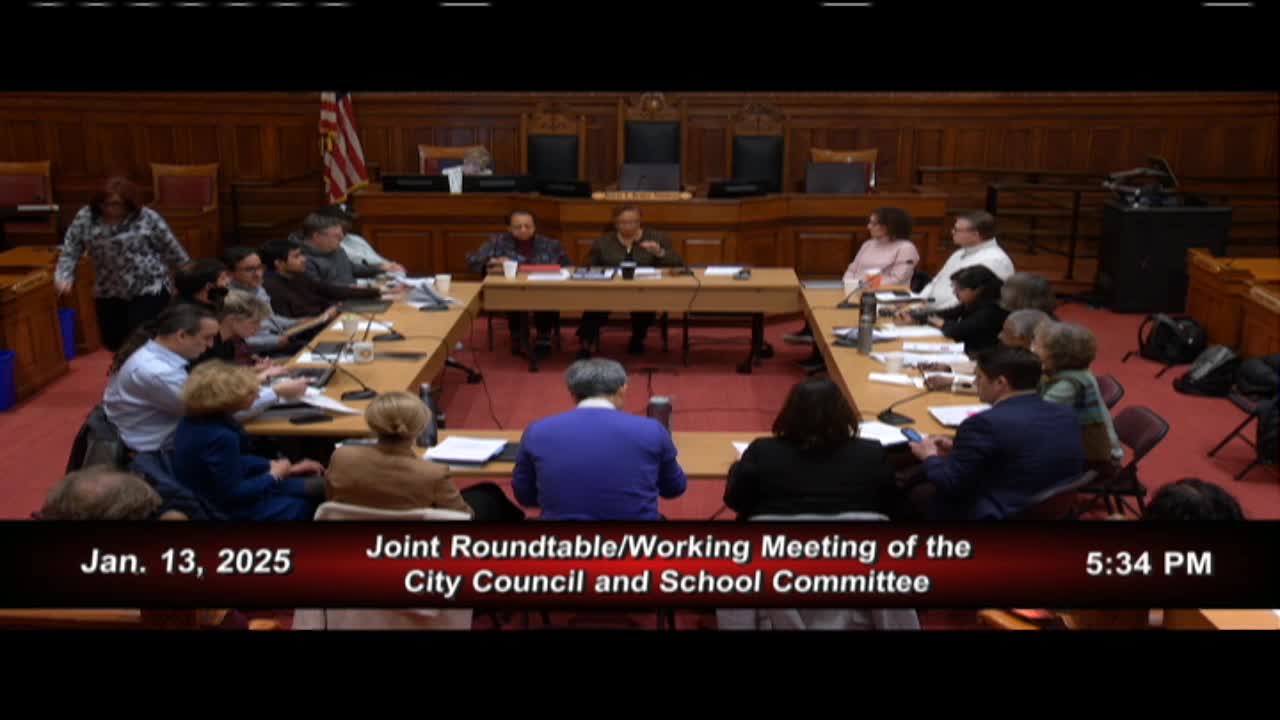
Cambridge — City and school officials on Monday reviewed early results from the Cambridge Preschool Program, the city’s newly launched universal preschool initiative, telling a joint roundtable of the City Council and School Committee that the program is four months into its first school year and already raising implementation questions.
The Office of Early Childhood and Cambridge Public Schools presented match and enrollment figures, quality-assurance steps and policy issues. Sheryl Olsen, executive director of the Office of Early Childhood, said the city has “a centralized location” for applications and a matching algorithm supplied by BridgeCare that prioritizes low-income families, siblings and continuity-of-care students. Karen Feeney, executive director of early childhood for Cambridge Public Schools, described CPP as “an opportunity to serve our community and to really bring high quality education in preschool to our youngest learners.”
Why it matters: CPP is one of the few municipally backed universal pre-K systems in the U.S. that uses a mixed-delivery model (district classrooms, Department of Human Service Programs sites and community-based providers) and aims to prioritize families with the greatest need. Officials said early data show most priority families received one of their top choices, but the program’s launch has surfaced budget and operational questions that could shape Year 3 planning.
Most important facts
- Enrollment and match results: Officials reported 24–25 (first year) figures of 939 eligible applications and 734 matches; in the most recent cycle they said there were 966 eligible applications and 839 matches (preliminary). The affiliate matches for university-affiliated sites (Harvard, MIT) and families arriving later will increase final counts.
- Family choice and satisfaction: Presenters said about 89% of families received their top choice and “well over 90%” of priority families received one of their top three…
Already have an account? Log in
Subscribe to keep reading
Unlock the rest of this article — and every article on Citizen Portal.
- Unlimited articles
- AI-powered breakdowns of topics, speakers, decisions, and budgets
- Instant alerts when your location has a new meeting
- Follow topics and more locations
- 1,000 AI Insights / month, plus AI Chat