Get Full Government Meeting Transcripts, Videos, & Alerts Forever!
Get email alerts on the Early Childhood topic
No spam. Unsubscribe anytime.
Cambridge reviews first year of universal preschool as enrollment, provider strain prompt policy questions
Summary
City and school officials reviewed Cambridge Preschool Program (CPP) data four months into year 1, reporting strong family matches and satisfaction but flagging supply-demand mismatches, provider financial stress, limited extended-day options and next-step policy choices on pay parity, workforce credentials and serving 3‑year‑olds.
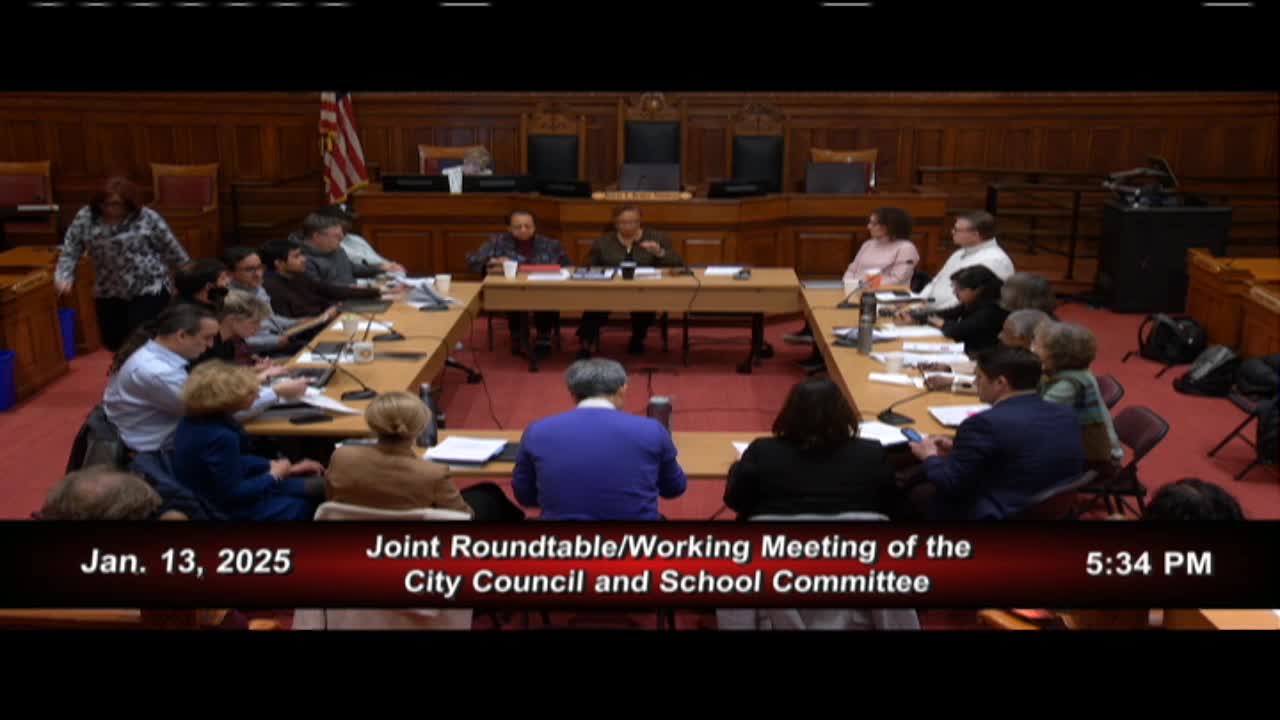
Cambridge — City and school officials on Monday reviewed early results from the Cambridge Preschool Program, the city’s newly launched universal preschool initiative, telling a joint roundtable of the City Council and School Committee that the program is four months into its first school year and already raising implementation questions.
The Office of Early Childhood and Cambridge Public Schools presented match and enrollment figures, quality-assurance steps and policy issues. Sheryl Olsen, executive director of the Office of Early Childhood, said the city has “a centralized location” for applications and a matching algorithm supplied by BridgeCare that prioritizes low-income families, siblings and continuity-of-care students. Karen Feeney, executive director of early childhood for Cambridge Public Schools, described CPP as “an opportunity to serve our community and to really bring high quality education in preschool to our youngest learners.”
Why it matters: CPP is one of the few municipally backed universal pre-K systems in the U.S. that uses a mixed-delivery model (district classrooms, Department of Human Service Programs sites and community-based providers) and aims to prioritize families with the greatest need. Officials said early data show most priority families received one of their top choices, but the program’s launch has surfaced budget and operational questions that could shape Year 3 planning.
Most important facts
- Enrollment and match results: Officials reported 24–25 (first year) figures of 939 eligible applications and 734 matches; in the most recent cycle they said there were 966 eligible applications and 839 matches (preliminary). The affiliate matches for university-affiliated sites (Harvard, MIT) and families arriving later will increase final counts.
- Family choice and satisfaction: Presenters said about 89% of families received their top choice and “well over 90%” of priority families received one of their top three ranked programs. A family survey cited in the presentation showed roughly 85% of respondents were satisfied or very satisfied with the match; about 6% were dissatisfied.
- Program mix and seats: Officials reported CPP seats distributed across Cambridge Public Schools (12 CPS sites), Department of Human Service Programs (7 sites this year, expanding to 9 next year) and 23 community-based providers operating across 42 sites. Four community providers were described as for-profit (one national operator, Bright Horizons; one local operator with five sites; family child care counted separately).
- Funding and costs: Presenters said payments to community programs for the current year are on the order of $12 million. The city manager noted prior budgetary work that referenced a larger $34 million figure in earlier planning; staff explained that the larger figure included funds already invested across the system and was not an additional, single-year increase.
- Quality and oversight: All CPP providers were required to adopt one of a set of evidence-based, play-based curricula and to participate in annual CLASS (Classroom Assessment Scoring System) assessments administered by contracted, independent assessors. Officials said the city is building coaching, mentoring and professional-development supports and aims for lead teachers to hold bachelor’s degrees in early childhood or a related field by 2028.
Implementation challenges and council questions
Presenters, councilors and school committee members focused on four recurring issues: supply vs. demand, provider financial stability, extended-day/after-school access, and future policy decisions on pay parity and expansion to 3‑year‑olds.
- Supply and demand: City staff said birthrates have fallen and new preschool capacity has opened in Cambridge, producing a mismatch for some providers. “There are more preschool seats in the city of Cambridge and there's just fewer young children to fill them,” Olsen said. Officials said some CPP sites are in far greater demand than others and that the office will analyze reasons families prefer particular programs.
- Provider financial stress and churn: Several councilors and providers told officials that late changes by families — enrolling then switching or declining seats after staffing decisions — created financial strain for small community providers that had staffed to anticipated enrollment. Officials moved the annual match earlier in the calendar year this cycle to reduce late churn, said presenters, and noted programs can choose to return unfilled seats to the city or fill them with paying families.
- Extended day and after‑school care: Several members of the council and school committee pressed for expanded extended-day options. Karen Feeney and CPS leaders said extended-day availability varies across providers and noted structural constraints for school-based preschool classrooms under current state rules. The school department said it will explore targeted solutions for families who require longer hours, but officials said systemwide expansion of extended-day options is limited by budget and regulatory constraints.
- Pay parity and workforce: Officials described a multi-year plan to raise community-based teacher pay toward parity with CPS preschool teacher pay by 2028. Presenters said pay parity is complex and will be developed with provider input; the office is assembling provider and parent advisory boards and a workforce-development plan, including partnerships with local colleges to support teachers’ degree attainment.
Special-population supports and quality
Officials emphasized continuing support for children with developmental differences. Interim Superintendent Murphy and CPS staff said the Special Start model — integrated preschool classrooms that include children with identified special needs alongside peers — remains in place and that curriculum alignment is intended to remain developmentally appropriate and play based. The Office of Early Childhood said it will partner with child-development specialists (cited as the Early Years Project) to provide consultative supports where providers need additional expertise.
Next steps and commitments
City and school staff said they will: publish more granular data about why families select specific providers; convene parent and provider advisory boards; pursue an external evaluation focusing on equity and system impacts; continue outreach and targeted business supports for small programs (including partnerships to help with finance and enrollment management); and refine policy choices on whether and how to expand 3‑year‑old seats and how to phase in pay parity.
Quotations from the record
- “We are really leading the way, for other communities,” the city manager said, describing Cambridge as “one of the few municipalities across the country that have found the resources and the capabilities to put together high quality preschool for all 4 year olds.”
- “I consider myself incredibly fortunate to have joined this team,” Sheryl Olsen, executive director of the Office of Early Childhood, said as she described the program management team and their work.
- “I'm the executive director of early childhood for the Cambridge Public Schools,” Karen Feeney said, introducing her role in CPS implementation.
Ending note
Officials said the program is at an early implementation stage and that staff will return with additional data, survey results and policy recommendations as Year 2 enrollment is finalized and the office completes planned evaluations. Several councilors urged continued, direct outreach to small community providers and timely resolution of outstanding operational issues such as invoicing and clearer written guidance on timelines for families and programs.
(Reporting is based on presentations and discussion at the Cambridge City Council and School Committee joint roundtable on the Cambridge Preschool Program.)