Get Full Government Meeting Transcripts, Videos, & Alerts Forever!
Panel reviews DCFS annual case audits, fatality reviews and systemic recommendations
Summary
The Child Welfare Legislative Oversight Panel on Oct. 17 reviewed DHHS Office of Service Review annual audits and a DHHS fatality-review executive summary, seeing strong performance on some monthly-visit and sibling-placement measures but gaps in early transfer-of-information to placement providers and timely initial case plans.
SALT LAKE CITY — The Child Welfare Legislative Oversight Panel on Oct. 17 reviewed the Department of Health and Human Services’ annual audits of child welfare practice and a DHHS fatality-review executive summary, hearing recommendations for improving parent engagement, case-team coordination and statutory alignment on fatality review scope.
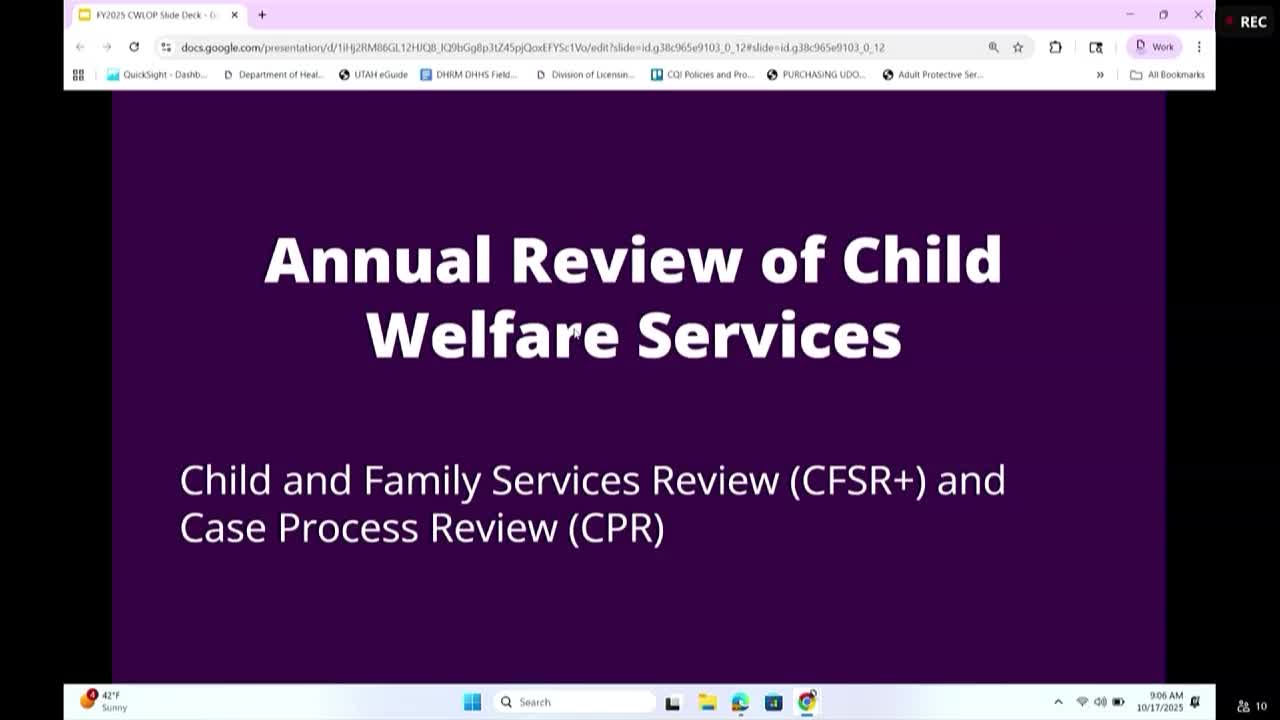
The Office of Service Review (OSR) presented findings from two annual processes: a case process review (CPR) of 682 randomly selected child welfare cases in fiscal year 2025 and a Child and Family Services Review Plus (CFSR Plus) of 85 cases drawn from the state’s five DCFS regions. The presentation and follow-up discussion focused on where agency practice meets policy and where improvements are needed to protect children and support reunification.
OSR director Carrie Bramborough, identified in her presentation as division director for Continuous Quality and Improvement at DHHS, told the panel that some performance indicators remain strong. She said interview rates of children outside the presence of alleged perpetrators exceeded the target, reaching 95 percent, and evidence showed efforts to identify kinship placements in 93 percent of reviewed custody cases. Monthly caseworker visits exceeded goals in both foster care (92 percent) and in-home cases (86 percent).
At the same time, Bramborough highlighted gaps. Evidence that vital medical and allergy information collected at the time of removal was communicated to placement providers was found in 49 percent of cases. The initial child-and-family plan was finalized within 45 days of case start in 61 percent of in-home cases and 35 percent of foster-care cases, both below the 85…
Already have an account? Log in
Subscribe to keep reading
Unlock the rest of this article — and every article on Citizen Portal.
- Unlimited articles
- AI-powered breakdowns of topics, speakers, decisions, and budgets
- Instant alerts when your location has a new meeting
- Follow topics and more locations
- 1,000 AI Insights / month, plus AI Chat