Panel reviews DCFS annual case audits, fatality reviews and systemic recommendations
Loading...
Summary
The Child Welfare Legislative Oversight Panel on Oct. 17 reviewed DHHS Office of Service Review annual audits and a DHHS fatality-review executive summary, seeing strong performance on some monthly-visit and sibling-placement measures but gaps in early transfer-of-information to placement providers and timely initial case plans.
SALT LAKE CITY — The Child Welfare Legislative Oversight Panel on Oct. 17 reviewed the Department of Health and Human Services’ annual audits of child welfare practice and a DHHS fatality-review executive summary, hearing recommendations for improving parent engagement, case-team coordination and statutory alignment on fatality review scope.
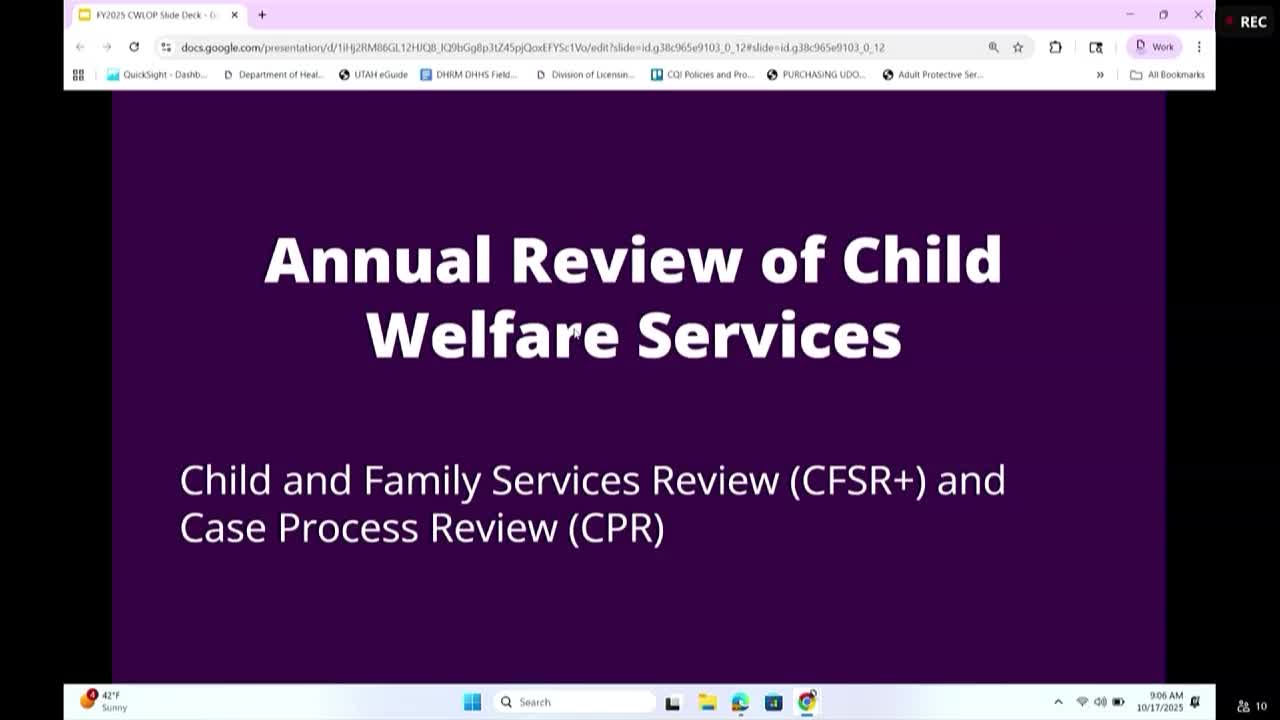
The Office of Service Review (OSR) presented findings from two annual processes: a case process review (CPR) of 682 randomly selected child welfare cases in fiscal year 2025 and a Child and Family Services Review Plus (CFSR Plus) of 85 cases drawn from the state’s five DCFS regions. The presentation and follow-up discussion focused on where agency practice meets policy and where improvements are needed to protect children and support reunification.
OSR director Carrie Bramborough, identified in her presentation as division director for Continuous Quality and Improvement at DHHS, told the panel that some performance indicators remain strong. She said interview rates of children outside the presence of alleged perpetrators exceeded the target, reaching 95 percent, and evidence showed efforts to identify kinship placements in 93 percent of reviewed custody cases. Monthly caseworker visits exceeded goals in both foster care (92 percent) and in-home cases (86 percent).
At the same time, Bramborough highlighted gaps. Evidence that vital medical and allergy information collected at the time of removal was communicated to placement providers was found in 49 percent of cases. The initial child-and-family plan was finalized within 45 days of case start in 61 percent of in-home cases and 35 percent of foster-care cases, both below the 85 percent policy target. “It is essential that foster parents and placement providers be provided this information to ensure the safety and care of the child placed with their home,” Bramborough said.
The CFSR Plus qualitative review showed overall stability or improvement on most items: agency performance on monthly visits rose from 78 percent three years ago to 88 percent this year, and siblings were appropriately placed or valid reasons documented for separation in 97 percent of relevant cases. Areas needing improvement included assessing parents’ needs and aligning services (item 12b) at 55 percent and frequency/quality of visits with mothers and fathers (item 15) at 53 percent. OSR offered four system-level recommendations: improve regular visits with all parents (especially fathers and noncustodial parents); strengthen provision of services to address safety and avoid foster placement; analyze and improve teaming practices; and analyze the DHHS fatality-review section.
Bramborough also presented the DHHS fatality-review executive summary. The DHHS multidisciplinary committee reviewed 101 fatalities and near-fatalities across DHHS programs in the fiscal year; 27 of those involved DCFS cases (21 fatalities and six near-fatalities), down from 59 the prior year. DHHS staff said changes to statutory definitions in the 2024 legislative session — restricting reviews to individuals who received DCFS services within 12 months prior to death rather than any family member — likely reduced the number of qualifying reviews.
The fatality team recommended several statutory or policy actions. Among them: (1) ask the Legislature to consider oversight requirements for K–12 online education, including attendance and engagement monitoring that could affect child welfare protections; (2) align the Utah State Developmental Center (USDC) fatality-review timing and reporting expectations with those already required for the Utah State Hospital (60 days after discharge, if the department becomes aware of a death); and (3) urge the Division of Services for People with Disabilities (DSPD) to strengthen protocols and contract language related to emancipated adults who become incapacitated and cannot make end-of-life decisions.
Panel members pressed for more granular data. Sen. Luz Escamilla asked for detail on referrals that were not accepted for investigation and for the methodology behind the CPR and CFSR sampling; Bramborough said the annual report contains detailed indicator results and offered to provide targeted data on non-accepted referrals. She also confirmed OSR would supply the full fatality executive summary and recommendations to the panel.
Tanya Myroup, director of the Division of Child and Family Services, told lawmakers DCFS has begun examining OSR recommendations and implementing operational changes. Myroup described work on recertifying the Utah Family and Child Evaluation Tool (UFACET) to strengthen family engagement and training, a GOPB efficiency evaluation and subsequent intake workflow changes, new data dashboards for supervisors, a caregiver outreach expectation for supervisors, and continuing training partnerships with the University of Utah — including immersive simulation and a virtual social-work trainer to build practice skills.
Myroup said DCFS treats conduct and performance separately: conduct concerns can lead to human-resources action, while identified performance gaps generally prompt supervisor-led coaching, targeted training and, if needed, a 90-day practice-improvement plan. She said compensation increases supported by the Legislature have reduced frontline turnover from the mid-40 percent range to the mid-20s, and that about 30 percent of former workers have returned following pay adjustments.
Committee members also discussed foster care capacity and recruitment. Myroup said the state has a stable pool of foster families but continuing shortages for sibling groups, medically complex children and those with severe behavioral needs; DCFS is using “snapshots” to share limited, privacy-protected information with nearby foster families to increase placement options.
Public comment included attorney and former state representative Levar Christensen, who urged the panel to review state law and court practice to ensure the “least restrictive means” are used before long-term removal from parents. Christensen asked to present more detailed proposals to the panel.
Votes at a glance: the panel unanimously approved the minutes of Oct. 10, 2024, and later unanimously voted to close part of the meeting to the public under Utah Code for the purpose of reviewing fatality review committee reports and agency responses.
Panel members requested follow-up briefings and more detailed indicator-level data from OSR, particularly on non-accepted referrals and the 45-day case-planning metric. OSR and DCFS committed to providing the fatality executive summary, indicator-level detail on the CPR and CFSR Plus, and continued collaboration with the Legislature on recommendations that may require statutory or funding changes.