Get Full Government Meeting Transcripts, Videos, & Alerts Forever!
Get email alerts on the Healthcare Addiction Treatment topic
No spam. Unsubscribe anytime.
Planning board weighs rezoning for rehabilitative clinic at 1410 E. Franklin; ordinance vote fails
Summary
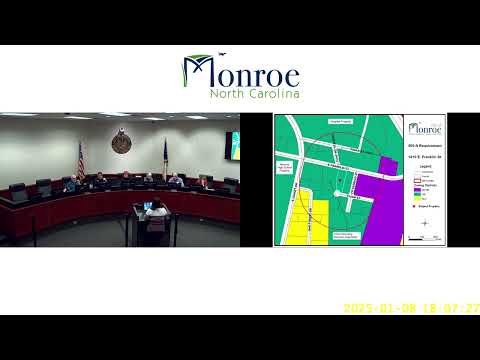
The Monroe City Planning Board on Jan. 8 considered a rezoning request from KSK Properties LLC for 1410 East Franklin Street to allow a rehabilitative clinic operated by McLeod Centers for Well-being.
The Monroe City Planning Board on Jan. 8 considered a rezoning request from KSK Properties LLC for 1410 East Franklin Street to allow a rehabilitative clinic operated by McLeod Centers for Well-being.
Carrie Mendler, planning department staff, told the board the parcel (tax parcel 09-157-004) is currently zoned Office Medical and that the applicant seeks to rezone the property to permit a rehabilitative clinic alongside other OM uses. “The ordinance currently requires that rehabilitative clinics be located at least 500 feet from existing clinics, single-family residential zoning districts, and schools,” Mendler said, adding that the property sits about 174 feet from residential zoning and is adjacent to an existing facility that provides similar services.
That separation requirement changed after a text amendment last January, Mendler said, and the applicant is requesting a deviation from the 500-foot distance rule. Mendler also said the ordinance requires North Carolina Department of Health and Human Services licensing for such facilities and that the proposed tenant has provided its license to the planning department. She said the existing paved parking lot provides 22 spaces; the ordinance requires a minimum of 10 for rehab clinics.
Why it matters: Board members, city staff and community speakers framed the proposal against two competing priorities — expanding access to medically regulated opioid treatment in Monroe and concerns about proximity to homes and schools.
McLeod Centers representatives described the clinic’s services and safety measures. Christine Cesaro, president of McLeod Centers for Well‑being, said the clinic is a nonprofit that currently serves “a little bit over a 100 patients” and sees about “45 patients a day that come every day for life‑saving medication.” Dr. Logan Adams, introduced as McLeod’s medical director, answered clinical questions during the discussion.
Jessica Perry, a realtor with Walt Perry Realty representing the landlord and property managers, told the board the current tenants have been “some of our best tenants” and that their operation has been “clean” and “very professional.”
Board members and attendees asked about patient behavior, security and public‑safety impacts. McLeod’s staff described high security at its clinics — 24/7 camera monitoring, locked medication safes, restricted staff access and regulated dispensing — and said federal regulators (DEA, FDA and SAMHSA) and North Carolina oversight apply. Cesaro and other McLeod speakers argued that medication‑assisted treatment reduces overdose deaths by half and reduces the risk of HIV and hepatitis C by curbing injection drug use.
Several board members and residents voiced concern about the clinic’s location near Monroe High School and nearby homes, asking whether proximity might encourage loitering, attract dealers or increase disease transmission. McLeod and supporters disputed those claims, saying evidence and meta‑analyses show clinics do not drive local crime and that their operation is outpatient and highly regulated.
Regulatory and land‑use details: Staff emphasized the site is within the city’s Traditional Development character area, where office and medical uses are listed as priority uses, and noted existing large trees and no additional landscaping proposed. Mendler reiterated the clinic’s license was provided and that staff recommended approval of the rezoning request because the location adjoins Office Medical uses and sits across from the hospital.
Board action: The planning board held two formal votes on the item. The board voted to recommend approval of the site’s land‑use and transportation plan compliance (motion and second recorded in the minutes). A subsequent motion to adopt an ordinance amending the office zoning map failed; after a recorded show of hands the chair stated, “4 to 2. Motion does not carry.” The item will proceed to city council for final action and public notice prior to that hearing.
What remains unresolved: The planning board debate reflected a split in how to weigh clinical access versus neighborhood concerns. The clinic and its supporters asked the board and the public to consider public‑health benefits and regional access to care; opponents pressed for stricter buffers from residences and schools. The transcript shows staff, the clinic and the property manager answered questions about security, hours (clinic staff said they operate roughly morning through early afternoon to accommodate dosing) and the grandfathering of an adjacent facility under prior rules.
The matter will appear before Monroe City Council, which will receive the planning board’s recommendation and public comment before taking any final zoning action.